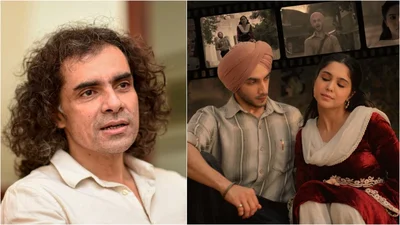
Filmmaker Imtiaz Ali has explained why he continues to describe himself as "apolitical", despite his latest film, Main Vaapas Aaunga, being widely viewed as political. The director said he does not believe in approaching films with a fixed political agenda, calling such an approach "restrictive" for a storyteller.
In a conversation with The Hollywood Reporter India, Ali reflected on the politics in Main Vaapas Aaunga, which ends with visuals from Gaza and Palestine while referring to tragedies unfolding across the world. Asked why he still described himself as "apolitical" while promoting the film, the filmmaker said politics is often propelled by personal emotion or desire, and that this was where he located himself.
Referring to the lead characters, Keenu (played by Vedang Raina) and Jia (Sharvari), Ali said their opposition to Partition is rooted in their love for each other rather than ideology.
"Their politics is that Partition should not happen. But the reason for that politics is personal. They want to be together. One is Sikh and the other is Muslim. They don't want to be separated, so the politics is propelled by personal emotion or desire. That is my status in life," he said.
According to him, the politics in the film grows out of what the characters want in their personal lives rather than from a fixed ideological position.
He also said he could not take a political side in a film because he had to understand why each character was moving in a certain direction. Referring to the character Afzal, played by Danish Pandor, Imtiaz said the character argues that Partition should happen, even while saying it is sad. Afzal also tells the central characters that worse things are likely to happen and that it would be better for them to leave. Imtiaz said Afzal too was being driven by something personal, possibly an ambition to become a leader, and added that the character could easily have been like Keenu under different circumstances.
He said politics is often "subservient to people's desires", adding that people frequently adopt political positions because they align with their personal interests.
The filmmaker also said he avoids making films with a fixed political agenda because he finds it creatively limiting. "I think it's very restrictive if you have a fixed political agenda in any film. As a filmmaker, if I have the same political agenda all the time, then I'm not really letting myself go and explore the world," he added.
Main Vaapas Aaunga centres on the human cost of the Partition and follows two lovers whose lives are altered by the division of India. The film concludes with visuals from Gaza and Palestine, drawing parallels between historical and contemporary conflicts. It has earned around Rs 96.97 crore worldwide since its release.
- Ends
Published By:
shweta keshri
Published On:
Jul 21, 2026 18:33 IST