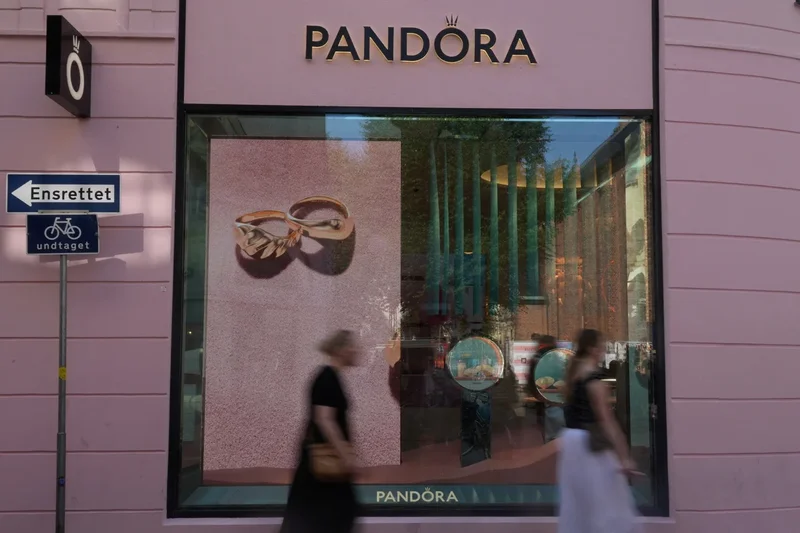
Pandora’s CEO says fresh jewelry lineups are driving growth as the retailer diversifies its core business of silver charm bracelets.
"What we are doing in terms of distinctive newness is working, so where we are launching new collections that are inspiring and good for consumers we are delivering growth," CEO Berta de Pablos-Barbier said Thursday. She stepped into the top job on January 1 after serving as chief marketing officer.
Pandora shares climbed 4% at the market open after the group raised its 2026 profit outlook on the back of U.S. tariff refunds, while posting stronger than anticipated second-quarter sales.
De Pablos-Barbier’s strategy centers on introducing novel designs with distinct aesthetics and a broader range of metals, moving past the core offer of silver charm bracelets.
Its Pandora Wonders line — featuring pearl and gold charms shaped as frogs, pufferfish, or mushrooms — debuted in July during Paris Haute Couture week.
The business is transitioning to platinum-plated products to lower silver reliance after price surges last year. De Pablos-Barbier noted yellow-plated gold ranges are a primary growth source as gold jewelry increases in popularity.
Even so, volatile metal costs make Pandora’s profit trajectory hard to predict, Citi analyst Thomas Chauvet noted, despite silver exposure being hedged for 2026.
"Near-term conviction is further limited by an uncertain consumer backdrop in North America and Europe (~85% of sales), as well as execution risk associated with the planned shift to platinum-plated collections," Chauvet added.
European summer heatwaves also weighed on store visits, steering shoppers online, de Pablos-Barbier explained.
"We saw a disproportional increase versus last year on e-commerce, so I think people stayed in their home and decided not to go out on the street," she said.
Though comparable sales across Europe and North America dropped in the second quarter, overall organic growth reached 3% — topping the 2% expected by analysts — primarily driven by store expansions. Weak demand among mid- and lower-income U.S. consumers continued to hamper store traffic, the company noted.