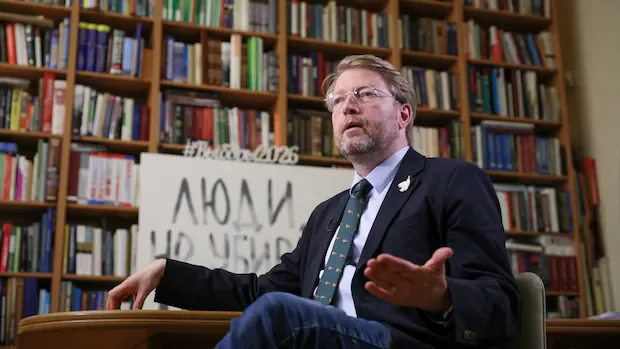
Leader of Russia's only anti-war party vows to remain in country and keep pushing for change
Remarks come as Yabloko party excluded from parliamanetary elections
The leader of Russia's only registered anti-war party said he will stay in the country and keep pushing for change, despite increased pressure from the authorities that has led to the party's exclusion from upcoming parliamentary elections.
On Monday, the Supreme Court ruled to bar from September's vote the post-Soviet liberal party Yabloko, which means "apple" in Russian. Leader Nikolai Rybakov told Reuters the decision reflected the authorities' concern that its call to end the more than four-year-old war in Ukraine was striking a chord with voters.
"For us, the support of the people that exists now, which is completely obvious and impossible to hide, is far more important than the court's decision," he said in an interview at his Moscow headquarters, relating how, after the verdict, hundreds of supporters on the street had chanted "shame" loudly enough to be heard clearly inside the court.
Yabloko, once a leading liberal voice in parliament and a government critic, now has just a handful of regional seats and no representation in the State Duma, the lower house of parliament, which is dominated by the Putin-backed United Russia party.
The September vote will elect members to the 450-seat lower house. United Russia is all but certain to retain its dominance, although Rybakov said Yabloko would be a stronger-than-expected contender if allowed to run.
Yabloko is appealing the Supreme Court ruling, which followed a lawsuit alleging that the party received undeclared campaign support from Western sources, among other charges that it denies.
'People, don't kill each other'
"I tell everyone that this is only the beginning, because many people have only now begun to pay attention," Rybakov said in his office, where a handwritten placard said: "People, don't kill each other."
"One of the things the authorities would very much like to see is for people to become disillusioned, for them to decide that they are alone, that there is nobody around them who thinks the way they do."
The 47-year-old opposition veteran said he had no plans to leave Russia despite tight censorship laws and other wartime legislation that has driven many opposition figures and activists to flee or risk prosecution for voicing anti-war views or other dissent.
"I am in Russia and will remain in Russia," said Rybakov, who wore a peace dove pin on his lapel. "It is only possible to change what is happening in Russia, to change the political situation in Russia, by being inside the country."
Public opposition to the war is difficult to assess due to strict state controls on dissent, but the share of Russians who say they support the actions of their armed forces in Ukraine fell to 66 per cent in July, the lowest level since February 2022, according to the Levada Center, a non-governmental pollster that is on Moscow's foreign agent list.
Rybakov said Yabloko's short manifesto calling for peace and a prosperous democratic Russia had attracted many new supporters, showing that a significant portion of Russian society wanted the war to end.
"You may keep Yabloko out of certain places, you may use various coercive methods against members of our party and against our party leaders, but there is nothing you can do about these millions of people who think the same way we do," he said.
Social media has buzzed with videos supporting Yabloko. Many didn't contain political slogans but instead showed young men and women holding apples when asked their voting preference for the Sept. 18-20 election or dancing to Russian songs that referenced apples.
With files from The Associated Press