- READ MORE: Hedge fund boss warns of a 2000-style stock market crash
- See more Daily Mail on Google - save us as a Preferred Source
Michael Burry, the Wall Street prophet of doom made famous by hit film The Big Short, has issued a fresh warning about the booming artificial intelligence industry – and this time he isn't telling investors to short a stock.
He's telling them to read a book.
The legendary investor has recommended The Smartest Guys in the Room: The Amazing Rise and Scandalous Fall of Enron, the 2003 book by journalists Bethany McLean and Peter Elkind about the spectacular collapse of energy giant Enron.
In a post on X, Burry shared a link to the book and wrote: 'History is repeating. Time to read this one again, or for the first time.'
He did not explain exactly what history he believes is repeating – but the timing does not seem to be accidental.
Burry has spent months warning that the extraordinary sums of money being poured into AI infrastructure could be creating similar financial distortions that helped bring down Enron – from optimistic accounting assumptions to complex financing arrangements.
He has also been betting against a string of major AI companies, including Nvidia, Palantir, Oracle, Nebius and Micron.
For investors, his latest post raises an obvious question: Does Burry believe an AI company could be the next Enron?
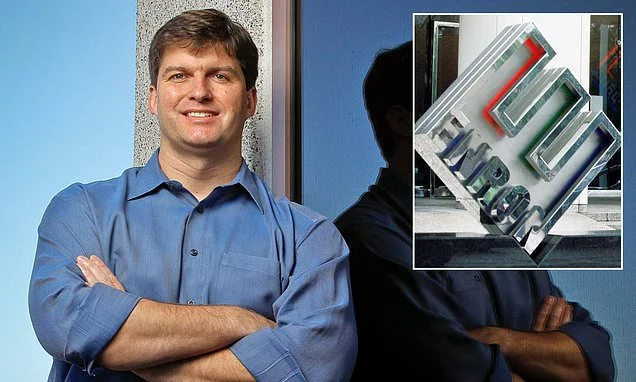
The legendary investor has recommended The Smartest Guys in the Room: The Amazing Rise and Scandalous Fall of Enron, the 2003 book by journalists Bethany McLean and Peter Elkind about the spectacular collapse of energy giant Enron
Michael Burry, the investor made famous by The Big Short, has issued a fresh warning about the booming artificial intelligence industry - and this time he isn't telling investors to buy or sell a stock. He's telling them to read a book
Enron was once one of America's most celebrated companies. The Houston-based energy trader grew rapidly during the 1990s and was hailed as an innovative new kind of business, with its executives considered to be some of the smartest people on Wall Street.
But in the wake of the dot-com stock market bubble, it spectacularly collapsed. The company filed for bankruptcy in December 2001 after investors discovered that its apparently impressive profits and financial position had been propped up by a complex web of accounting techniques and off-balance-sheet arrangements.
One of the central problems was mark-to-market accounting, which allowed Enron to book the estimated future value of long-term contracts as immediate profits. It also used special-purpose entities to hide debt and losses.
The result was a company that could appear extraordinarily profitable while accumulating enormous risks under the surface.
That's what Burry appears particularly interested in today, as he has repeatedly questioned whether the huge investment in AI infrastructure will ultimately generate enough profits to justify the spending.
His criticism has focused on companies spending enormous sums on chips, data centers and computing infrastructure while making assumptions about how quickly those investments will generate returns.
He has also raised concerns about depreciation. Companies do not generally count the entire cost of expensive equipment as an expense immediately. Instead, the cost is spread over several years.
If companies assume expensive AI hardware will remain useful for longer, annual depreciation expenses can appear smaller and reported profits can look healthier.
Energy firm Enron filed for bankruptcy in December 2001 after investors discovered that its apparently impressive profits and financial position had been propped up by a complex web of accounting techniques and off-balance-sheet arrangements
Burry has also pointed to complex financing arrangements between companies involved in the AI boom, arguing that some of the money flowing around the sector can make the scale of investment difficult for ordinary investors to understand.
That does not mean he is accusing today's AI companies of committing Enron-style fraud. There is no evidence that companies such as Nvidia, Microsoft or Oracle are repeating Enron's criminal conduct.
Instead, Burry's argument is essentially that investors should question whether today's spectacular growth figures and valuations are based on assumptions that could eventually prove too optimistic.
This is not the first time Burry has sounded the alarm. The former hedge-fund manager has become one of the most prominent skeptics of the AI stock boom as valuations have soared.
He has disclosed bets against Nvidia and Palantir and has subsequently taken positions against other companies exposed to the AI infrastructure boom.
His reputation means those warnings attract enormous attention. Burry became famous after betting against the US housing market before the 2008 financial crisis – a trade later immortalized in Michael Lewis' book The Big Short and the Hollywood film of the same name.
His track record does not mean every prediction he makes will be correct. Markets can remain expensive for much longer than a skeptic expects.
But he has repeatedly shown a willingness to challenge popular investment narratives when he believes prices have become detached from reality.
Burry has actually invoked Enron previously. Following the collapse of Silicon Valley Bank in 2023, he suggested: 'It is possible today we found our Enron.'
His latest intervention therefore appears less like a completely new prediction and more like a continuation of his long-running argument: don't assume an apparently unstoppable growth story will continue forever.
That is particularly relevant as the AI boom becomes increasingly dependent on vast amounts of capital, electricity, data centers and increasingly sophisticated financing.
If demand keeps growing, those investments could look like brilliant bets. If growth disappoints, investors could discover that some of the world's most valuable companies have been making enormous assumptions about the future.
Burry's post prompted a mixture of agreement, jokes and scepticism on X. One user responded with a reference to another infamous corporate collapse: 'and then there was Worldcom.'
Another joked about the book's title, writing: 'You mean to tell me they're 'the smartest guys in the room'?'
AI is already transforming businesses and generating enormous demand for computing power
Burry became famous after betting against the US housing market before the 2008 financial crisis - a trade later immortalized in Michael Lewis' book The Big Short and the Hollywood film
Others were more ominous. One commenter argued that Enron was not simply an isolated scandal but a warning about the way modern businesses can present risk through complicated financial structures.
Another recalled how Enron's collapse became intertwined with California's energy crisis.
There was plenty of gallows humor too, with one user asking whether it was finally time for another high-profile executive to 'go down.'
The reaction was hardly unanimous, however. And that distinction matters. There is currently no evidence that today's AI giants are engaged in anything resembling Enron's fraud.
Burry's message is not necessarily that AI is a scam. It is closer to: don't confuse an exciting technology with a guaranteed investment.
AI is already transforming businesses and generating enormous demand for computing power. Companies such as Nvidia are producing huge revenues from that demand, while technology giants continue to invest billions in data centers and chips.
The question is whether those investments will ultimately generate returns large enough to justify their extraordinary cost. That is where the Enron comparison becomes useful.