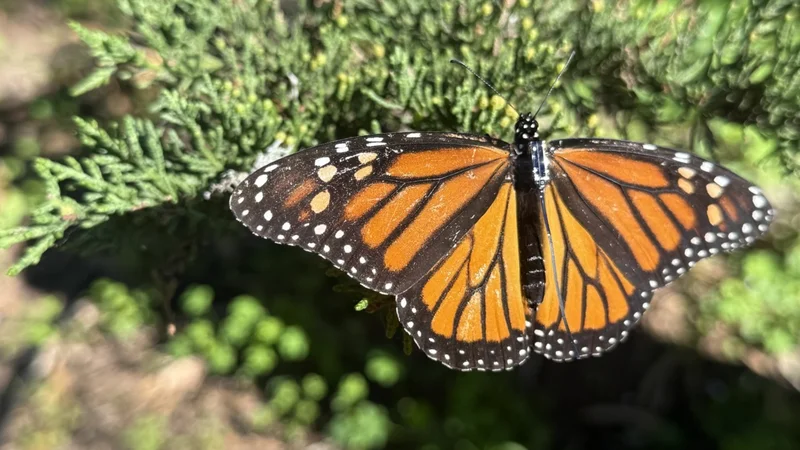
How do you track the movements of the majestic monarch butterfly (Danaus plexippus)? By giving each bug a solar-powered radio backpack, of course.
The orange, black, and white polka-dotted pollinators are native to North America, and can be found in more than 90 countries, islands, and island groups. They exist everywhere there is milkweed, which is the only thing that their caterpillars feed on. There are both migratory and non-migratory populations, and the migratory monarch butterfly (Danaus plexippus plexippus) was listed as endangered by the IUCN Red List in 2022.
The more scientists know about a particular species, the easier it is to protect. So in an effort to eventually track how these pollinators use their overwintering habitat and nectar flowers close by, staff from organizations such as the U.S. Fish & Wildlife Service Coastal Program in Central California and the biological and environmental consulting firm Althouse & Meade tagged monarchs in three locations across San Luis Obispo and Santa Barbara Counties in November 2025.
The effort is part of a study testing technology that can monitor monarch movement and migration. These tags look like an antenna sticking out of a small rectangular box, and staff used eyelash glue to stick them to the back of the butterflies. The tagging system employs solar-powered radio telemetry tag technology, which sends geospatial data through radio waves.
“Weather data is also being collected at the [overwintering] site[s] and will be used in conjunction with the movement data to further understand monarch habitat needs,” the U.S. Fish & Wildlife Service wrote in a statement. “The goal of this project is to increase our understanding of monarch butterfly use of overwintering groves in coastal California. The results will be used to better inform restoration and management of monarch overwintering groves.”
But how do you catch a butterfly without harming it? The team leveraged the monarch’s cold-bloodedness. The insects need the sun to achieve the right body temperature to fly. The workers started collecting and tagging them early in the morning when it was under 55 degrees Fahrenheit, a condition in which it’s harder for the butterflies to fly.
The collected butterflies were put in a cooler to maintain their temperature at a maximum of that 55 degree mark. For each one, the team noted its sex as well as its weight and size to make sure they were big enough to carry a tag.
The project also provides the opportunity for the participation of citizen scientists.
“The public is welcome to participate in data collection for this effort using the Project Monarch App which can be downloaded on a smart phone,” the statement continued. “The App has a map of all tagged monarchs and a feature allowing data entry.”
One thing is for sure—the project certainly isn’t winging it!