Sign in. It’s quick, free and it’s up to you.
An account is an optional way to support the work we do. Find out more.
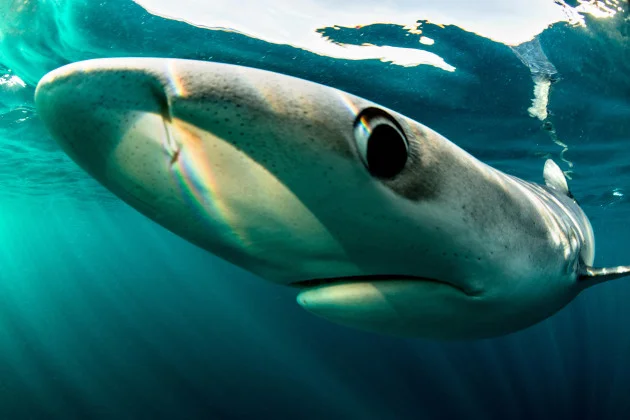
THE INCIDENT THIS week, where a man was bitten by a blue shark on an angling boat off the coast of Waterford, has put a spotlight on recreational fishing for sharks in Irish waters.
Although not a happy encounter for the fisherman concerned, who needed airlifting to hospital, while also highlighting unnecessary media sensationalism around anything to do with sharks, it has brought welcome publicity for a group of animals that get too little attention when compared to their importance in marine ecosystems.
Sharks, and their closely related cousins rays and skates, are fish but are unusual in that their skeletons are made of cartilage rather than bone. Some of the biggest fish in the sea are sharks (such as basking sharks), while others are small, like the cat sharks that grow no more than the length of your arm.
Many species are long-lived; some give birth to live young, some live solitary lives wandering the oceans and others live in shoals and will gather in certain locations to breed, feed or give birth.
Generally speaking, little is known about the lives of sharks and rays compared to similar-sized animals on dry land, but what is commonly accepted is their role as top predators in the marine environment. A healthy marine ecosystem has healthy populations of sharks and rays.
In 2016, a team led by the National Parks and Wildlife Service evaluated the populations of 58 species of sharks and rays in Irish waters; a figure that will come as a surprise to many who may have thought that the tropics are their principal domain.
Just as shocking, though, should be the finding that fully two thirds of these are threatened or ‘near threatened’ with extinction. This is much higher than for other groups of plants or animals and points to the chronic over-exploitation of our seas.
Six species on this list are ‘critically endangered’, meaning they are very close to extinction, including the porbeagle shark (looking very much like a miniature white shark), the unusually flattened angel shark that hides in sand and the enormous blue and flapper skates.
The prime reason that these species are heading for extinction is commercial fishing, either through targeted fishing or ‘by catch’, the term used for fish that are caught unintentionally in nets or on hooked lines.
Even small boats using the wrong gear can cause a lot of damage, such as the high levels of by-catch of angel sharks and flapper skates that have been recorded in the fishery for crayfish in the west of Ireland.
However, recreational angling can also have an impact. These days, recreational angling is nearly all ‘catch and release ’, and there is evidence that for some species, being caught does not do a lot of harm. This is against a backdrop of low levels of data, particularly over the longer-term, on many species, not all of which respond in the same way to being caught.
Recreational angling is largely unregulated, which sets it apart from angling in freshwater where Inland Fisheries Ireland issues angling licences, prosecutes illegal activity and can close rivers to fishing entirely if they believe stocks get too low.
At sea, no licence is needed to target sharks and rays, no special training is required on handling the fish and there are no closed areas or prohibited species that would allow for species recovery.
Only one marine fish is listed as protected wildlife in the Wildlife Act: the basking shark. This list needs to be a lot longer as it in no way reflects the degree to which marine species are rare or threatened. The only statute protecting most endangered sharks is a prohibition on landing them under fisheries laws. This is not enough.
Sharks and rays are biologically ill-equipped to be out of water, even for short periods. Their internal organs have no internal divisions, meaning they come under a lot of pressure if inappropriately handled on a boat.
Some species will be ‘played’ for a long time in the water, effectively exhausting them, while others will abort young due to the stress of being hooked and taken out of the water. Many anglers still want a photo of the animal they have caught while lifting it off the ground, sometimes grabbing sensitive areas of the fish such as the gills. Proper handling rules would eliminate much of the potential for harm.
Anglers are not the bad guys in this story, and they have an important role to play in the conservation of sharks and rays. For many years, they have been working with scientists to tag fish, something that can track the animals and provide invaluable information on their movements and biology.
However, this information has not been used by authorities to introduce conservation measures, such as restricted areas, closed seasons, or to prohibit the targeting of certain species entirely, particularly those that are critically endangered. Gathering data, on its own, is not conservation.
All fishing needs to be properly regulated if marine life is to recover; this includes recreational fishing. Anglers need to be trained in the appropriate handling of the fish, just like hunters on land need to show their competence with a firearm. As this week has shown, this is as much for the safety of the angler as the fish.
Data from licensed catches will improve our understanding of these beautiful animals, which the authorities can then use to introduce enforceable conservation measures, including Marine Protected Areas. It is not the fault of anglers that the State has been so poor in this area.
Most of the harm to sea life happens from commercial trawling and netting, out of sight and so generating very little public outcry. Still, recreational anglers have an important role in this story and should support better management and regulation for their sector.
Pádraic Fogarty is an environmental campaigner.
To embed this post, copy the code below on your site