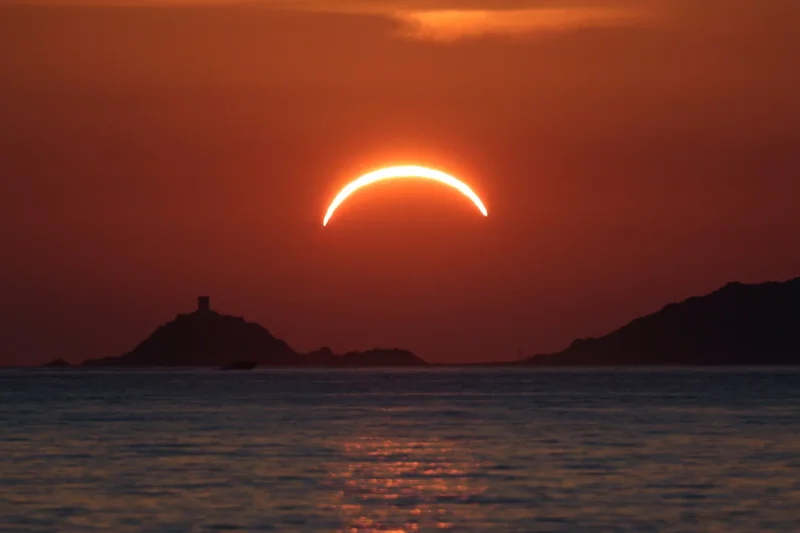
The solar eclipse that stretched over the UK and Europe this week was not just a stunning celestial spectacle – but an opportunity to get to know our Sun much better.
Millions of people looked up on Wednesday evening to watch as the Moon moved in front of the Sun, blocking out its light. It produced a unique view of the Sun, as the Moon ate into it, as well as the eerie effect of dimming and changing the light of the day.
But some of those millions of people were also scientists, who will use the data gathered during the eclipse to better understand our own star. Though it is central to life on Earth, and visible each day, the Sun remains mysterious in a variety of important ways – and the eclipse can help us understand some of that mystery.
The central scientific value of an eclipse is much the same as it is for everyone else. Because the Moon moves so neatly in front of the Sun, it only leaves the “corona” around the edge visible.
It makes for stunning images. But it also means that researchers can study that layer of gas that surrounds the Sun to understand how our star works.
Astronomers have been using eclipses for scientific work for years. Indeed, an Eclipse in Brazil in 1919 was used as one of the first proofs of Einstein’s work on relativity: photographs of the eclipse were used to study the way that gravity changes light, and proved the theoretical work right.
And still today, an eclipse offers a unique view of the Sun. While scientists are able to use equipment called a coronagraph to block out the light from the rest of the Sun – in a similar way to a total eclipse – they don’t work perfectly, and our view of the corona nearest the Sun is still obscured.
As such, total solar eclipses are the only way to see that innermost part of the corona. That can help explain deep questions about how the Sun works: how its heat and energy are sent into the solar wind, for instance, which in turn affects us and our technology on Earth.
It can also help us understand our own planet better. During an eclipse, the Earth is lit differently, in a very specific region. Scientists can use that localised dimming to understand how the Sun affects our atmosphere, especially at its upper reaches, where the Sun’s energy forms a layer of charged particles.
Universities and space agencies such as Nasa have been making use of these effects for decades. During the major solar eclipse in North America in 2024, for instance, Nasa ran a range of projects including flying scientific balloons to study the atmosphere and putting imaging teams right along the eclipses path to examine how the corona changed over time.
That was no different this year. For the 2026 eclipse, for instance, Nasa put flying experiments onto a jet and scientific balloons, making the most of the totality when it appeared in Iceland and Spain.
Scientists hope to use those observations other better understand our Sun. That in turn could give us useful information, including better predictions of space weather – which can disrupt satellite operations and knock out power on Earth.
And the work will continue. Another eclipse will arrive in 2027, when scientists hope to do much of the same work and more, allowing them to compare their work across eclipses.