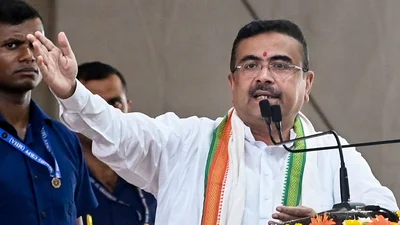
On July 20, the eve of Trinamool Congress’s (TMC) annual July 21 Martyrs’ Day rally, the battle over one of West Bengal’s defining political events took an unprecedented turn, with chief minister Suvendu Adhikari tabling in the legislative assembly the long-pending judicial commission report into the 1993 police firing even as former Mamata Banerjee loyalist Firhad Hakim questioned the way the TMC had observed the day during its years in power.
The developments struck at both the historical and emotional foundations of a movement that had helped propel Mamata Banerjee to power in Bengal.
Presenting the report of the Justice Sushanta Kumar Chattopadhyay Commission—constituted by the Mamata government after it assumed office in 2011—Adhikari accused the former regime of using the tragedy for political mobilisation while failing to uncover the truth behind the police firing.
“Many people have benefited politically by using July 21. Some secured political positions, some enjoyed the privileges of power, some went to Johns Hopkins in the United States for eye treatment, travelled by chartered flights, or acquired 38 plots of land on Harish Chatterjee Street and Harish Mukherjee Road. But the 110 million people of West Bengal still do not know what exactly happened on July 21, why the police opened fire, and who was responsible," Adhikari said in the assembly.
For close to three decades now, the events of July 21, 1993—a time when Mamata was in the Congress and Bengal was under Left Front rule—have remained synonymous with the TMC. Every year, Mamata has led thousands of her party workers to commemorate the death of 13 Youth Congress supporters killed in police firing during a march to Writers’ Buildings (state secretariat) in Kolkata. The incident gradually evolved into the TMC’s largest annual political gathering.
This year, however, the symbolism of July 21 has been overshadowed by the split in the TMC after the assembly election defeat, with rival camps competing to define both the legacy of the movement and the events of that day in 1993.
Adhikari used the commission’s report to question the conduct of the Mamata government. He noted that while the commission had examined 44 witnesses—including former chief minister Buddhadeb Bhattacharjee, former home secretary Manish Gupta, former Kolkata police commissioner Tushar Talukdar, veteran Left leader Biman Bose and former Congress leader Somen Mitra—it never summoned Mamata herself.
Quoting from the commission’s findings, he said apprehensions of an attack on Writers’ Buildings had been described as “imaginary” while the police firing at Mayo Road, Dorina Crossing and Esplanade was held to be “unnecessary, unprovoked and unjustified”. He alleged that crucial records had disappeared from Writers’ Buildings and accused the previous TMC government of failing to cooperate fully with the commission by withholding documents.
The chief minister also attacked the TMC government over compensation paid to the victims’ families. “The commission had recommended Rs 25 lakh for the families of those killed and Rs 5 lakh for those injured. But you gave only Rs 2 lakh to the families of the deceased and Rs 15,000 to the injured. Aren’t you ashamed?” he said.
Adhikari announced that the families of those killed or injured could lodge fresh FIRs into the incident, with the state government extending full legal assistance. He also promised that the balance compensation recommended by the commission would be paid from the chief minister’s relief fund.
Adhikari indicated that the publication of other reports linked to the TMC regime could follow. “From the CAG report on Amphan [cyclone relief] to reports relating to the procurement of medical equipment during the Covid pandemic, all such reports concerning corruption will be placed before this House and the people," he said.
Almost simultaneously, another voice from within the TMC’s old guard challenged Mamata’s observance of Martyrs’ Day. Hakim, once among Mamata’s closest associates but now aligned with the Ritabrata Banerjee camp in the TMC, said he had long been uncomfortable with the manner in which the event had evolved.
According to him, what had begun as a solemn remembrance of those killed gradually turned into a celebration. “Many of us had objections, but none could say so openly,” Hakim claimed, adding that the political circumstances left little room for dissent. “We did not have the courage to say so publicly.”
Hakim also recalled the role of then Youth TMC president (Adhikari) in organising the programme. Referring to a Brigade Parade Ground rally, he said he remembered an incident in which a microphone was snatched from his hands, leaving several leaders aggrieved. The former Kolkata mayor also spoke emotively about his own experience during the violence of July 21, 1993, saying he had narrowly escaped death.
He recalled standing near the Mayo Road entrance when two or three people were shot before his eyes. According to Hakim, an unidentified man saved him from the line of fire. “It was because of that person’s presence of mind and God’s grace that I am alive,” he said.
The convergence of the two developments in the legislative assembly has transformed the texture of Martyrs’ Day in 2026. While the BJP government has sought to reopen questions surrounding the 1993 firing through the commission report and promises of fresh legal action, one of Mamata’s former confidants has publicly acknowledged that many within the Trinamool had privately questioned the manner in which the day has come to be observed all these years. Together, it has only intensified the battle over the legacy of July 21, 1993.
*Subscribe to India Today Magazine*
- Ends
Published By:
Shyam Balasubramanian
Published On:
Jul 21, 2026 18:39 IST