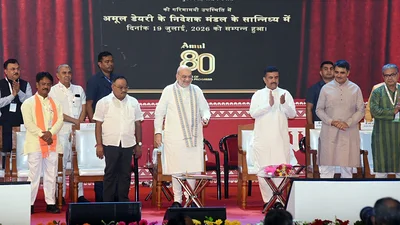
West Bengal’s BJP government, on July 19, unveiled a ‘blueprint’ for cooperative-led industrialisation, rural prosperity and employment as Union minister home and cooperation Amit Shah laid the foundation stone for a Rs 700 crore integrated dairy processing plant of AMUL at Sankrail in Howrah.
The ceremony, attended by chief minister Suvendu Adhikari and BJP state president Samik Bhattacharya, also saw the launch of a series of initiatives, ranging from expansion of the dairy cooperative network to a new cooperative-based taxi platform that would compete with private ride-hailing companies.
The AMUL facility is expected to become the world’s largest manufacturing centre for yoghurt and fermented dairy products. It will process 3 million litres of milk every day, produce 1 million litres of packaged milk daily and manufacture 1,000 metric tonnes of yoghurt, besides long-life milk, ice cream, chhana, ghee and sweets.
AMUL, which began procuring milk in West Bengal in 2004, currently works with more than 125,000 farmers through 880 village dairy cooperative societies and 107 bulk milk chilling centres spread across districts. The cooperative procures around 900,000 litres of milk every day and plans to increase this to 2 million litres over the next few years.
Addressing the gathering, Shah said the project marked the beginning of a new phase of economic development in the state under the BJP government. “The Bengal that once showed the country the path in science, education, culture and patriotism was systematically destroyed during the years of Communist and Trinamool Congress rule. Under Prime Minister Narendra Modi’s leadership, the BJP is committed to restoring Bengal to its former glory,” Shah said.
Promising to fulfil every electoral commitment, he added that the government would build “an educated, secure and prosperous Sonar Bangla”. Highlighting the cooperative model, Shah said nearly 120,000 dairy farmers would directly benefit from the project. He also announced that the state government would provide another 30 acres of land to the Gujarat Cooperative Milk Marketing Federation for two additional dairy projects in North and South Bengal, which, he said, would benefit another 250,000 livestock rearers.
“AMUL is today the world’s number one cooperative society. The biggest strength of this model is that 87 per cent of the profits go directly into farmers’ bank accounts instead of into the pockets of capitalists,” he said, while announcing a new programme to improve cattle breeding and raise milk productivity in the state by 25 per cent.
Shah also said the Centre had prepared more than 70 cooperative-sector initiatives for West Bengal, which would begin reaching farmers within six months. He announced the computerisation of the Registrar of Cooperative Societies and inaugurated a 1,400 metric tonne capacity cooperative warehouse for agricultural storage.
Adhikari described the project as the beginning of a “White Revolution” in Bengal and said it would also trigger a “Sweet Revolution” by commercially expanding the state’s famed sweet yoghurt industry. “The cooperative movement has shown that it can become the backbone of an alternative rural economy,” he said, crediting Prime Minister Modi’s decision to create separate ministries for cooperation and fisheries.
Tracing AMUL’s growth in Bengal from 11 primary societies to a network of 880 cooperatives collecting around 950,000 kg of milk daily, Adhikari said the organisation now supports around 125,000 farmers, including 30,000 women.
Seeking further investment, the chief minister urged AMUL to establish two large ice-cream plants in North and South Bengal, assuring the company that the state would provide 15 acres for each project. “These plants will benefit milk producers while creating employment for skilled, semi-skilled and unskilled workers, besides generating livelihood opportunities for 10,000 to 15,000 hawkers and retailers,” he said.
Bhattacharya said Bengal was once again emerging as an investment destination. “‘Bengal Means Business’ and ‘Destination Bengal’ will no longer remain slogans. The exodus of capital has stopped. With its skilled workforce, fertile land and strategic location, West Bengal will emerge as one of India’s leading investment destinations within a year," the BJP state chief said.
The event also featured a major announcement in the transport sector. Shah unveiled the cooperative ride-hailing platform ‘Bharat Taxi’ under the Sahkar Taxi initiative, saying it would free drivers from dependence on private app-based aggregators. “Drivers will no longer remain merely drivers. They will become owners and stakeholders in the company itself, and the profits will reach them directly,” he said.
The Bengal government simultaneously announced that its Yatri Sathi app would be integrated with Bharat Taxi. The revamped platform will combine the technological features of both services, expand to include bike taxis and auto-rickshaws across the state, and enrol partner drivers as cooperative members eligible for government welfare schemes.
“We remain committed to building a more efficient, reliable and faster transport system for the people of West Bengal. We will continue making the best possible use of technology to achieve that objective,” Adhikari said in a social media post.
While the BJP government projected the project as a symbol of a new era of cooperative-led industrialisation, the Opposition sought to contest that narrative. Kunal Ghosh, an MLA of the Mamata Banerjee-led faction of the Trinamool Congress, said the groundwork for the investment had been laid during her government. “The decisions, planning and announcements all began under then chief minister Mamata Banerjee. The project is welcome. Naturally, the present government is publicising the event—that is what governments do. But please do not forget, amidst all the publicity, that it was the Trinamool government that brought AMUL to Bengal,” Ghosh wrote on social media.
*Subscribe to India Today Magazine*
- Ends
Published By:
Shyam Balasubramanian
Published On:
Jul 21, 2026 18:38 IST