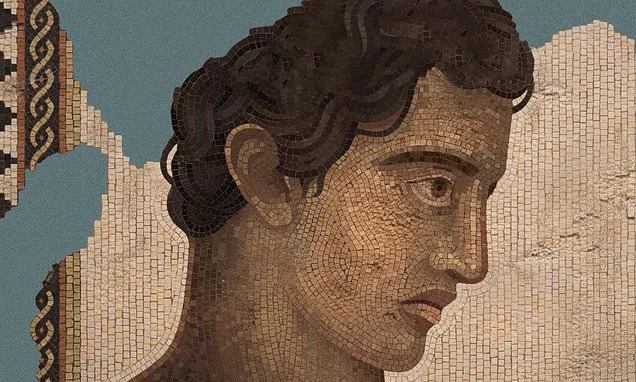
- Rex Juba by Andrew Kenrick (Torva £25, 320pp) is available now from the Mail Bookshop
Spring 46BC and Rome is having a spectacular triumph for its great military hero, Julius Caesar. Four triumphs rolled into one, in fact: for Caesar has just defeated Vercingetorix in Gaul, conquered Egypt, the kingdom of Pontus (in modern-day Turkey), and Numidia, north Africa, resulting in the death of its king, Juba I.
In the procession of captives is a boy, little more than a toddler in fact, so young that he had to be carried.
He is Juba II of Numidia, son of a dead king. A dramatic beginning, yet Juba would prove a canny survivor, and live on until the ripe old age of 72.
Glimpses: Artistic reaction of what Rex Juba II would have looked like as little survives of his writing, belongings or image
He was also a supreme scholar and writer. Why haven’t we heard of him? Alas, the blunt truth is that many details of his life are obscure, which is why this fascinating portrait of a ‘lost king’ often reads something like a detective story. And the author is very honest with his subtitle – he offers us only 15 ‘glimpses’ of Juba as he moves through these tumultuous times, among far bigger characters.
Juba spent his boyhood in Rome, common for the children of its defeated enemies, where, along with many other royal children, he was given an impeccable upper-class Roman education.
Soon enough, they were joined by a little girl called Cleopatra Selene, her parents being Cleopatra and Mark Antony, now both dead by suicide after their defeat at the titanic naval Battle of Actium. In time, these two orphans, Juba and Selene were married, which seems very sweet, and clues suggest a happy union.
Meanwhile, would Juba have in fact seen himself as Roman, or African? The author warns against imposing neat or modernised definitions. It can just confuse things, like calling Cleopatra Egyptian, when she was in fact Greek.
He warns astutely that ‘in trying to find traces of his African ancestry we risk constructing an identity for Juba that he would not himself have recognised’.
Rex Juba II depicted on a coin and as a bronze bust
‘Romano-Berber-African’ is perhaps the safest we can say – but one who also spoke Greek.
There were battles, dynastic manoeuvrings, assassinations (of Julius Caesar himself most famously, in 44BC), and through it all, King Juba II, albeit as a careful and obedient ‘client king’ of Rome, pursued his other great interest: scholarship, and especially history, geography and exploration.
With an immense intellectual curiosity about the world around him, Juba wrote books with titles such as Roman History, On Theatre, Libyka (a geographical and historical survey of the whole of North Africa from the Atlantic to the Red Sea), On Arabia, On Painters, and so on.
He wrote another called On Resemblances, a book of early linguistics, tracing the marked similarities between words in Latin and Greek. He even wrote a book called On Euphorbion: yes, a little treatise on euphorbia plants. Keen on botany too, evidently.
And alas, here too we are restricted to glimpses, for not a single one of his many books has survived. There is nothing sinister here, he wasn’t deliberately erased, it’s just that vast swathes of ancient literature have been lost.
Books were expensive, rare and fragile, library fires were alarmingly frequent, and then came the Fall of Rome, and the Dark Ages . . . It’s a miracle any of the literature of Greece and Rome came down to us at all.
With The Odyssey currently showing in cinemas, we can be grateful we still have Homer’s two incomparable masterpieces, The Iliad and The Odyssey, but we have also lost his ‘epic comedy’, the Margites.
Tomb of Juba II and Cleopatra Selene II at Tipasa ruin, Algeria
Our glimpses of Juba’s writings come from numerous quotations and references in other ancient writers, such as Pliny the Elder, Plutarch and Strabo.
One fun fact that emerges is that Juba named the newly discovered islands in the Atlantic ‘the Canaries’, i.e. The Island of the Dogs, due to its population of mutts. He wrote about these new-found lands with great enthusiasm, describing a temple carved from a single block of stone on Fuerteventura, and the great lizards of Gomera.
He lived his scholarly life with his wife Selene, in his elegant capital on the Mediterranean coast, at Lol, renamed by him to Caesarea (to keep in with the ruling family across the water, very wise).
It was a regal seat on a plateau, commanding fine views, with a royal palace, temples, a lighthouse, all built of finest Carrara marble imported from Italy, and lavishly decorated with fine statuary.
He even survived the rebellion of a ferocious bandit chieftain called Tacfarinas, who caused everybody no end of trouble.
Very little remains of Juba’s capital today (now the town of Cherchell, Algeria), much like his books, leaving us with an abiding, rather haunting sense of a very likeable figure from those times, whom we can indeed only see now in glimpses.
To cap it all, his son Ptolemy would end up being executed by the deranged Emperor Caligula, and Juba’s dynasty was ended for ever.
Tempus edax rerum indeed, in the words of another great classical writer, Ovid: Time, the devourer of all things.