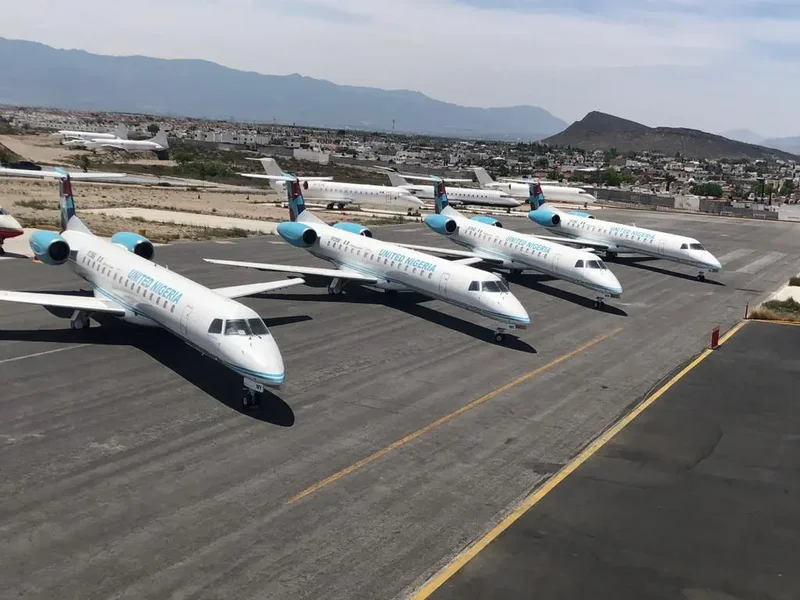
Air Peace and United Nigeria Airlines suffered significant operational disruption following Tuesday’s industrial action by aviation unions, with dozens of flights cancelled or affected and thousands of passengers facing disruptions to their journeys.
Air Peace put the financial impact of the action on its operations at more than ₦2 billion, while more than 30 United Nigeria Airlines flights were affected after the carrier suspended some operations amid the disruption.
The action, which lasted several hours, followed a dispute between aviation unions and domestic airlines over the five per cent Ticket Sales Charge (TSC) and allegations concerning workers’ freedom to join trade unions.
Speaking at a press conference in Lagos on Wednesday, Oluwatoyin Olajide, Chief Operating Officer of Air Peace, said more than 70 Air Peace flights were affected by the disruption, causing substantial financial losses in addition to the difficulties experienced by passengers and employees.
| | |
|---|
The figure is higher than the more than ₦1 billion loss initially estimated by the airline shortly after the disruption.
The unions had accused domestic airlines of failing to remit the statutory TSC collected from passengers to the appropriate aviation agencies and had also raised concerns about workers’ freedom to join trade unions.
Air Peace, however, maintained that it had been complying with the applicable directives of the Nigeria Civil Aviation Authority (NCAA) on the remittance of the charge.
Mrs Olajide questioned why Air Peace was singled out for picketing if the dispute over the TSC involved the wider airline industry.
She also rejected the allegation that the airline prevented its employees from joining unions, saying the workers had voluntarily chosen not to unionise.
According to her, the disruption went beyond picketing, as some Air Peace employees were allegedly physically assaulted during the action.
She said a female employee was among those allegedly assaulted.
The airline also raised concerns about the wider implications of the disruption, particularly the effect of airport blockades on passengers, airline operations and confidence in Nigeria’s aviation industry.
Air Peace said it had evidence that could assist authorities in investigating the incident and called for an independent investigation into the events surrounding the picketing.
The airline also referred to a 2024 Federal High Court judgment which it said restrained labour unions from coercing its employees into union membership or disrupting its operations.
Mrs Olajide said Air Peace was not opposed to unionisation but maintained that its employees had a constitutional right to decide whether or not to belong to a union.
United Nigeria
United Nigeria Airlines was also affected after the industrial action disrupted its scheduled operations.
The airline had earlier said its morning flights were affected and that it was working to accommodate passengers whose journeys were disrupted.
More than 30 of the airline’s flights were affected by the disruption.
A senior United Nigeria official, who spoke on condition of anonymity because he was not authorised to speak publicly on the matter, said several aircraft scheduled to operate multiple sectors were affected.
The aircraft included Boeing jets, CRJ aircraft, Embraer 190s and Embraer 145s.
Two Boeing aircraft, each configured to carry 175 passengers, were scheduled to operate four sectors each, while two CRJ aircraft, with a capacity of about 90 passengers each, were also scheduled to operate four sectors.
Two Embraer 190s, each configured for about 110 passengers, and two Embraer 145s, each with a seating capacity of about 50 passengers, were also affected.
Based on the aircraft configurations and scheduled sectors, the official estimated that United Nigeria could have transported about 1,200 passengers had the disruption not occurred.
The airline’s suspension of some operations demonstrated that the impact of the industrial action extended beyond Air Peace, with passengers booked on other carriers also caught up in the disruption.
The effect also extended to travellers on connecting flights, as cancellations and delays in Lagos and Abuja disrupted onward journeys.
Passengers whose flights were cancelled or postponed had to rearrange accommodation, business meetings, appointments and other commitments, while airlines had to reorganise aircraft and crew schedules as services resumed.
ATSSSAN speaks
The Air Transport Services Senior Staff Association of Nigeria (ATSSSAN) rejected allegations made by Air Peace and said it would respond to the airline’s claims at the appropriate time.
Francis Akinjole, Secretary-General of ATSSSAN, said the union had seen the airline’s position but would provide a detailed response to what he described as misinformation.
He also rejected Air Peace’s allegation that the union had selectively targeted the airline.
“All those allegations are baseless, and that is their problem, honestly,” Mr Akinjole said.
He questioned the suggestion that the union should have grounded all airlines simultaneously if its grievances involved the wider industry.
“First, they said we singled them out. Are they the ones to tell us how to carry out our struggle?” he said.
Mr Akinjole said the union would address the issues raised by Air Peace in detail when it was ready.
“At the appropriate time, we will speak and react properly. We have seen a lot of the narratives they are spinning, and we will address them all when the time is right,” he said.
The financial and operational consequences of the disruption come as Nigeria’s aviation sector continues to grapple with high operating costs, aviation fuel prices and multiple charges.
The dispute over the TSC and workers’ unionisation rights has added another layer of pressure to an industry already facing significant operational challenges.
Although the unions temporarily suspended the industrial action and airlines resumed operations, the disruption left carriers with cancelled flights to manage, passengers to accommodate and schedules to reorganise.
The underlying dispute between the unions and airline operators also remains unresolved, with the unions indicating that further action could follow if the issues are not addressed.