This article by Katembo Mbuto Victoire was originally published on Icicongo on December 12, 2024. It has been republished on Global Voices as part of a content partnership agreement.
Since the 1990s, the Democratic Republic of the Congo (DRC) has been rocked by continuous armed conflicts stemming from various factors, including internal tensions, regional instability, and a legacy of colonialism. Today, more than 100 active armed groups operate in this country.
The conflict currently marring eastern DRC first began in 2012. Rebels from the March 23 Movement (M23) took up arms in the North Kivu Province, claiming that the central DRC government had failed to honor the 2009 peace agreement it had signed with the M23 predecessor, the National Congress for the Defense of the People (CNDP).
In areas gripped by armed conflict, sexual violence against women is prevalent. However, the perpetrators are not only soldiers or armed rebels. Civilians also take this opportunity to abuse and rape women seeking domestic work in their homes.
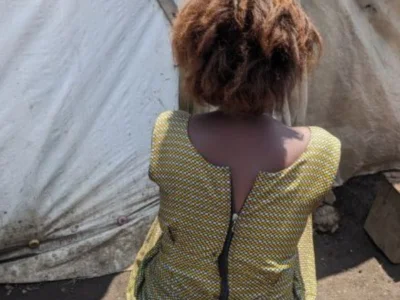
This is precisely what happened to Charline, a young woman in her twenties. Staring blankly ahead as tears streamed down her face, her sadness was evident. She recalled:
C’était un mercredi. Pendant que je faisais le tour des parcelles à la recherche de l’emploi, une maman m’avait demandé de lessiver les habits de ses enfants pour me payer 5000 franc congolais, puis elle est partie au bouloPendant que je lessivais, un de ses fils, un peu costaud, m’avait appelée dans la maison. Je croyais que c’était pour me donner d’autres habits à laver. Quand suis entrée, comme on était seulement deux dans la parcelle, il m’a plaqué sur le sol et m’a violé. J’avais peur de le dire à sa mère. Les images de cette scène me reviennent souvent.
It was a Wednesday. As I went around the neighborhoods looking for work, a mother asked me to wash her children’s clothes for 5,000 Congolese francs (USD 2.19), and then she left for work. As I washed, one of her sons, who was a bit stocky, called me into the house. I presumed it was to give me more clothes to wash. However, when I went inside, as we were the only two people on the property, he pinned me down on the floor and raped me. I was scared to tell his mother. Images of this incident frequently come to mind.
Like Charline, many women displaced by war also fall victim to sexual violence when looking for odd jobs to support their families. They are easy targets for predators who exploit their vulnerability.
A mother of two, interviewed at the Don Bosco refugee camp in Ngangi, DRC, explains:
Nous vivons la misère au camp. On n’arrive pas à survivre. Chaque jour, je me réveille pour aller en ville afin de chercher où travailler. Mais certains profitent de ce temps pour abuser de nous. Nous avons du mal à dénoncer vu que nous cherchons les moyens pour nourrir nos familles et répondre à nos besoins vitaux.
At the camp, we live in squalor and struggle to survive. Every morning, I set off into town, looking for work. However, some men take advantage of this to abuse us. As we are constantly looking for the means to feed our families and meet our basic needs, we find it difficult to report these incidents.
According to Semu Sikulimwenge, Clinical Psychologist at the HEAL Africa Hospital in Goma, the capital of the North Kivu Province, DRC, sexual violence reinforces skewed power dynamics between survivors and perpetrators. He explains:
Il est essentiel de développer des moyens de subsistance, notamment par des activités génératrices de revenus, afin de favoriser l’autonomie économique des victimes et de renforcer la résilience des communautés affectées.
Developing means of survival, especially through income-generating activities, is essential for fostering the victims’ economic independence and the affected communities’ resilience.
Fear of reprisals
In response to the rising tide of rape cases involving displaced persons, Attorney Patrick Musambali stresses that such acts of sexual violence are gross violations of Article 170 of the Congolese Penal Code. This article stipulates:
Est puni d'une servitude pénale de cinq à vingt ans celui qui aura commis un viol, soit à l'aide de violences ou menaces graves, soit par ruse, soit en abusant d'une personne qui, par l'effet d'une maladie, par l'altération de ses facultés ou par toute autre cause accidentelle, aurait perdu l'usage de ses sens ou en aurait été privée par quelque artifice.
A person who commits rape, either through serious violence, threats, deception, or by abusing a person who, as a result of an illness, impaired faculties, or any other accidental cause, has lost the use of their senses or had them stripped by deceptive means, shall be punished with 5 to 20 years of penal servitude.
Most rape victims fail to report their abuse out of fear of reprisal from the perpetrators. However, through awareness-raising campaigns, some now want to see their perpetrators behind bars. Eugénie Wimana, a leader at the Don Bosco displaced persons camp, stated:
Nous sensibilisons des femmes et des jeunes filles d’avoir une conscience collective pour arriver à lutter contre les violences sexuelles. Grâce aux soutiens de quelques organisations humanitaires, certains déplacés entreprennent des petites activités génératrices de revenus.
We raise collective awareness among women and young girls to effectively combat sexual violence. With the support of humanitarian organizations, some displaced persons have begun small-scale income-generating activities.
What’s more, Sikulimwenge highlighted:
Le soutien psychosocial est crucial pour créer un espace sécurisé où les victimes peuvent exprimer leurs émotions
Psychosocial support is vital for creating a safe space where victims can express their feelings.
The women’s rights organization Women Power also offers its assistance. As part of its “Emergency Response to Gender-Based Violence and Sexual and Reproductive Health” project, the NGO raises awareness about respect for human dignity and advocates to ensure the perpetrators are punished by law.
Small businesses for survival
According to Aurélie Maliro, Women Power Communications Assistant, around 70 percent of women from the Kashaka Shabindu refugee camp in northern Goma are at risk of various forms of violence. This results in unwanted pregnancies, unsafe abortions, and sexually transmitted infections (STIs).
Nous intervenons dans la prise en charge psycho médicale pour apporter de l’espoir aux victimes. Nous demandons à notre gouvernement de soutenir ces femmes victimes de violences sexuelles car leurs vies socioéconomiques chutent après ces abus.
We provide psychological and medical care, offering the victims hope. As their socioeconomic lives collapse around them following this abuse, we call on our government to support female victims of sexual violence.
To avoid sexual abuse, some displaced women, who are also survivors of sexual violence, rape, and other types of violence, gradually start small businesses. One displaced woman from the Don Bosco camp anonymously explained:
Je fais le commerce. Je prends de produits vivriers chez une vendeuse qui vit aux alentours du camp pour les revendre ici. De cette manière je gagne mon pain et je subviens à d’autres besoins.
I run a small business. I buy food products from a vendor who lives near the camp to resell here. This way, I can make a living and meet other needs.
To see lasting change, officials and advocates must foster an environment where survivors can speak out and report their abusers. If these perpetrators go unpunished, they will only continue to commit these heinous crimes.