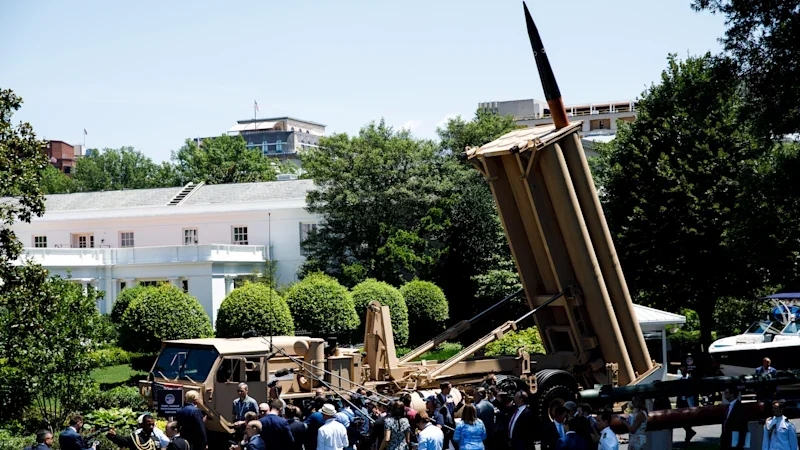
Washington: An influential Trump-aligned think tank is urging Australia to spend billions buying US-made missile interceptors to defend key bases, while also suggesting AUKUS could be used to boost lagging production of the weapons.
The recommendation comes amid broader concerns about how the war against Iran has depleted America’s stockpiles of critical munitions and left it exposed to a potential Indo-Pacific conflict.
The Heritage Foundation – a right-wing Washington think tank that drafted the Trump policy blueprint Project 2025 – called on Australia to buy at least three THAAD batteries and hundreds of missile interceptors to defend bases such as RAAF Base Darwin and HMAS Stirling near Perth.
This would reduce the inventory and cost burden on the US while enhancing Australia’s ability to defend itself from a Chinese attack, the organisation said in a report released last week.
The Terminal High Altitude Area Defence anti-ballistic missile system is built by Lockheed Martin and used to destroy incoming ballistic missiles 200 kilometres away.
Each battery set costs up to $US2.73 billion ($3.84 billion), with additional interceptors in the realm of $US15 million each. The US military only fields eight THAAD batteries at present.
The Heritage Foundation also called for the US Congress, Australia and Japan to “fund additional Indo-Pacific infrastructure improvements to harden them against ballistic missile attack”.
Those calls align with the burden-sharing strategy being aggressively pursued by the Trump administration, which wants Australia to lift defence spending to 3.5 per cent of gross domestic product.
Jim Fein, the report’s author, said the cost to Australia would be $US5 billion-$US10 billion ($7.1 billion-$14.2 billion). He acknowledged the US was not making nearly enough of the weapons, but suggested the AUKUS framework could be used to co-produce the interceptors, if not the batteries too.
“That would both increase production capacity, benefiting both countries, while creating jobs in both as well, which increases political viability in both countries,” he said.
Fein said Australia needed the interceptors to protect RAAF Base Darwin, but also HMAS Stirling, where US attack submarines are due to begin rotations next year, and where the US Navy expects to have an ongoing presence.
That facility was the subject of a recent political row after Defence Industry Minister Pat Conroy claimed US submarines would only be there for five years, before correcting himself amid scrutiny from the Pentagon.
Other experts disagreed that Australia needed the expensive missile interceptors. Bryan Clark, director of the Centre for Defence Concepts and Technology at the conservative Hudson Institute, said Australia could get by with more modest missile defence systems, such as the US-made Patriots, for a third of the price.
China did not have enough DF-27 long-range missiles to destroy air bases, Clark said, and would more likely target the power grid to try to shut down Australia’s economy in the event of a conflict.
The Pentagon did not engage with questions about whether it was in discussions with Australia about selling THAAD interceptors. But it denied there was a shortage of US munitions.
“We have everything required to strike at the time and place of the president’s choosing,” Pentagon spokesman Sean Parnell said. “Any adversary who confuses media noise with American weakness will discover the truth the hard way.”
However, numerous think tanks that study weapons stockpiles have documented the shortage. The bipartisan Centre for Strategic and Independent Studies found the number of THAAD missile interceptors in the US’s inventory fell from 452 before the Iran war to about 250 in late July, while the number of Patriot interceptors plunged from 2330 to about 800.
The Heritage Foundation concluded similarly, saying: “In practical terms, the United States would run out of interceptors in the first few days of a conflict should China target US bases with even a fraction of its missile inventory.”
Australia’s existing missile defence system is short-range, but the government plans to expedite a medium-range, ground-based air defence capability. It has planned but not approved $7 billion - $10 billion in spending on active missile defence over the next 10 years and is exploring options.
Last month, Australia and the US successfully tested a hybrid missile defence system by firing an existing Australian missile using an American launcher, in what one defence news outlet branded a “Frankenstein” solution.
A spokesperson for Defence Minister Richard Marles did not engage directly with questions about the THAAD option but pointed to the plans outlined in the National Defence Strategy and related investment program.
Marles announced last week that the federal government would spend $736 million to equip the Air Force with AIM-260 Joint Advanced Tactical Missiles, also made by Lockheed Martin, becoming the first country to operate the missile outside the US.