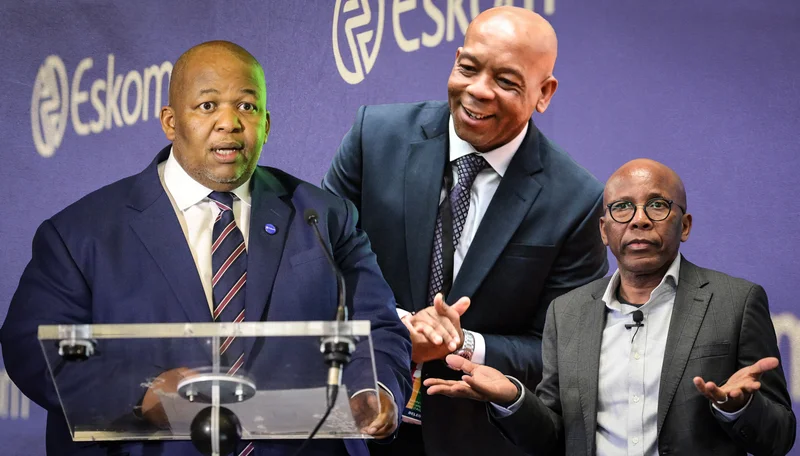
Minister of Energy and Electricity Kgosientsho Ramokgopa chose to dedicate most of his keynote speech at the Unisa Graduate School of Business Leadership Distinction to a history lesson. He traced Eskomâs origins back to the late 19th-century discovery of diamonds and gold, explaining that the earliest power stations were built by private industrialists to maximise extractive efficiency.
âElectricity was not a public good. Electricity was an instrument for capital and private accumulation led by industrialists of the time.â
He followed this with a meander through other historic highlights like the Transvaal Act of 1910, Hendrik van der Bijlâs 1923 establishment of the utility, the 1973 oil crisis and 1983 De Villiers Commission, before landing on the subsequent profit-seeking workforce reduction from 66,000 in 1985 to 46,000 in 1991.
Then came an unexpected shot. Ramokgopa explained that in 1998, the democratic governmentâs White Paper on Energy advocated for unbundling and privatisation.
However, due to political resistance from progressive forces, it was never implemented. Crucially, during subsequent reforms, âthe democratic government has abandoned the idea of public interestâ, he said, in the Electricity Regulation Act, creating a complex policy mismatch where Eskom was expected to act as a commercial competitor while bearing social obligations.
He is not wrong.
Detached leadership
In the time immediately leading up to the dramatic turnaround, Eskom suffered from operational stress, weakened controls and a dysfunctional culture.
This was, at least, the description of events offered by Eskom board chair Mteto Nyati, who said that the board discovered a massive internal divide:
âManagement of Eskom was completely disconnected with the rest of the business... there was a very clear view from the ground in terms of what is it that needs to be done to get us out of this problem, but none of those voices were ever listened to.â
It was the time when highly competent engineers were politically or organisationally sidelined. Nyati recalled finding Bheki Nxumalo (former chief of generation) in âSiberia... a place where you know when people want to forget you, they put you thereâ.
The chairman was careful to correct the public perception of the turnaround, setting the record straight that it was not dictated by external consultants, but driven by the workforce itself.
âThe generation recovery plan, as much as we may claim that it was part of what we came with as the board, it was not... Itâs something that came from the ground up. Itâs something that those employees of Eskom believed in, and they have believed in for a very long time, but nobody was listening to them.â
What the board did was bring Nxumalo back from organisational exile to lead the plan.
Eskom group CEO Dan Marokane then picked up the narrative baton to detail how the power utility had to withstand public scepticism to execute the plan.
During the summer of 2023/24, management took the high-risk decision to take massive capacity offline for deep maintenance.
âThose in the
knowwere actually wondering as to why we have so much maintenance going on... And we kept on saying we have a lot of our units on maintenance. This is going to be short-term pain for long-term gain.â
As South Africans will know, this strategy eventually paid off, securing base load reliability through subsequent seasons and enabling Koeberg nuclear units to run continuously.
The great restoration
Nyati anchored the chronicle relay with a reminder that the turnaround meant returning to basic principles.
âThis is an engineering company. There are standard operating procedures with regard to how you go about doing things. If you deviate from that, you should not be surprised when you are having the consequences.â
To enforce this, 45% of the leadership team in generation was replaced with leaders who could execute with discipline. The boardâs audit and risk committee then went to work systematically, closing procurement loopholes.
According to the chairman, when approval limits were set at R1-million, they uncovered a proliferation of suspicious transactions valued at R999,999 to bypass oversight; these loopholes were aggressively closed.
Despite the trip down memory lane, Ramokgopa painted a picture of Eskomâs future according to the Presidentâs numbers, with an assertion that unbundling was vital to protect the economy from the vulnerability of a single point of failure.
âWe know the perils of a monopoly. So when a monopoly is complacent, the monopoly is misdirected, is unable to execute its mandate, it can collapse an economy.â
A major transition barrier to that future is the Public Finance Management Act (PFMA), which imposes slow, rigid bureaucratic requirements on Eskom while its private competitors move freely.
Ramokgopa is fiercely advocating to remove these constraints:
âEskom sees an opportunity â like now weâre launching Eskom Green â we will not be able to compete with the IPPs at the speed that is required because it has to comply with the PFMA... We have liberalised... then Eskom must be freed from that because when the Act was envisaged, that dispensation never existed.â
Of morale importance
Marokaneâs telling of the Eskom 2.0 story says that the utility is looking far beyond simply ending load shedding.
âThis was not about ending load shedding... load shedding was not the destination... this is broadly about the reinvention of Eskom itself... We have announced the emergence of Eskom Green... youâll see more of EV charging stations coming from us... we are engaging differently as far as product offerings... [including] data centres which are power hungry.â
Nyati said that as Eskom established excess capacity, its vision was to export base load power to fuel industrialisation and critical mineral processing across Zimbabwe, Zambia, and Democratic Republic of Congo (DRC).
A cornerstone of the turnaround was the recognition that a demotivated, publicly ridiculed workforce could never execute a highly technical recovery. According to the panel, the board inherited a toxic environment where employees had suffered a five-year salary freeze while being blamed for load shedding.
Nyati aggressively challenged this practice:
âIf you are a scholar of leadership, you would understand actually thatâs a bad thing to do. Itâs what I call collective punishment. You just donât do that.â
The board successfully negotiated with the shareholder (read: our elected officials in Parliament) to restore salary increases and also reinstated short-term and long-term performance-based incentives to reward high performers and drive accountability.
What emerged from this deeply considered retelling of events in the Eskom saga is an image of executive leadership all reading from the same script.
A meticulously orchestrated ballet that has, to its credit â no matter what gets written about the private sector ditching the Eskom monopoly â steered the once captured power utility back into the light.
The next act is landing the unbundling leap, despite the differences in opinion with the Presidentâs open access mission. DM