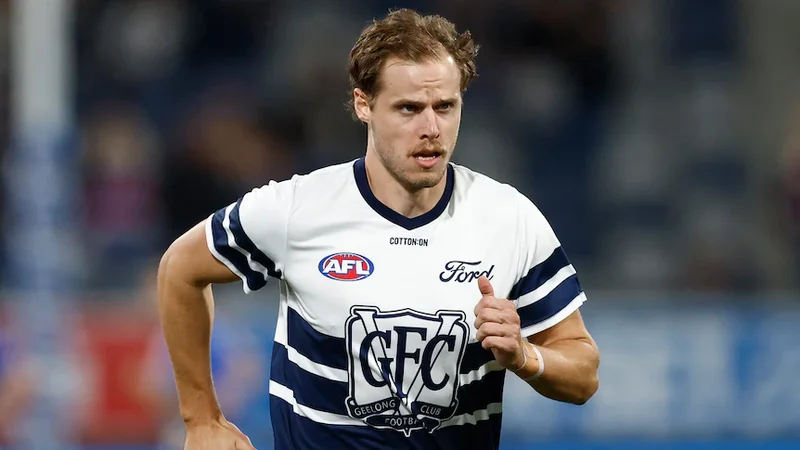
The secret document that Geelong defender Jake Kolodjashnij signed to release his club from any legal risk over future concussions has opened an enormous can of worms.
That is aside from the ethical considerations, the conflict of interest faced by the AFL chairman, Craig Drummond, who was Geelong president at the time, and the Cats' response to why they did not lodge the document with the AFL.
What the incident does shine a light on is the logical extension of sanctioning high-collision sports.
Because the truth is, by allowing people to play contact sport, particularly at the elite level, they are exposed to a life of potential brain injuries and chronic pain.
Neurophysiologist and concussion researcher Alan Pearce from Swinburne University found the longer professional athletes participated in certain contact sports, at any level, the greater their chance of some form of brain trauma.
His findings sparked a realisation involving multiple swear words.
"I say 'holy f***" a lot," he told ABC Sport.
"As I progressed with the increasing of the numbers, I began to realise that there is a spectrum of damage that players were getting.
"This is something that's going to happen to everyone who plays this sport for a long period of time."
For some it was micro damage that would not affect a person's quality of life, but for others it was more serious.
"So, how do we accept a certain amount of damage that is not going to significantly affect the rest of their life or even cut their life short?" Professor Pearce asked.
He and his colleagues published the work earlier this year in the Journal of Clinical Neurophysiology, studying 113 retired male professional Australian rules, rugby league and rugby union players, aged between 28 and 68.
They found that it was the length of a player's total career, not the length of their professional career, nor the number of concussions they suffered, that was the problem.
Consider someone starting Aussie rules as a 10-year-old, getting drafted when they are 18, but then continuing to play long after they retire from the professional game.
Professor Pearce had some test subjects who had played at various levels for 35 years.
The damage was not necessarily caused by major concussions; it was the constant sub-concussive knocks that were the problem.
What does this mean for professional contact sports?
When someone signs a professional contract to play Aussie Rules, or another collision sport, they are potentially signing up to future brain damage.
That is not to mention any number of other risks: An ACL injury, the likelihood of a knee or hip replacement at an early age, the possibility of chronic pain or injuries that restrict a person's lifestyle and career.
This is the price they pay, but is it worth the cost?
"It's like this unspoken acceptance of professional sport," Professor Pearce said.
"It goes beyond healthy living; in some ways professional sport is extreme sport."
Which raises a difficult question the AFL and other codes are facing: How do you run a sport where there is an implicit risk of brain damage for participants?
Acknowledgement of risk
Which brings us back to the document that Kolodjashnij signed and that Geelong did not think necessary to run by the AFL.
It has now been reported the document was titled "Voluntary Assumption of Risk" and stated: "You take upon yourself the physical and legal risk of loss, damage or injury of any kind arising directly or indirectly as a result of concussion sustained by you following your decision."
There may be a myriad of problems with what happened, but the concept of an acknowledgement of risk is not so far-fetched.
Anyone undertaking surgery signs a consent form. It does not absolve a surgeon of gross negligence or malpractice — you cannot break the law or contract your way out of legislation.
But consent effectively protects surgeons from foreseeable events that may occur in surgery, like an infection.
The idea is that people go into the surgery fully aware of the potential risks.
Have we reached a point, given what we know about the dangers of concussion in collision sports, that players may need to sign a consent form when they take up a professional sports contract?
Professor Pearce thinks so; not to absolve clubs and the AFL of responsibility, but for ethical reasons.
"So that everyone knows everything up front," he said.
"It's also about risks of ACL and other injuries. I don't know if young players understand the psychological stress that they're going to be under."
At present, there is nothing in the AFL standard players' contract or the players' collective bargaining agreement that spells out the potential risks of the game.
"You could argue that the whole premise of the AFL educating the playing group on concussion probably covers that," a spokesperson for the AFL Players Association told the ABC.
Professor Pearce said the expectation is that the AFL should do all it can to minimise the chances of players getting concussed and for clubs to play their part.
He cited monitoring loads through the use of smart mouthguards, placing limits on kids playing football and limiting contact training.
The latter was a recommendation of the Victorian State Coroner, John Cain, from his findings into the death of the former AFL player Shane Tuck in 2023.
The AFL responded in 2024, saying it was implementing that recommendation, although it is still yet to come into place after a long period of collecting training data.
It is understood the AFL is considering limiting contact training from next year.
The bigger picture
Consent would not stop players from suing the AFL or clubs if they have acted negligently.
That is an allegation that will play out in the Supreme Court of Victoria next year, when a class action led by the former Geelong player Max Rooke will hear arguments that he was left with brain damage because of the actions of the AFL and his club.
Rooke has been joined by around 120 former players who are suing the AFL and 11 clubs.
Loading...This is the bigger picture of the risk facing the entire AFL, and all other collision sports for that matter.
In a writ lodged with the court, Rooke claimed he suffered between 20 and 30 concussions while playing for Geelong, resulting in "life-altering injuries".
This week Margalit Lawyers, acting for the players, signed up two more former players to the class action.
The writ argues the AFL and the clubs failed in their duty of care to enforce rules and protocols around concussion to ensure the players' safety and to avoid exposing them to risk.
"We say that the precautions that we allege should be taken in our statement of claim should have been in place a lot earlier based on medical evidence," special counsel with Margalit Lawyers, Daniel Schram, said.
While Schram believes the AFL should continue to educate players and keep them up to speed with the newest evidence around concussion, he doesn't believe a consent form is the way to go.
Neither does the University of Melbourne Law Professor, Jack Anderson.
"We do know that there is a risk there and the players do agree to that to a certain extent," he said.
"It's an implied consent."
But he said the risk shouldn't be placed on the players.
"The risk should lie with the AFL to make the game as safe as it possibly can."