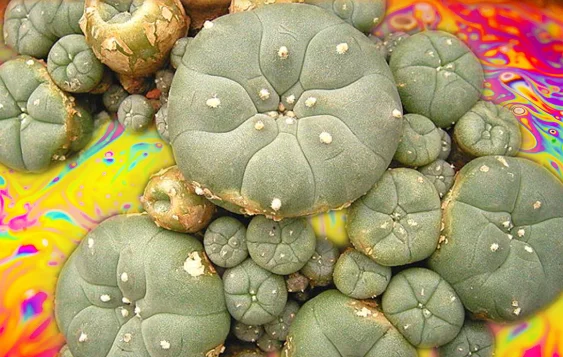
Mescaline, derived from cacti like peyote in North America and San Pedro in South America, is the drug that gave psychedelics their name. Psychiatrist Humphry Osmond coined the term in a letter to writer Aldous Huxley in 1956, a few years after he took his first mescaline trip. In a follow-up to Huxley a few days later, he penned a now famous rhyming couplet about the drug’s vertiginous effects: “To fathom Hell or soar angelic, just take a pinch of psychedelic.”
Some say mescaline isn’t just the original psychedelic, but also the first to be used by humans. Known to generate vivid visuals, deep emotional connectedness, and a dream-like state, it’s played a critical part in ritual practices in Indigenous societies throughout the Americas, including the Aztec and Huichol, for millennia. Archaeological evidence of peyote use, in particular, traces back more than 5,000 years.
Read more: “What Is Your Brain Doing on Psychedelics?”
But mescaline’s celebrated place in the psychedelic pantheon hasn’t translated into the same kind of research renaissance seen by other psychedelics such as psilocybin and LSD. The drug’s effects on the brain are vastly less well understood, so much so that one research paper from 2023 called mescaline “the forgotten psychedelic.”
One of the reasons for the lack of research on mescaline may turn out to be wrong: Scientists who study psychedelics have generally assumed mescaline would produce similar effects in the brain to LSD and psilocybin, given that they all hit the same receptor: 5-HT2A. In fact, the effects may be quite different.
A new study of rats from Northeastern University has provided some glimmerings of what may happen when mescaline works its magic on the brain. The researchers used mescaline in rats that were awake and scanned their brains with fMRI. The only previous neuroimaging study of mescaline was conducted in 1992 in a small sample of 12 humans, with much cruder technology, while prior mescaline work in animals primarily looked at behavior rather than brain imaging.
LSD and psilocybin mostly seem to fire up the cortex, which handles high-level thinking and interprets senses, and the thalamus, which sorts sensory and motor signals. But the authors of the new study found that instead, mescaline primarily hits the cerebellum. A structure at the back of the brain that coordinates movement, the cerebellum has also been hypothesized to act as a kind of gatekeeper, distinguishing sensory input that’s routine and ordinary from input that’s surprising, only allowing the novel signals through.
Read more: “The Long History of Psychedelic Theft”
More specifically, the researchers found that under the influence of mescaline, the rats’ cerebellum activity dropped locally, but this butterfly-like structure also started forming more connections with other brain regions, such as the hippocampus, thalamus, somatosensory cortex, and the midbrain. The team of scientists decided this may mean the mescaline breaks down the filtering function of the cerebellum so that it stops screening sensory input and begins broadcasting raw unfiltered signals to the rest of the brain, driving some of the perceptual strangeness and intensity of the mescaline experience.
A few caveats: The scientists only tracked a single dose in rats, and they didn’t follow heart rate or breathing during the scans, so some of the activity patterns they saw in the rats’ brains could be related to physiological changes rather than drug effects. Animal-to-human translation is also, of course, uncertain, especially since the human experience of mescaline is heavy on the visuals, something that barely registered on the scans in rats.
Either way, don’t expect a sudden surge in mescaline studies. The other reasons that research is stalled on this particular drug may not change any time soon. The grueling 8-to-12-hour duration of the mescaline trip, and its tendency to produce physical nausea and vomiting, mean that research requires more intensive medical supervision than other psychedelics. And strict legal protections govern the slow-growing cacti that contain the drug, which are threatened by over-harvesting, and are central to ritual practice in the Native American Church.
Perhaps it’s fitting that the drug that gave elusive, mind-bending psychedelics their name is the one we understand the least. That said, scientists may finally be getting a peek through doors of perception that mescaline throws ajar.
Lead image: Frank Vincentz / Wikimedia Commons and rei310 / Adobe Stock