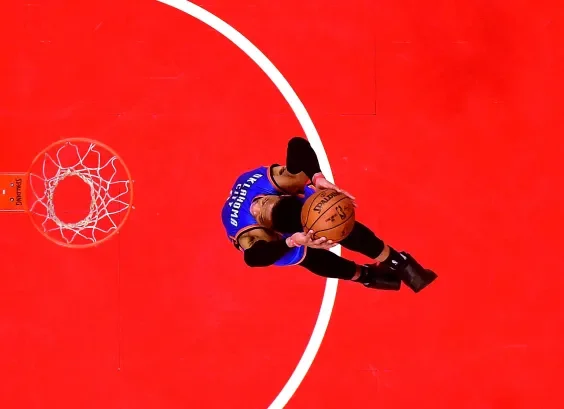
It’s hard to imagine now—like imagining an era when man did not know the sun was huge, hot, and bright—but there was a time when we did not yet understand Russell Westbrook as a basketball player. Slow to hit his growth spurt, Westbrook didn’t dunk until his senior year of high school. Coming out of UCLA after his sophomore year, he was hailed as a defensive stud, with unexplored skill offensively; he still mostly played off the ball. Envision, if you can, an adult Russell Westbrook who had already given over his life to basketball, but did not yet dunk and did not yet dominate the ball. It makes me feel a little insane, like it’s never too late to carve out the defining traits of your life. Go out and remake yourself tomorrow, then decide that that’s you from here on out, and then don’t quit for 18 years. That’s what Westbrook did, before announcing his retirement on Wednesday, throughout 18 years of uncompromising, rock-headed, glorious self-actualization.
Westbrook entered the NBA in 2008, at the same time as the Oklahoma City Thunder franchise. He helped form a molten triple-future-MVP core that arrived at the 2012 NBA Finals, before coming apart piece by piece. James Harden left that offseason, where he pursued his own, slightly more sluggish, ball-dominant destiny in Houston. That ushered in the “your turn, my turn” era with Westbrook and Kevin Durant, only for KD to defect to the Californian enemy in 2016. First there were three, then there were two, and then there was only Russell Westbrook. Again, it’s hard to imagine him any other way. Left to his own devices he began important investigations into the very structure of basketball. How much can one man do? How much of an ostensible “team” sport can we instead funnel through the willpower and fast-twitch muscles of one tireless and pissed-off man? He answered these questions with his performances: the coast-to-coast dunks, the 20-20-20 game, the triple-double average MVP season, the carry job to end all carry jobs. He was a perpetual motion machine.
What it looked like, when it was good: hurling himself headlong at the rim, over and over, with bone-rattling fury and apparent disregard for his own welfare. What it looked like, when it was bad: hurling himself headlong at the rim, over and over, with bone-rattling fury and apparent disregard for his own welfare. There was only ever one true way to be Westbrook, and his mere presence on the hardwood colonized every aspect of game play. A little like Vonnegut’s ice-nine, once he touches the ball, the whole floor becomes instantly Westbrookized. Everyone else slots into their tidy supporting roles. Big man: set screens hard enough to hospitalize, then roll to the basket, and box out so Russ can grab every rebound and go, go, go. Teammates on the wing: stay the hell out of the way and be ready to shoot once that kickout pass scorches your fingertips. The opposing team: build a wall in the paint and steel yourself as he prepares to ram into it. It’s not like he’s going to do something else. In the Westbrook minutes, everyone knew their part.
Other skills came and went—a smooth pull-up midrange he called his “cotton shot,” unprecedented offensive rebounding for a point guard, a fleeting three-ball—but his game was always premised on puncturing the defensive shell and blasting downhill. Throughout his prime, my mental picture of him approximated the large grinning bullet in the Super Mario games. Westbrook was a skilled passer, though because of the hellacious speeds he operated at, his menu was mostly limited to mid-air dump-offs to the big, or the screaming skip passes out to the arc, as opposed to the probing, slow-down fare that characterized point-guard play up to that point in basketball history. His ass wasn’t “reading and reacting,” he was acting, decisively and murderously, agnostic to anything the defense was doing. I suspect most of his key decisions were made post-leap and pre-landing or -collision. He peaked during the apex of spread pick-and-roll, but somehow never actually enjoyed the roomy spacing that would’ve made life much easier for him. This man became the MVP with Andre Roberson and Victor Oladipo standing in the corners because he kept barreling ahead anyway. That was cool, too.
It’s fascinating to think about Westbrook amid the churn of an evolving NBA. He helped usher in the now-receding age of heliocentrism, where teams routed all the decision-making through one ball-handler, but even in that world, he remained an anomaly. As the big guys started handling the ball, and as the little guys stretched their shooting range to comical distances to survive, here was the one straggler, a non-shooting little guy resistant to trends, getting by on his singular athleticism and even rarer cast of mind. Even at the time, Westbrook struck me as futuristic and antiquated at once, and watching him throw down those dunks I was acutely aware that there would never be another player raised to play like him. Anthony Edwards arrived with many of the physical and attitudinal attributes required to be a Westbrook acolyte, but it wasn't long before he read the room and tamed his own recklessness with a diet of pull-up middies and volume three-point shooting. A lot of people seem to have picked up on something fatalistic in Westbrook's style of play, including our own David Roth, who articulated it well in the ancient year of 2016, the sheer “want” at its center.
Westbrook exited his prime in 2019 and shuffled around unhappily from Houston, to Washington, to Los Angeles. Call it the rubber-necking phase of his career. As the basketball front offices, fandom, and media got a little more wised up, conversant with all-in-one metrics and value contracts, Westbrook became an accursed discourse object, a shibboleth separating the basketball romantics and realists, a debate laid out masterfully in a 2023 John Saward essay. Both camps stated their cases forcefully, and continue to do so today. As I write this I feel that true enlightenment is synthesizing these views. I’ve moved beyond box-score watching, but only an idiot would allow knowledge to desensitize him to the visceral pleasures of the Russell Westbrook Experience.
I loved watching Westbrook, even when it drove me nuts, because, as with a loved one, you have no choice but to accept him in its totality. Since there’s no room in a eulogy for dishonesty: What made him such an intoxicating watch was that in a 100-second span, he could do the coolest shit you’ve ever seen, and the dumbest shit you’ve ever seen. He could incinerate an entire defense en route to a clamorous dunk; he could then clank a midrange jumper off a region of the backboard that had never been touched by a basketball before. There were perhaps three humans ever who could have executed the first play, and a few billion humans who could have executed the second play, but only this one, blazing, spectacular man sat at the intersection of those two groups. I can admit to myself that this physical-comedic aspect accompanied the sincere-awe-witnessing-transcendence-of-this-mortal-shell aspect of it.
Years ago, as I began to feel more aches and pains from my own pedestrian athletic pursuits, I began to really admire NBA players who aged in style. I watched with joy as an old Blake Griffin, hopless but not hopeless, learned to dribble, pass, and shoot his way to an All-NBA team. As infuriating as I’d found Carmelo Anthony’s stubbornness when I rooted for him as a Knick, I wished him well in his humbler days hucking corner threes to make room for his star teammates. And this appreciation extended to some mid-career guys, too. I saw how futile Aaron Gordon was as a first option, but rejoiced upon his discovery that he was lab-engineered to play alongside Nikola Jokic. I loved watching players evolve and even flourish in these second and third and fourth acts, discovering new versions of themselves, meeting the fresh challenges of a shifting league.
That wasn’t the sort of ending Westbrook could ever expect. It’s not that losing some athleticism tanked his ability to be a useful NBA player; he still had plenty to spare, and a world-historic motor. It just would have required some rejiggering of priorities, reallocation of his effort. Timely cuts, attentive off-ball defense, connective passing—boring, un-Westbrookian repertoire, the parts of basketball played when you are no longer the center of its universe. That’s not for everyone. Late-period Westbrook, laboring for the Clippers, Nuggets, and Kings, remained the main character of the action, which led to some indelible sequences, both good and bad, as ever. One thing has changed since I first started glorifying the gracefully aging NBA veteran. I have seen norms, habits, and inertia sand down once-idiosyncratic people. I’ve seen friends and acquaintances lose what made them them. Not so with Westbrook. Now, as always, when you describe Russell Westbrook, you are cornered into using the sorts of words associated with natural disasters or premodern myth. There is simply no other language available. I’d call that an accomplishment, too.