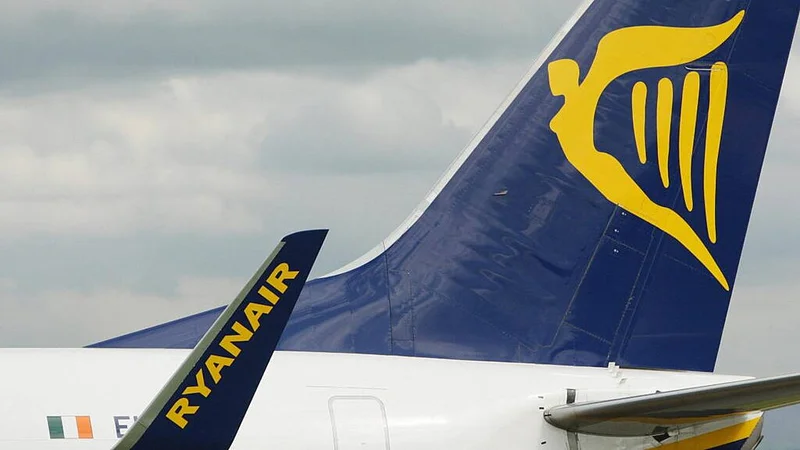
An engine fan blade broke off on a Ryanair flight and sent parts flying that shattered a plane window shortly after take-off in Greece.
The incident caused a man’s head to be sucked into the hole in the fuselage before his fellow passengers pulled him to safety, US investigators said Thursday.
NTSB issues preliminary report for the July 10 engine fan-blade-out failure on Ryanair flight 1879 during climb out from the Thessaloniki International Airport in Thessaloniki, Greece: https://t.co/J38avfYZAs pic.twitter.com/es22bMFmJB
— NTSB Newsroom (@NTSB_Newsroom) August 13, 2026
The engine parts damaged the plane’s fuselage in several other places, the National Transportation Safety Board (NTSB) said in its report.
The NTSB also said it found bird remains inside the engine, suggesting the plane may have struck birds as it took off.
The terrifying incident happened shortly after the Ryanair plane took off from the northern Greek city of Thessaloniki on July 10.
Oxygen masks dropped from the ceiling after the window broke and the cabin lost pressure.
The 61-year-old man who was nearly sucked out of the plane suffered neck and shoulder injuries and friction burns before his fellow passengers pulled him back inside the Boeing 737-800.
Passengers told Greek media that they heard a loud bang, oxygen masks dropped and the plane began to lose altitude.
Panic spread through the aircraft and some passengers screamed after the man was partially sucked out of the missing window.
One passenger told Radio Thessaloniki: “Most people had fallen asleep, we had closed our eyes. We heard a sound, I’d describe it like a tyre bursting … but very loud.
“We knew straight away we lost pressure because we lost altitude.”
A series of short videos recorded from inside the plane and shared by Radio Thessaloniki showed passengers wearing oxygen masks after the cabin lost pressure.
Another appeared to show the blown-out window, with a man seated nearby wearing an oxygen mask.
A third video, apparently filmed after the aircraft landed, showed first responders working in the aisle.
At the time, Ryanair said in a statement that the flight “returned to Thessaloniki shortly after take-off when a passenger window dislodged in-flight”.
But the NTSB said then that the plane had a right engine issue during the flight.
International aviation rules allow Greece’s Hellenic Air and Rail Safety Investigation Authority to hand over investigations to the NTSB, which they did in this case, with Greece participating.
The NTSB reprimanded Ryanair chief executive Michael O’Leary after he told investors last month that the investigation was focused on foreign object damage and not the plane’s age or maintenance history.
The NTSB said investigators hadn’t ruled anything out and Mr O’Leary was not authorised to discuss it.
The narrow-body plane that can seat up to 189 passengers was delivered new to Ryanair in 2008, according to flight-tracking site Flightradar24.
Additional information about the Ryanair (Malta Air) flight from Thessaloniki. The 737-800 suffered an apparent uncontained failure of its right engine, with debris shattering the window before the passenger was partially sucked out of the aircraft. https://t.co/NPpT6hZ7fa pic.twitter.com/vR66Ah6EG1
— Flightradar24 (@flightradar24) July 10, 2026
Flight records show that the aircraft climbed past 4,570 metres about six minutes after departure and then immediately descended to about 1,830 metres “to burn fuel for 30 minutes” before returning to Thessaloniki about an hour after taking off, Flightradar24 said.
The flight was operated by Malta Air, a subsidiary of Ryanair, Europe’s largest budget carrier.
The plane landed normally and passengers returned to the terminal, and one passenger requested and received medical assistance on the ground in Thessaloniki, the airline said in a statement at the time.