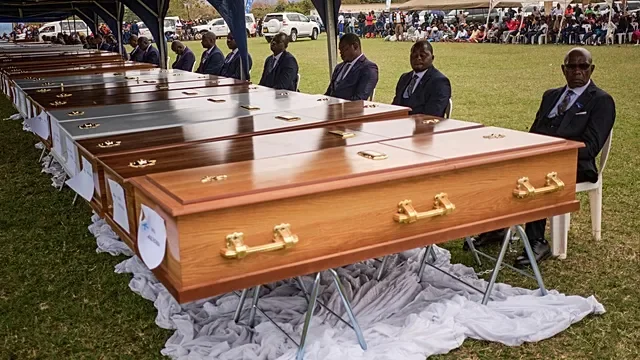
Hundreds gathered for a memorial service in northern Zimbabwe on Thursday to honour victims of the Lake Kariba ferry disaster, which killed at least 44 people. Survivors recalled a desperate struggle for life as the vessel capsized in rough waters.
Grieving families and survivors gathered in Kariba to remember those who died when a government passenger ferry overturned on the vast lake.
Among the survivors was Anymore Chambate, who said heavy winds caused water to flood the ferry’s engines, leaving only one still operating as the vessel began to sink.
“I tried to give life jackets to people on the ferry and I managed to only give not more than ten,” he recalled.
Another survivor, Norah Chadenga, described clinging to a window as the ferry went down.
She said she struggled in the water despite being unable to swim, drowning several times before a young man pulled her to safety.
Ferry overloaded in rough waters
The vessel was carrying 114 adult passengers and five crew members, exceeding its stated capacity of 90 people. The number of children aboard remained unclear.
Survivors said passengers had urged the driver to turn back as the weather deteriorated, but the ferry continued across the lake.
Witnesses reported seeing bodies and debris in the water after the vessel overturned.
The Civil Protection Unit initially said 77 people had been rescued and 15 bodies recovered. Police later raised the confirmed death toll to 44.
Search and rescue operation continues
Rescue teams involving the army, divers, local boats and a helicopter continued searching the waters around the wreck.
The ferry served as a crucial link between the lakeside town of Kariba and surrounding islands and fishing communities, transporting villagers and traders across one of Africa’s largest reservoirs.
The disaster is among the deadliest passenger boat accidents recorded on Lake Kariba, which straddles the border between Zimbabwe and Zambia.
President declares national disaster
President Emmerson Mnangagwa declared the ferry disaster a national tragedy and called for urgent improvements to maritime safety and rescue capabilities.
“This tragedy has exposed serious deficiencies in our maritime capabilities,” Mnangagwa said, warning that recreational and transport sites must not become “death traps”.
As families mourn, questions are likely to focus on why the ferry sailed in dangerous conditions, whether it was adequately equipped and how safety regulations were enforced.