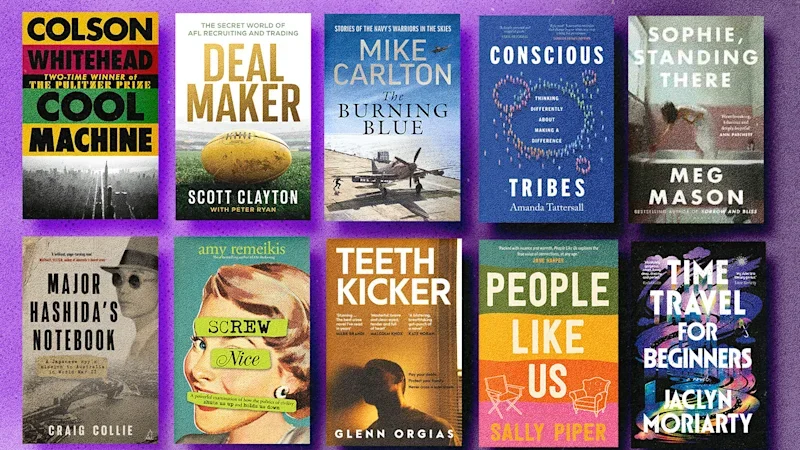
There’s plenty of star power in this week’s crop, with new novels from Meg Mason, Colson Whitehead and Jaclyn Moriarty among the fiction under review. Elsewhere, Amy Remeikis takes aim at the politics of playing nice, while Australian histories uncover wartime spies, naval aviation and the ruthless business behind AFL deals. Here are our critics’ picks – and misses – from 10 of the latest releases.
Fiction
Sophie, Standing There by Meg Mason (4th Estate, $35)
Sophie Pattison isn’t supposed to be noticed. Sound techs at literary festivals all wear black, and their job – fixing up literary guests with mics, and so on – involves being as unobtrusive as possible. Sophie does, however, take careful notice of the Talent, and the descriptions of famous writers’ obnoxious quirks should make everyone in the literary trade smirk. Behind her kind and cheerful demeanour, though, Sophie is desperately lonely – and when her husband dumps her with casual brutality, with dire consequences for her, sadness moves in to stay.
A chance encounter launches the bookish Sophie into a parasocial obsession with a renowned author, known for her sardonic wit and wisdom. But when her idol is scheduled to appear at a festival – a last-minute replacement for a COVID-19-stricken Elizabeth Strout – they meet in the flesh, even as the disparities between art and life, idea and reality, come into focus. Sophie, Standing There is bittersweet, its precise notes of humour and joy delivered from under a veil of persistent melancholy. Genuinely uplifting books for intelligent readers are rare, and this is one of them.
Cool Machine by Colson Whitehead (Fleet, $35)The Harlem Trilogy, from two-time Pulitzer Prize winner Colson Whitehead, is set in New York City – through the Civil Rights movement in the ’60s (Harlem Shuffle), and the murderous urban decay of the ‘70s (Crook Manifesto). In the final book, Cool Machine, the ‘80s have arrived in a welter of gentrification and Wall Street greed, as the have-nots sink deeper into the pit. Master fence Ray Carney bridges both worlds, a purveyor of stolen goods who’s been roped into every kind of hustle and crime caper. This time he faces moral qualms as he gets into sports memorabilia – with rival black and white buyers of Jesse Owens’ Olympic gold medal – in a novel of great range that roves from the opulence of five-star hotels to the grim kingdom of the homeless.
It’s hard-boiled crime fiction with a pulpy edge, the entertainment enlivened by cultural satire with progressive sympathies. The trilogy’s also a continuing love/hate letter to NYC: “a monstrous entity powered by innate miseries, operated by brute will, and held together by pluck, fury and rebar”. Blaxploitation and the origins of hip-hop have been replaced by antiracist arthouse and ghetto blasters in this one, but the brilliance of Whitehead’s writing is a constant.
Teeth Kicker by Glenn Orgias (Harper Collins, $35)
Shark attack survivor Glenn Orgias has turned novelist; he delivers a gritty debut with teeth, and heart. Vincent Silk - a heroin addict out on bail - gets released penniless onto the mean streets of Steel City (Newcastle) with only one way to repay his debt to a loan shark. Although he’s built like a brick shithouse, being an enforcer does not sit well with Vincent. He craves the chance to atone and regain some self-respect. Offering violence to vulnerable debtors (like himself) is a dark path. It’s one he doesn’t want his younger brother Ray to follow, especially given that Vincent was responsible for a motor vehicle accident which left Ray an amputee. When his next target is Henrietta – a woman he loves, who once saved him from an overdose – crushing shame leads Vincent to concoct a plan to protect her. But the maw of crime has a sharp bite, and the shark could kill them all if Vincent’s scheme comes undone.
Teeth Kicker is a hard-boiled crime thriller with echoes of 90s “grunge lit” and a violent but good-hearted antihero, desperate to make amends for poor choices. It’s an entertaining white-knuckle ride, with a complex portrayal of masculine virtues, failures and challenges that stands in sharp contrast to the hardcore misogyny of the manosphere.
People Like Us by Sally Piper (UQP, $35)
Women aged 55 and over have the fastest-growing risk of homelessness in Australia. Tina Lamb isn’t there yet, but she does live in a caravan park in a down-at-heel locale. An acrimonious divorce in midlife has robbed her of security. Her straitened circumstances require adjustment – not least to her fellow denizens at the caravan park – and reinvention is frustrated by discrimination based on Tina’s age and gender. Despite raising four kids and nursing her dying mother, she doesn’t hold out much hope of finding secure long-term employment.
Finally, Tina lands a job caring for a wealthy elderly woman. Mrs Bell is not at all what she expected – highly educated, ferociously outspoken and acid-tongued. Yet the pair form an unusual friendship that might just provide the help Tina needs (but refuses to ask for) to rebuild her life. Sally Piper’s People Like Us should probably have expanded on that unusual friendship – it’s the sharpest part of the novel – though making Tina a difficult-to-like victim is a refreshing move.
Time Travel for Beginners by Jaclyn Moriarty (Ultimo, $35)
On a bustling Sydney street, an obscure Time Travel Agency welcomes patrons with a coffee, delicious pastries, and a chance to travel backwards in time without changing the present. (If that sounds to you like an Australian version of Before the Coffee Gets Cold, you’re not alone.) Most customers don’t believe the Agency is the real thing, whether they’re travelling back to the ancient Greek Olympic Games or visiting their dearly departed. Yet it might just be, and during their travels, the fates of three characters intertwine.
Single mother Anna needs a fresh start and is offered a job at the Agency. A customer named Teddy seeks answers from the past after the breakdown of his marriage, while Jade is caught in the trauma of unanticipated loss. Exploring grief, parenting, atonement, forgiveness, and regret – as well as learning to live with choice and consequence – Time Travel for Beginners covers all the self-actualisation bases. It has a nifty plot resolution and well-observed human drama, but the novel felt too derivative to be genuinely moving or inspiring.
Screw Nice by Amy Remeikis (Hachette, $35)
When Amy Remeikis was 9, a group of boys taunted her to lift her top. She refused, then one of them tried to do it himself, and she pushed him so hard he fell over, adding, “That is sexist!” Proud of herself, she told her father, who was furious and condemned it as “PC bullshit.” It was her first experience of the price of not being nice.
Central to her contentions here is the proposition that “niceness” – or what she calls “civility politics” – will always favour the entrenched white patriarchy. That “niceness” has been weaponised to stifle opposition to, say, racism and sexism, and there will always be an inherent hypocrisy to it. While Hillary Clinton identified racist “deplorables”, Trump stated he could shoot someone and lose no votes. Yet all media attention fell on Clinton.
Screw Nice is a polemic and, like all polemics, carries with it the element of calculated reduction to give the argument punch. Remeikis is in no mood to play the game, and at a time of mounting authoritarianism at home and abroad, and seemingly unaccountable “leaders”, this is one of those necessary political hand grenades.
Major Hashida’s Notebook by Craig Collie (Allen & Unwin, $35)
It’s an unlikely sort of spy who goes around getting his picture in major daily newspapers and giving press interviews – all of which might be called hiding in plain sight – but when Major Hashida of the Japanese Army visited Australia in January 1941 (only 11 months before Pearl Harbour), he was here ostensibly on a kind of trade mission. Nobody believed that. The problem was, however, that Australian authorities were a bit hamstrung – the British having given him a visa without consulting Australia – so authorities couldn’t refuse him entry. In what amounted to a cat-and-mouse game, Intelligence and police shadowed him throughout his few months down under, checking out factories, war industry, ports, airports, and anything that might be useful to the Japanese military.
Craig Collie’s reconstruction of the time is intriguing and entertainingly detailed, but there is also something comical, even absurd, about the natty figure of Hashida himself – a spy who took time off in Sydney to do some shopping at David Jones and had a taste for Ye Olde England. In the end, he was arrested in Batavia and the notebook was confiscated, Hashida eventually fetching up on Guam, where he was killed.
Conscious Tribes by Amanda Tattersall (Hardie Grant, $37)
Trying to make some kind of political impact as an individual has always felt daunting, even more so in times such as these when world leaders like Trump and Putin act unilaterally, oblivious to what anybody thinks. Amanda Tattersall’s deeply thoughtful analysis of activism draws on her extensive experience as both a co-founder of GetUp and of the Sydney Alliance.
She takes her journey back to the massive 2003 protests here and abroad against the war in Iraq – which failed. It led her into a long, ultimately academic examination of just what constitutes effective protest, and the result is this book – which revolves around the idea of forming effective tribes, while also being mindful of the historical baggage that comes with the term. An example of her use of “tribe” is the Sydney Alliance – a huge coalition of religious organisations, unions, and community groups aimed at collective action. Integral to this is her examination of the “paradoxes” of power and the potential positives of dichotomies like sameness and difference – crucial in the story of Maha, a Muslim Australian woman. A personal, sometimes demanding work.
The Burning Blue by Mike Carlton (Penguin, $37)
The first probable instance of wartime gunfire from a plane could almost be something out of Blackadder. It took place in France, 1914, when a British reconnaissance plane, after landing briefly and warning of a German advance, flew back over said Germans having lunch in a forest. The Germans put down their lunch and took potshots; the two-person crew returned fire, dropping a few grenades on the troops for good measure. It’s part of the historical backdrop in Mike Carlton’s highly informed, sweeping history of the RAN Fleet Air Arm – Carlton being a specialist in the field.
After setting the scene (including Houdini’s exhibition flight at Diggers Rest), he charts the course of Australian naval aviation, including World War II, Korea, and the helicopter war in Vietnam (where Carlton was a war correspondent). As you might expect, there’s no shortage of larger-than-life figures—none more so, possibly, than Sir Arthur Longmore, who commanded both British and Australian air arms in two world wars. It’s a subject that’s not often covered, but as Carlton makes engagingly clear, the discovery that “planes could leave ships” transformed warfare.
Deal Maker by Scott Clayton with Peter Ryan (Hardie Grant, $35)
If you’ve ever wondered what goes on behind the scenes when recruits are signed up or players move from team to team, this fly-on-the-wall account from former AFL player Scott Clayton (Brisbane) puts you in the picture. And, often as not, it’s a pretty Machiavellian world he opens up – just one example of many being the intricacies of signing up Nathan Buckley, a three-way deal involving Brisbane, North Melbourne, and Collingwood that ultimately saw Buckley leave Brisbane after 1 year and head to Collingwood to become a club legend, Brisbane gaining Chris Scott in the exchange. Well might we call it horse-trading, the back-room deals as intricate as any political machination. It pulls the curtain away and takes you backstage.
What else is happening in the book world?
- The 3000-year-old poem Australians suddenly can’t get enough of
- Aussie novelist Mag Mason shares her experience of growing up in a religious sect
- Happy 100th birthday to the world’s most loveable teddy bear
- Is Helen DeWitt the literary messiah we’ve been waiting for?
- Looking for a new read? Our critics check out 10 new releases