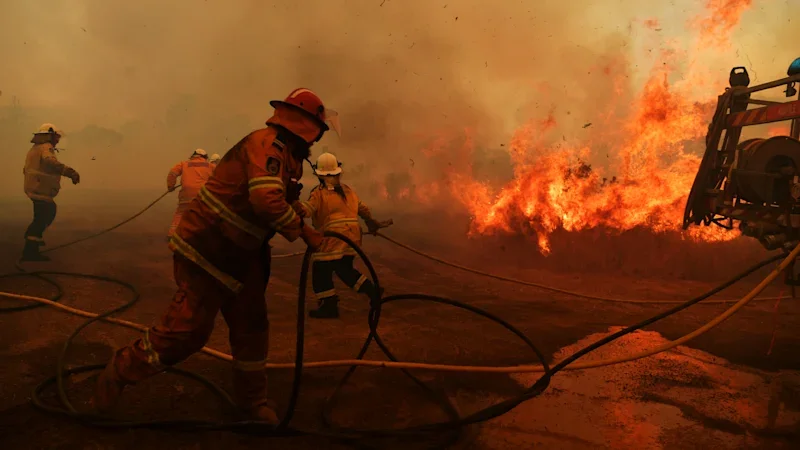
The system that carves up $102 billion worth of GST between the states and territories is so broken that a bushfire in NSW would deliver a multimillion-dollar financial windfall to the state with the strongest finances in the country while hurting every other part of the nation.
A scathing interim report by the Productivity Commission into the GST allocation system put in place by Scott Morrison in 2018 labels the deal a “mistake” that could end up costing federal taxpayers up to $12 billion a year or more than is spent on the nation’s air force.
As revealed by this masthead, the commission found the current allocation system is on track to cost federal taxpayers up to $60 billion and is failing all of its key objectives while making the annual GST carve-up less equitable and more complex.
The 2018 deal was put in place after a collapse in Western Australia’s share of the GST despite the state being in a domestic recession caused by the end of the decade’s mining boom.
Morrison, the then treasurer, came up with a new system that topped up Western Australia’s share until it received the equivalent of 75¢ for every dollar of GST notionally raised by the state. It would then change to the current system, where no jurisdiction can get a smaller share of each dollar raised than either NSW or Victoria.
A “no-worse-off” guarantee was put in place, which has been extended by the Albanese government, to 2030, that ensures the GST of every other state and territory is not reduced.
The Productivity Commission report, delivered to the nation’s treasurers on Friday, found the 2018 deal had effectively created a two-tier GST allocation system where only one state – Western Australia – got ahead.
Commission deputy chair Alex Robson said the GST system was meant to deliver each state and territory enough cash so they could provide similar levels of services and infrastructure to their residents.
Instead, the 2018 reforms had undermined that principle while also not working as the Morrison government had expected.
“The 2018 changes tried to achieve too much and moved too far away from the system’s core objective,” he said.
“The result is a system that is now more complex, less consistent and more costly. If the government wants to support other objectives, they could do so outside the GST distribution system.”
The commission found the 2018 changes had created perverse outcomes, almost all of which benefit Western Australia at the expense of the rest of the federation and federal taxpayers.
Commissioner Angela Jackson said under the pre-2018 allocation system, if NSW suffered a substantial bushfire, then it would receive extra GST to deal with the disaster’s impact. That extra money would come from every other state and territory.
But that has been upended by a “perverse” system under which NSW’s share of the GST is a floor, below which no other state or territory’s share of the tax can fall. That means Western Australia gains a windfall from a NSW disaster while the government of NSW would receive slightly less.
“Under the current system, if New South Wales is hit by a natural disaster and spends money on the recovery, it receives more GST to reflect its increased need,” she said.
“But under the standard state benchmark, Western Australia also receives more GST from the other states, for a natural disaster it didn’t have.”
Victoria could end up in the same position as NSW if, as expected, its share of GST declines over the next few years.
Not only is Western Australia better off from a NSW bushfire, an increase in the price of iron ore – which would previously be shared among the rest of the federation – means it could keep the windfall from higher mining royalties and enjoy an increase in the GST pool.
If iron ore prices, currently around $US95 a tonne, were to climb towards $US200 a tonne, then under the 2018 system the annual cost to federal taxpayers of not leaving states and territories worse off would reach $12 billion.
The 2018 system has delivered Western Australia so much extra revenue that the federal government would have to find $47 billion in a single year to share with every other jurisdiction to match Western Australia’s financial position.
The commission’s report also rejects claims by the WA government that the old GST system encouraged states not to undertake major economic reforms, finding there was no evidence of the practice.
The WA government is demanding no changes to the 2018 deal while both the Albanese government and Taylor opposition have said they support the current system.
The Productivity Commission, however, has offered three possible changes. They include returning to the pre-2018 system but with the federal treasurer able to direct the Commonwealth Grants Commission, which calculates the annual GST carve-up, to take into account situations where a single state may have a dominant financial position in a particular part of the economy.
This would enable the commission to discount the way WA is effectively the only producer of iron ore, or how Queensland and NSW are the largest producers of black coal.
Another option is to return to the pre-2018 system with the federal government then making direct grants to WA to offset its small share of the GST.
Before the report’s release, Prime Minister Anthony Albanese reassured West Australians they would continue to get a “fair deal” under the GST system.
“I assure Western Australians of this – you will get your fair share because your work and what you contribute to the national economy really counts,” he said.
“The Commonwealth picks up the additional costs to the states and territories. The no worse off guarantee to the states and territories ensures WA has got additional funding, but not at the expense of other states and territories.”
The commission plans to hold hearings into its interim report through September, with a final report due by year’s end.