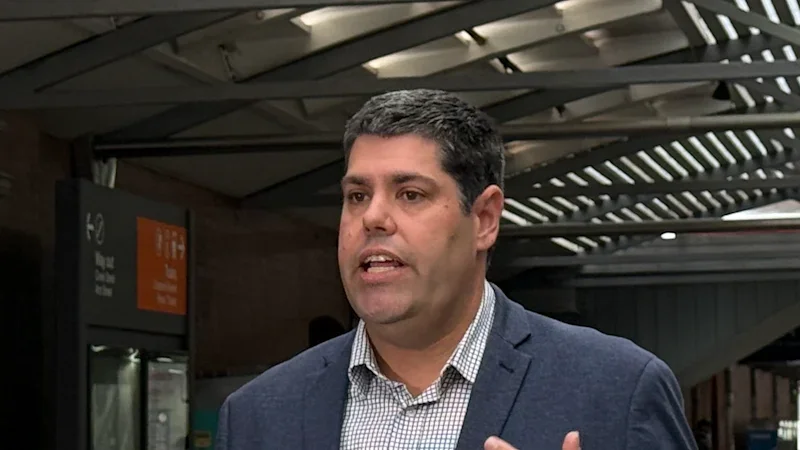
Queensland Rail will reintroduce some peak services from next Monday, with Transport Minister Brent Mickelberg praising workers who went against the union to perform network maintenance.
An extra 135 services will be added to morning and afternoon peaks across south-east Queensland after the maintenance backlog, from weeks of protected industrial action, was partially carried out.
Queensland Rail issued “no work, no pay” notices, which enticed some striking workers back on the job.
“I want to acknowledge those workers, in particular, who, in spite of that protected industrial action, have come back to work – a number of them,” Mickelberg said.
“That has allowed us to restore some of these services.”
Rail, Tram and Bus Union Queensland branch secretary Peter Allen said the restored services were “something that could have been done some time ago” and he was hopeful the industrial dispute could be settled as soon as next week.
“The RTBU paused all industrial action in maintenance some months ago as we worked hard to land a deal and to keep the trains running,” he said.
“I want to thank all of the commuters for their patience and support as our members were bargaining to protect their important workplace conditions and make sure they didn’t see their living standards go backwards.
“The good news is that we’re very close to reaching in-principle agreement across all of the areas in Queensland Rail that we’ve been bargaining for.”
“It’s been a hard fought campaign against a tough government and we are very near the end.”
Comment has also been sought from the Electrical Trades Union, which along with the RTBU has been at the forefront of the dispute.
Five more unions have also been involved in the enterprise bargaining.
Queensland Rail corporate affairs manager Nev Conway said QR remained committed on reaching a “fair and reasonable” deal with unions, in line with community expectations, to get all workers back on the job and a return to full services.
“The reduced timetable is still in place, but we have added these extra peak services as soon as we could, and this represents a step towards a full timetable,” he said.
“Unions are still taking protected industrial action with rolling work stoppages and a ban on overtime, but we wanted to show our customers that we are committed to delivering the very best we can in these frustrating circumstances.
“There’s still progress to be made to get back to a full timetable and that will only come when we can get all union action lifted, work out a deal, and get through the maintenance backlog.”
Tensions have been simmering since late March, when train controllers stopped work for coal and mineral freight trains – a carve-out Queensland Rail would not allow.
This led to major passenger train delays, which the Fair Work Commission blamed on Queensland Rail. A day later, the ETU joined the RTBU in taking protected industrial action.
Three of the disputed EBAs – the Administrative, Professional and Technical (ASPT) Enterprise Agreement; the Travel and Tourism and Other Employees Enterprise Agreement; and the Station Operations Enterprise Agreement – have reached in-principle agreement.
Conditions included an 8 per cent wage increase over three years plus an additional cost-of-living relief payment of up to 2.5 per cent over three years, in line with the Queensland government-owned corporations wages policy.
There will also be a strategic delivery allowance, an incentive to deliver major projects, and backpay from June 1, 2026.
The remaining agreements being negotiated were the Train Control Enterprise Agreement, Network Enterprise Agreement, Rollingstock and Operations Enterprise Agreement – and a proposed electrical-only agreement being pushed by the ETU.
“We are making progress on those negotiations – we have agreed in principle on three of the six agreements, approximately 3000 workers,” Mickelberg said.
“There’s still plenty more work to do, and Queensland Rail will continue to work through those issues, but my message to the union bosses is: withdraw the protected industrial action and avoid additional impacts on commuters.”
More: