“Taran, do you know who designed the Indian National Flag?” Appa was driving down M.G. Road in Vijayawada.
“I know,” said Taran confidently. “We were discussing this in school just last week. It was Pingali Venkayya.”
“Amazing. Good to know your school fees is not being wasted and you are learning something. But sometimes books and the Internet are not enough. That’s why we have museums.”
History comes alive
Amma nodded. “That too, a museum with a spot in history: Bapu Museum. First known as Victoria Jubilee Museum, it was built to commemorate Queen Victoria’s reign. Ironically, it became a place for freedom fighters to hold meetings.”
“Wow, it looks like a mini-palace,” said Taran, looking at the grand stone building with large arched windows and pillars.
“That was the colonial architecture of the time,” said Appa. He stepped aside to ask about the freedom struggle section. The lady at the ticket counter nodded and said, “3D Mural.”
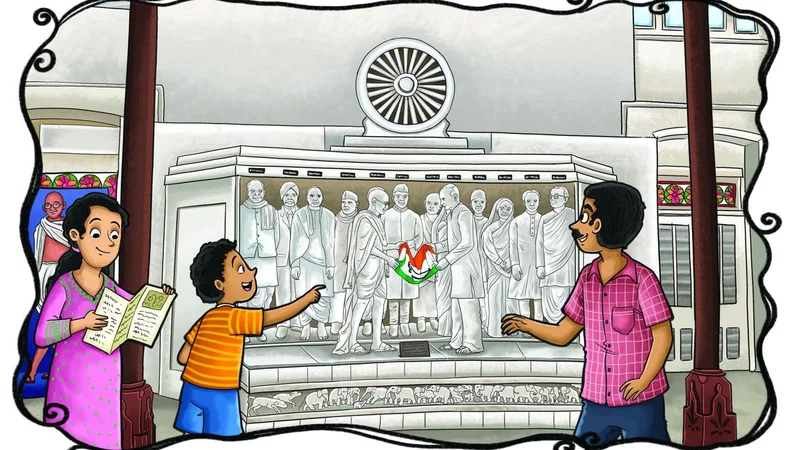
They walked through the cool halls looking at the historical artefacts. There were many galleries, but Taran was eager to see the Pingali Venkayya section. He soon spotted a mural where Venkayya was handing over India’s National Flag to Gandhiji.
“This happened in 1921. Vijayawada was one of the hubs of political activity and Gandhiji had already visited it many times to address gatherings and rally the masses to participate in India’s freedom struggle. It was the peak of the non-cooperation movement. Gandhiji requested Venkayya, a freedom fighter and agriculturist, to come up with a design for the Indian National Flag.
Taran tilted his head. “This flag looks a little different.”
Spot the difference
“Right you are, young man,” said the guide. “The mandate was to design a flag with the colours red and green to symbolise that India was a nation for both Hindus and Muslims, with a spinning charkha in the middle to signify self-reliance. Venkayya-avaru understood the assignment, came up with a design and showed it to Gandhiji here. It is said Gandhiji liked it.”
Taran looked around. There were displays about the evolution of the Indian National Flag. “Pingali Venkayya’s flag was slightly modified: red became saffron, white was added in the middle to include people of all other religions, and the charkha was replaced by the Ashoka Chakra signifying constant dynamic progress,” Amma pointed out.
“So much thinking behind a flag; I never thought about it,” he smiled, standing before the bust of the man who designed the Indian National Flag. “Thank you, sir,” he added and saluted.
Published - August 14, 2026 09:29 am IST