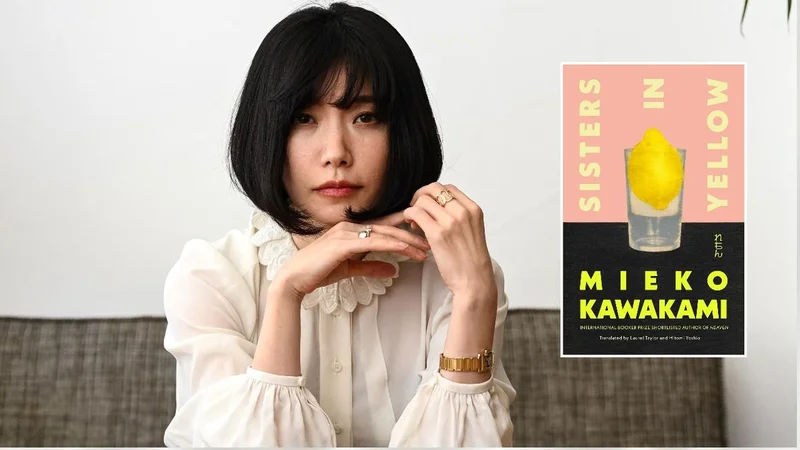
In the hyper-modern city of Tokyo, which glows like a disco ball at night, there is no shortage of places to drink — pubs, cabaret clubs, host clubs, lounges, and more. Long ago, Mieko Kawakami worked in a bar, keeping men company as they drank, and has joked that she graduated from “hostess university”.
In a piece in London’s Financial Times, Kawakami wrote, “I get the sense that all that matters about being in — or moving through — society came to me via the people and the ways of this world at night.” It is the people of this world — four nocturnal women — that the International Booker Prize-shortlisted author and poet brings to life in her latest novel, Sisters in Yellow, translated from the Japanese by Laurel Taylor and Hitomi Yoshio.
The world is stacked against these women — Hana, Kimiko, Ran and Momoko: if they suddenly disappeared, few would know or care. They live in a run-down house in the city, surviving on ramen and bento boxes from the convenience store. Their social life revolves mostly around McDonald’s. When they are not working or looking for work, they spend their days watching television shows, the canned laughter providing a steady distraction from their dreary lives. And when life batters them with wave after wave, they find new ways to stay afloat, holding each other up.
This is a novel about the brutality of life, but its focus on the power of sisterhood and the unbridled optimism of youth keeps it from becoming overwhelmingly bleak.
Dreams and reality
Sisters in Yellow begins as a thriller. At 40, Hana discovers from a newspaper article that her older friend Kimiko, who she hasn’t been in touch with for decades, has been charged with “blackmail, abduction, and battery”. The mention of Kimiko — a helpful and caring friend of Hana’s mother, but always inscrutable — sends Hana into a spiral, and the past threatens to swallow her whole. Reading the article takes her, and us, back to her youth in the 1990s, when she ran away from her cramped, unlit house and unreliable mother.
With a stroke of luck, at just 15, Hana begins running a seedy bar with Kimiko. Hana names the bar Lemon, inspired by her belief in feng shui, where yellow signifies prosperity. Every night, Lemon fills up with smoke, drinks flow freely, and people sing karaoke, giving Hana joy and a sense of purpose she has not known before. When she meets two other girls close to her age, Ran and Momoko, she convinces them to work at the bar too. Hana thinks, “This... must be what they mean by the springtime of youth.”
But their run ends abruptly when Lemon burns to a crisp one day. Out of a job and desperate, the straight-laced Hana finds herself making questionable decisions. She continues to hope that she will somehow be able to reopen Lemon with her chosen family.
Slowly, the novel turns into an indictment of inequality. Money is elusive for the poor, and when it does come into their hands, it disappears quickly — sometimes spent, sometimes stolen. Hana’s “yellow corner”, her small patch of hope, gathers dust.
An imperfect novel
Sisters in Yellow is a slow-burn, less interested in plot twists than in immersing the reader in its setting. In this, Kawakami is wonderful — you can smell the despair in the yellow paint that Hana uses to cover a wall, feel the warmth of hot hand towels in the bar, and taste the tantalising possibility of Hana’s escape with her “sisters”. There is sisterhood in the making of the novel too. The writer and translators are all women, and together, they capture not only the texture of late-90s culture, but also the intimate worlds of the women.
It is when Kawakami slips into little lectures that the novel becomes overly didactic. En, a woman running a restaurant, tells Hana about money one night: “Save your own, all your own, save it and save it, and just sip off the top to make ends meet... ‘Cause there’s no guarantee or promises in this life.”
Elsewhere, Kawakami writes, “People with money make the rules to help themselves, and poor people get sucked dry. And when you’re all dried up, when you’re nothing but dregs, they make you think it was your fault you failed at life.”
The overly long exposition also gets tiring, especially when Kawakami curiously delves into details such as the mechanics of credit card fraud or gives us character backgrounds that feel tangential to the story.
The novel is expansive, often rambling, yet gripping. Despite its flaws, I find myself dipping into its world days later. Perhaps it is Kawakami’s storytelling and her profound understanding of the world she writes about that makes it a powerful portrait of despair, while hope continues to shine in every corner. Or, perhaps, it is simply Hana, forever trying to make the best of what she has.
Sisters in Yellow
Mieko Kawakami, trs Laurel Taylor and Hitomi Yoshio
Picador
₹799
radhika.s@thehindu.co.in
Published - August 14, 2026 09:48 am IST