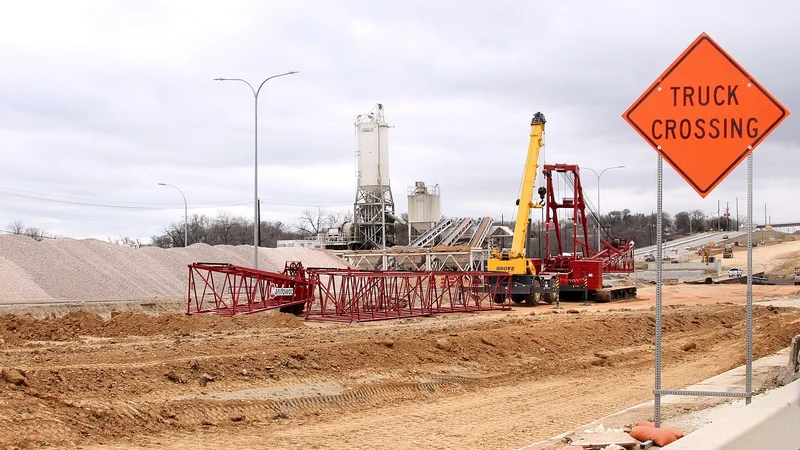
Cemex Wins Nearly US$38 Million From the UK Over an HS2 Land Taking
Mexico · Business
It took five years and a specialist tribunal. But the Mexican cement maker finally pinned a price on the Birmingham factory the British state took to build its high-speed railway.
Cemex has won almost US$38 million from the British government after a specialist tribunal ruled on what it was owed for a Birmingham factory site seized to build the HS2 high-speed railway. The Upper Tribunal set the compensation at about £29.9 million plus interest.
So a five-year argument over the price of losing a working site is now settled.
What Cemex actually won
The Upper Tribunal (Lands Chamber), a specialist UK court for land disputes, awarded Cemex about £29.9 million, or roughly US$38 million. On top of that headline sum the tribunal added statutory interest, so the bill keeps building until the government pays.
The award covers the money Cemex says it lost once a profitable site was taken out of its hands.
The site the state took for HS2
The land in question sits at Washwood Heath in Birmingham, in the industrial heart of England. Back in 2020 the government compulsorily acquired the site because it needed the ground for HS2, Britain’s long-delayed high-speed rail project.
Compulsory purchase lets the state buy land for big schemes even when the owner would rather keep it. So long as it pays fair compensation.
Live Company IntelligenceCemex SAB de CV ADR — the full investor dossier
Wall Street view
10Buy
5Hold
0Sell
$14.75· +25% vs 200-day
Valuation & profitability
Price & risk
$8.3752-wk high
$13.64
Revenue trend · 6y
$16.13B
Ownership
Dividend
What Cemex does.CEMEX, S.A.B. de C.V., together with its subsidiaries, engages in the production, marketing, distribution, and sale of cement, ready-mix concrete, aggregates, urbanization solutions, and other construction materials and services worldwide. It offers gray ordinary portland, white portland, and blended cement products; masonry or mortar products; standard ready-mix, architectural and decorative, rapid-setting, fiber-reinforced,…
Why the fight was about money, not land
Cemex never got to keep the site, since that part was settled once the government invoked its powers. Instead, the real dispute was how much the taxpayer owed for the business Cemex could no longer run there.
Because the two sides could not agree on a figure, the question went to the tribunal to decide.
What the Washwood Heath plant made
This was not an empty lot; it was a working industrial plant with real output. Its main business was making concrete railway sleepers, the heavy beams that hold train tracks in place.
Cemex also ran aggregates and asphalt operations there, the gritty raw materials that feed roads and construction.
How the tribunal reached the Cemex figure
The £29.933 million fixed by the tribunal covers the loss tied to the railway sleeper business. Working out lost profit means estimating what the plant would have earned for years had it kept running.
Both sides brought experts and rival numbers, and the tribunal weighed them before settling on its own.
The people who decided the case
The decision came from Upper Tribunal Judge Elizabeth Cooke, sitting alongside a chartered surveyor, Peter McCrea. Pairing a judge with a valuation expert is normal in the Lands Chamber, because the arguments turn on property numbers.
Their written decision, cited as [2025] UKUT 376 (LC), was handed down on 18 November 2025.
What the statutory interest adds
The award is not simply the £29.9 million, since interest runs on top from the date the land was taken. After five years, that interest can add a meaningful slice to whatever the government finally hands over.
In short, it is the law’s way of making up for the years Cemex waited without its money or its site.
Why this matters beyond Cemex
The ruling lands while Britain keeps taking private land for HS2 and other large public schemes. It is a reminder that compulsory purchase is no bargain for the state, because fair compensation can run into tens of millions.
For other firms facing the same squeeze, therefore, a clear tribunal award sets a useful marker.
Who Cemex is
Cemex is one of the world’s largest building-materials companies, with its home base in Monterrey, Mexico. It makes cement, concrete and aggregates across dozens of countries, and it has run a UK arm for many years.
Next to that global business the Washwood Heath award is a small line, yet it is still a clean win.
What happens next
Now that the figure is set, attention turns to payment and any wrap-up over interest and costs. Neither side has flagged a further appeal in the public reports, so the tribunal’s number looks like the end of the road.
For Cemex, meanwhile, it closes a chapter that began the day the diggers arrived for HS2.
Frequently Asked Questions
How much did Cemex win in the UK case?
The Upper Tribunal awarded Cemex about £29.9 million (roughly US$38 million) plus statutory interest for the compulsory purchase of its Washwood Heath site.
Why was Cemex’s site taken?
The government compulsorily acquired the Birmingham site in 2020 to build HS2, Britain’s high-speed railway. And the dispute was over how much compensation Cemex was owed.
What did the Washwood Heath site do?
It was mainly a factory making concrete railway sleepers, and Cemex also ran aggregates and asphalt operations at the same location.
When was the ruling made?
The Upper Tribunal (Lands Chamber) handed down its decision, cited as [2025] UKUT 376 (LC), on 18 November 2025.
This article was produced by The Rio Times’ automated newsroom system. How we use AI · Report an error