After almost five decades in the aviation business flying to all corners of the globe, I can assure you that some of the most complicated parts of any journey are not the actual flying but the taxiing to and from a busy runway.
I was the captain of an A380 lined up on a runway on the north complex of Los Angles (LAX) waiting for my take-off clearance when another aircraft landing on the parallel runway turned off and crossed the runway I was lined up on. As that “intruder” aircraft entered my runway all the lights on the ground in front of me turned bright red, leaving me in no doubt it was unsafe to take off. In this example, no one was at fault as I had not yet received my take-off clearance and air traffic control (ATC) had cleared the other aircraft to cross in front of me. But I was grateful for the automated back-up system just in case a super-busy human made a mistake.
I have flown into and out of Sydney Airport 1055 times according to my logbook, and I have to say the system of monitoring ground movement of aircraft, on active runways and taxiways, is not as good as I’ve seen in places like LAX.
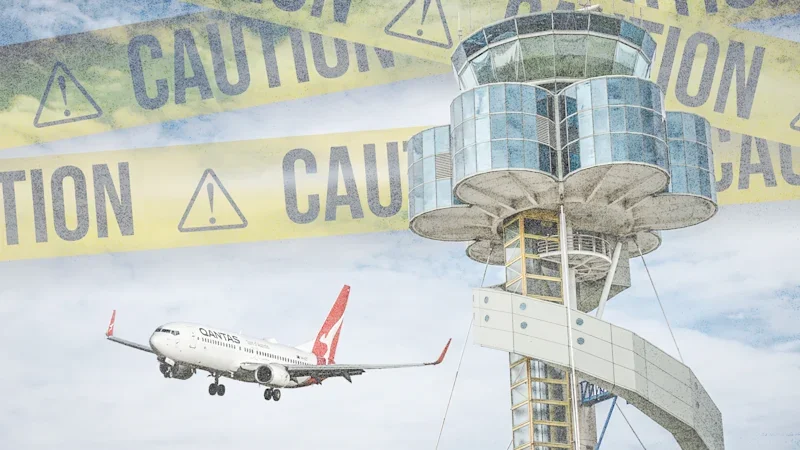
By all reports, it was the pilots of the Virgin 737 who saw the Qantas 737 crossing the runway it had been cleared to take off on last Sunday – the third incident in recent weeks. But what if they hadn’t, or there was low visibility?
Almost all aspects of modern aviation are standardised, from departure to climb out to cruise, and then descent and approach to land. Doesn’t matter if it’s Sydney, London or New York. All aspects of the flying sequence have become standardised to such an extent that – barring weather or unforseen circumstances – a pilot follows a very prescribed procedure.
Those daring young men and women in their non-flying machines at air traffic control co-ordinate this aerial ballet to achieve a safe standard of separation between aircraft. It’s a complex task, so to help human air traffic controllers, modern ATC systems have various electronic alerts to warn if safety standards are compromised or if an error has brought aircraft too close together.
What’s not standardised is the airport complex itself. Every airport is different and some are way more complicated than others. On the ground, an airport is usually divided into two distinct parts – runways and taxiways. Any movement on or in the vicinity of an active runway is managed by a controller on an ATC Tower frequency. To add a little more complexity, in Sydney’s case there are two Sydney Tower controllers for each of Sydney’s parallel runways.
Conversely, aircraft moving around the taxiways are under the control of another ATC group known as Surface Movement Control. Those in charge of ATC ground movement also have a separate radio frequency and go by the call sign of Sydney Ground. As there are separate parts of the airport and radio congestion increases with an increase in traffic movement, those roles can be divided into more than one ground frequency.
To get from the terminal to your take-off runway or from your landing back to the terminal, a pilot may need to speak to up to four or five different ATC individuals. All these controllers must co-ordinate with one another as your aircraft may have to cross active runways and avoid other aircraft trying to do the same thing.
Added to the mix are aircraft under tow, which we saw in the case of the second near-miss at Sydney, with a Qatar 777 almost colliding with a Jetstar A320. Sometimes an aircraft needs to move from a terminal gate to some other place on the airport complex. This could be to a maintenance hangar or to a remote parking space, as the aircraft may have a long layover before its next flight. The tug driver is a highly skilled and trained person who is also in contact with ATC and is required to follow ATC instructions when on the move.
If it all sounds ridiculously complex, that’s because it is. When an aircraft is airborne, there is a collision avoidance system that provides an audible warning if a plane is on a collision course with another aircraft. Three near-misses in recent weeks at Sydney Airport are also audible warning that it’s time to take a better look at the collision avoidance systems we have on the ground.
Yes, lots of air traffic controllers were laid off during COVID, and experience is hard to replace. But in an industry like aviation, redundancies need to be factored in after redundancies take place, for the safety of everyone involved.
As our Australian airspace continues to expand and congestion at our major airports increases, it’s time for CASA to investigate this type of safety system to help aid those hard-working and understaffed air traffic controllers who do a damn fine job under difficult circumstances, where the cost of a mistake is catastrophe.