Paul Jones / Android Authority
Last year’s Samsung Galaxy Z Fold 7 was a remarkably well-built phone, with the lack of S Pen support perhaps being the only blemish on a notably upgraded hardware package. Still, spec enthusiasts were perhaps left wondering whether the $2,000 asking price was too steep, given that the less expensive Galaxy S25 Ultra and now the Galaxy S26 Ultra offer faster charging, longer battery life, and superior camera specs.
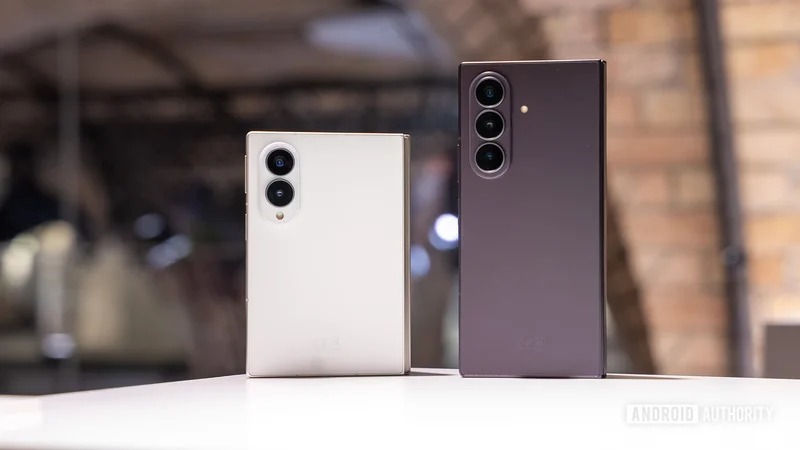
Samsung appears to have heard the call. For those clamoring for even more hardware, we now have two booklet Samsung foldables to pick from — the Z Fold 8 and Z Fold 8 Ultra. Perhaps the only drawback is that this means the regular Z Fold 8 missed out on a few series staples (like the telephoto camera), and the price of the Ultra has gone up, making Samsung’s best hardware even more expensive.
Let’s dig into the differences to see which of the two new Folds is the better buy. For an overview, I’ve included a full specs table of the Galaxy Z Fold 7, Z Fold 8, and Z Fold 8 Ultra.
| | | | |
| --- | --- | --- | --- |
| Model | Galaxy Z Fold 8 Ultra | Galaxy Z Fold 8 | Galaxy Z Fold 7 |
| Display Size | 8.0 inches, QHD+ | 7.6 inches, QHD+ | 8.0 inches |
| Display Brightness | 3000 nits (peak) | 3000 nits (peak) | 2600 nits (peak) |
| Front Display | 6.5 inches, QHD+ | 5.5 inches, QHD+ | 6.5 inches, QHD+ |
| SoC | Snapdragon 8 Elite Gen 5 for Galaxy | Snapdragon 8 Elite Gen 5 for Galaxy | Snapdragon 8 Elite for Galaxy |
| RAM | 12 GB (up to 16 GB on 512GB/1TB) | 12 GB | 12 GB (up to 16 GB on 1TB) |
| Storage | 256 / 512 GB, 1TB | 256 / 512 GB, 1TB | 256 / 512 GB, 1TB |
| Main Camera | 200 MP, f/1.7, 24mm, 1/1.3-inch | 50 MP, f/1.9 | 200 MP, f/1.7, 24mm, 1/1.3-inch |
| Ultrawide Camera | 50 MP, f/2.2, 13mm, 1/2.5-inch | 50 MP, f/1.8 | 12 MP, f/2.2, 13mm, 1/2.55-inch |
| Telephoto Camera | 10 MP, f/2.4, 67mm, 1/3.94-inch (3x zoom) | N/A | 10 MP, f/2.4, 67mm, 1/3.94-inch (3x zoom) |
| Battery | 5,000 mAh | 4,800 mAh | 4,400 mAh |
| Charging Power | 45W (65% in 30 min) | 45W (65% in 30 min) | 25W (50% in 30 min) |
| S Pen | No | No | No |
| Weight | 215 g | 201 g | 215 g |
Are the camera upgrades worth it?
Paul Jones / Android Authority
During our Galaxy Z Fold 8 briefing, Samsung was keen to point out that the Ultra model now uses the same sensors as the Galaxy S26 Ultra, hinting at truly game-changing photography capabilities.
In truth, the Z Fold 7 already shared a good deal of its mainstream flagship’s best camera features — namely, the 200MP primary sensor and the 10MP 3x telephoto lens. This year’s big upgrade, then, is in the ultrawide package, which jumps from 12MP to 50MP, though you’ll still get 12MP snaps.
It’s worth noting that the sensor size isn’t really any larger, and the lens apertures remain the same. The new ultrawide sensor might improve performance through newer HDR techniques and improved manufacturing, but I’d lean towards incremental rather than a massive overhaul.
While snapping better ultrawide pics is obviously a nice win, I would have preferred to see a more meaningful upgrade to the comparatively tiny 1/3.94-inch telephoto camera. Even in the Galaxy S26 Ultra, the small sensor has several limitations compared to the larger, 200MP sensors that have proven their performance in China’s best Ultra flagships. Perhaps Samsung never intended to introduce a brand new sensor for the Fold series, but this is an area I think the brand needs to seriously look into to improve its flagship photography versatility.
"Samsung's ultrawide camera sees an upgrade, but is that enough to catch the best?"
Unfortunately, the high-end camera upgrades only apply to the Z Fold 8 Ultra. The regular Z Fold 8 actually sees its camera package downgraded compared to the Z Fold 7. The 200MP camera is replaced by a smaller 50MP, f/1.9 package paired with a 50MP, f/1.8 ultrawide. There’s no telephoto for zoom snaps at all. We don’t know exactly which sensors these are, but the primary snapper could well be a close sibling of the setup found in the Galaxy S26 and Z Flip 8, but with the benefit of a sharper ultrawide.
Personally, I’m not a huge fan of ultrawide cameras. I’d rather have the ability to crop in on distant subjects and a natural focal length for portraits than fit more in the frame. But in a thin design (the Z Fold 8 is just 4.5mm unfolded), there’s not much room for a telephoto without a larger camera bump. If you really like to zoom, you’ll want the Ultra.
Battery and charging are the biggest wins
Hadlee Simons / Android Authority
When comparing the Z Fold 8 to last year’s model, the most obvious upgrades are undoubtedly found in the battery and charging departments.
First, the battery capacity upgrade, while perhaps not quite as impressive as some of the 6,000mAh silicon-carbon cells we’ve seen in some recent foldables, is a much-appreciated step in the right direction. In the Ultra, the upgraded 5,000mAh cell represents a 14% boost to battery life. Coupled with the supposedly more efficient Snapdragon 8 Elite Gen 5 for Galaxy, this could be a potent combination that builds on already solid battery life.
Even the regular Galaxy Z Fold 8 benefits. Its larger 4,800mAh battery should last about 9% longer than its predecessor.
"Bigger batteries and faster charging are practical, welcome upgrades."
Improvements in charging power have also caught my eye. While not the cutting-edge 60W capability found in the Galaxy S26 Ultra or Motorola’s 80W Razr Fold, adopting 45W charging across both Z Fold 8 models is a notable upgrade over the rather meager 25W of their predecessor. This puts the phones more in the mix with other high-end rivals in terms of power and, when paired with those larger batteries, should make keeping Samsung’s foldables topped up far less anxiety-inducing.
We’ll have to test these phones to see if they can sustain 45W for long enough in this ultra-thin frame to make a meaningful difference to total charge times. But Samsung’s claim that the phones can reach 65% after just 30 minutes on the charger appears to be a decent improvement over last year’s 50% in the same time frame.
A new paradigm for Samsung’s foldables
While Samsung’s S line has come in for criticism for a lack of innovation in recent years, we can’t say the same about the Galaxy Z Fold range. Though series fans may still be mourning the S Pen, year by year, Samsung has packed more and more into its most expensive smartphones.
The brighter, creaseless display is undoubtedly nice, but it’s the everyday hardware improvements that really make a big difference to how a phone feels after months and years of use. The bigger batteries and faster charging might not be as glamorous as the camera or display tweaks, but they will change what it feels like to use a foldable every day in more meaningful ways. Samsung has already done a good job of squeezing every last drop out of previously smaller batteries, but now the phone should feel even more comfortable to use without carrying a power bank.
This year’s improvements also pack more punch, but perhaps the bigger talking point this year is the difference between the Z Fold 8 and Ultra models. Samsung appears to have taken a page from the S-series playbook. Rather than giving every Fold flagship the best camera hardware, it’s reserving those features for the Ultra. That creates clearer product differentiation, but it also means buyers have to spend considerably more to get the complete flagship experience.
Paul Jones / Android Authority
The good news is that the core battery improvement applies to all models. However, the Z Fold 8 is a clear downgrade from the Z Fold 7 in terms of camera performance. Fortunately, it’s a little cheaper than last year, but given that cameras are such a huge part of most buyers’ checklists, the higher price of the Ultra will feel like a raw deal compared to last year’s pricetag.
Samsung’s booklet foldables were already expensive, and although the regular Z Fold 8 is a fraction less expensive than its predecessor at $1,900, it’s not cheap enough to make the phone feel like a drastically different value proposition, even with the new display format. The Galaxy Z Fold 8 Ultra is undoubtedly the better, premium flagship foldable if you want the best all-around experience Samsung can offer — and at $2,100, it isn’t dramatically more expensive either. The hardware upgrades make the Ultra the best Fold ever by some margin, but the price hike will be hard to swallow, regardless.
Thank you for being part of our community. Read our Comment Policy before posting.