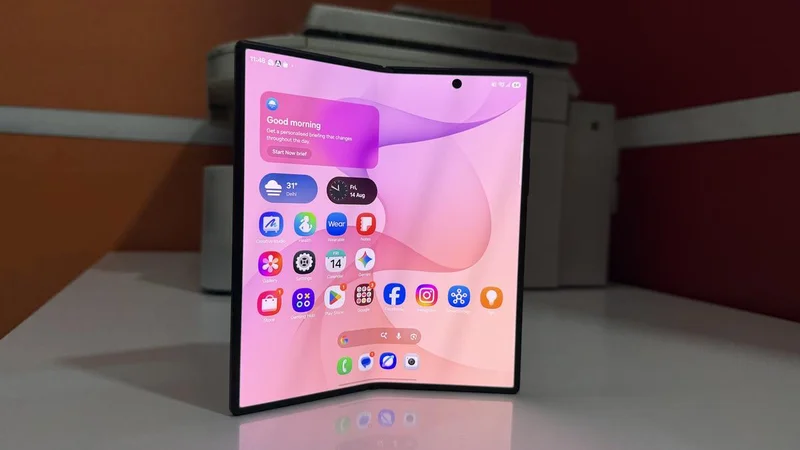
If the Samsung Galaxy Z Fold 8 made headlines with its unique passport-style identity, the Galaxy Z Fold 8 Ultra takes the foldable game a step further. The finesse and comfort Fold 8 Ultra offer make it feel like a phone you can comfortably use as your primary device every day. Priced at ₹1,99,999, it enters the super-luxury segment and costs ₹25,000 more than the Galaxy Z Fold 7, which launched at ₹1,74,999.
The price jump is significant, but Samsung has also brought meaningful upgrades, including an improved camera system, a bigger battery and a more refined hinge. So, the question remains whether the upgrades are justified or not, if you want to buy the Samsung Galaxy Z Fold 8 Ultra over the Fold 7. Let’s find out.
Design
I have been reviewing Samsung’s foldable phones for quite some time, and with the Galaxy Z Fold 8 Ultra, it finally feels like Samsung has sourced the right ingredients. The phone has excellent weight distribution and sits comfortably in one hand. In fact, it is so well designed that you can use it with just one hand without feeling like you are handling a bulky foldable. At 215 grams, the weight remains the same as the Fold 7, while the phone is just 4.1mm thick when unfolded, and 8.9mm when folded. It easily slips into the pocket of a pair of jeans and barely feels noticeable. What makes it even more impressive is that, from a distance, it looks almost like a regular slim smartphone rather than a foldable.
Overall, the design language sticks to the predecessor, the Samsung Z Fold 7, with similar controls. This year, Samsung has shifted to a titanium plate in the phone to make it more durable. And it does feel solid and sturdy. The hinge mechanism projects the main screen quite effortlessly. Remarkably, the centre crease is rarely visible. The phone is protected by Corning Gorilla Glass Ceramic 3 on the cover and Corning Gorilla Glass Victus 2 at the back. It is also IP48-rated for water and dust protection.
Display
The 6.5-inch FHD+ Dynamic AMOLED 2X cover display is the first thing you interact with, and Samsung has made it good enough that you won’t feel the need to unfold the phone for every task. It gets a 2520 x 1080 resolution, 422ppi and a 120Hz adaptive refresh rate, while the 3,000 nits of peak brightness keep content clearly visible even under bright sunlight. The taller format works particularly well for scrolling, checking messages, browsing and viewing portrait-oriented content. It feels like a proper smartphone display rather than a secondary screen, making the Fold 8 Ultra practical for quick, everyday tasks.
Open the phone and the 8-inch QXGA+ Dynamic AMOLED 2X main display takes over with a 2504 x 2256 resolution, 422ppi and a 120Hz adaptive refresh rate. It is easily one of the most immersive foldable displays available today, with rich colours, excellent contrast and impressive brightness. Content looks vibrant and detailed, while the stereo speakers make watching videos in landscape mode even more enjoyable. The crease is among the least distracting I have seen on a foldable. You can still feel it when you run your finger across the screen, but it barely interferes with viewing. The punch-hole camera can be noticeable with certain content. But overall, the inner display delivers an excellent experience for entertainment, reading, documents and multi-tasking.
Processor
The Galaxy Z Fold 8 Ultra runs on the Snapdragon 8 Elite Gen 5 processor and comes with One UI 9.0 based on Android 17 out of the box. It is the same processor found on the Galaxy Z Fold 8, and the 12 GB RAM on my review unit is more than enough to keep this multi-tasking-focused phone running smoothly. Qualcomm’s top-tier chip also does a good job with thermal management, keeping performance stable even during demanding tasks. Gaming is another area where the Fold 8 Ultra performs well, with stable frame rates and a smooth experience even during extended sessions.
One UI 9.0 takes the phone’s productivity capabilities a step further. Flex Mode lets you prop the phone up and use it almost like a mini laptop, while the larger inner display can accommodate up to three apps in a split-screen layout. Floating windows make it easier to move between apps without interrupting what you are doing. Samsung has also brought features from the Galaxy S26 series, including the Now Bar and Now Nudge. These features make notifications and alerts easier to access while also using information on the screen to offer more contextual suggestions, adding another layer of intelligence to the overall experience.
Camera
The camera setup is one of the areas where Samsung has made a meaningful upgrade with the Galaxy Z Fold 8 Ultra. It retains the 200 MP wide camera from the Fold 7, but the ultra-wide sensor gets a major jump from 12 MP to 50 MP. It is paired with a 10 MP telephoto lens offering 3x optical zoom, while the main sensor also supports 2x optical-quality zoom and up to 30x digital zoom. The wider f/1.9 aperture on the ultra-wide also brings 34% more brightness than the Fold 7, which comes in handy during low-light shots.
In daylight, the 200 MP primary camera captures images with plenty of detail, good dynamic range and Samsung’s familiar punchy colour profile. Photos look sharp and detailed, while the improved 50 MP ultra-wide does a much better job of retaining detail when you switch perspectives. The 3x telephoto is useful for portraits and distant subjects, although pushing the zoom further naturally brings some loss in detail. Portrait shots have good subject separation, while selfies from both the cover and main-screen cameras look natural, helped by Samsung’s upgraded AI image signal processing.
Night photography is another area where the Ultra performs well. The larger 200 MP sensor and brighter ultra-wide work with Samsung’s ProVisual Engine to improve detail, colour and noise control in low light. Video recording also gets a major boost, with 8K recording at 30fps and the ability to move between the wide and ultra-wide perspectives. Super Steady with Horizontal Lock is useful for keeping footage level when the camera moves. Overall, the camera system feels more complete than the Fold 7, particularly because the ultra-wide feature is no longer the weak link.
Battery
The Galaxy Z Fold 8 Ultra gets a 5,000 mAh battery, up from the 4,400 mAh unit on the Galaxy Z Fold 7. That is a meaningful jump, especially for a foldable with an 8-inch inner display. Samsung rates it for up to 27 hours of video playback. During real-world use, the Ultra comfortably handles a full day of streaming, gaming, scrolling and multi-tasking. Even with the larger screen being used extensively, I rarely found myself reaching for the charger before the day ended.
What makes this upgrade more impressive is that Samsung has managed to increase the battery capacity without adding to the phone’s weight. The 45W charging is reasonably quick, too, making short top-ups useful when you are in a hurry. It may not lead the segment in charging speeds, but the combination of larger capacity, efficient performance and all-day endurance makes the battery one of the Ultra’s more practical upgrades.
Verdict
After spending considerable time with Samsung’s foldables, the Galaxy Z Fold 8 Ultra feels like the most complete version of the formula so far. It is slimmer, comfortable to hold and surprisingly easy to use as your primary smartphone. The 8-inch inner display, powerful Snapdragon 8 Elite Gen 5, improved ultra-wide camera and larger battery make it more than just an expensive foldable. It is a device that can genuinely replace your regular phone while offering a larger canvas when you need it.
But does it justify spending ₹1,99,999? That depends on what you expect from a smartphone. The ₹25,000 jump over the Galaxy Z Fold 7 is significant, and this remains a luxury purchase. However, the Fold 8 Ultra addresses many of the compromises that once made foldables difficult to recommend. It is lighter on the hand, easier to carry and more practical in everyday use. If you want the best foldable experience Samsung currently offers and can afford the premium, the Fold 8 Ultra makes a strong case for itself.
Published - August 14, 2026 12:50 pm IST