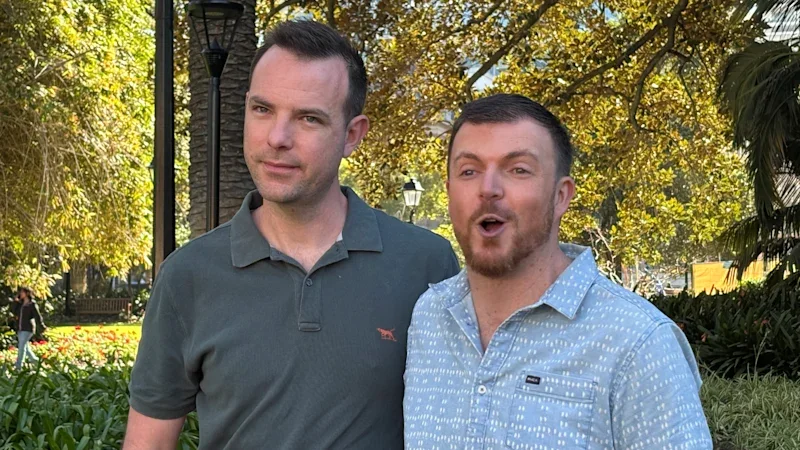
A gay couple have won a Supreme Court fight to have a baby via surrogate after a West Australian law prevented them from becoming biological parents.
Trent and Brad Dunn have now become the first same-sex couple to receive approval from the Reproductive Technology Council of WA to proceed with plans to become parents via surrogacy.
They took their fight to court three years ago when they were told the Surrogacy Act 2008 currently requires that couples accessing surrogacy be heterosexual.
New surrogacy laws are expected to take effect next year, but the couple challenged the laws as they stand, ultimately convincing the Court of Appeal that not allowing them to pursue surrogacy was discrimination because it breached federal anti-discrimination laws.
“This has been a really long journey for us and for our family, for our surrogate’s family, for our egg donor’s family, it’s been incredibly long,” Brad Dunn said on Friday.
“Western Australia is the last state to allow surrogacy for same-sex couples within Australia to be able to proceed and get treatment, and even with legislation being promised to be brought in, I believe some time next year, this has been something that’s taken a really long time, and every time we pleaded, every time we begged for it to happen, all we were responded with was just wait, be patient, it’ll come.
“And for a lot of people going through any type of treatment, any type of journey along the same lines, knows that time’s really precious, time’s really crucial. Just waiting and waiting and waiting all the time isn’t always an option, and that’s an incredibly hard thing to be told to do consistently.”
The couple have now started treatment with a surrogate and her wife and a separate egg donor.
“I want to also make it really clear that when we enter a surrogacy process … it’s about the over a year of counselling,” Brad said.
“It’s about the year of psychology assessments. It’s the medical tests. It’s the legal documents that you have to form to make every single decision before anything has even occurred.
“Every potential outcome that may occur has to be decided, and then you send that to a group of people you’ve never met to decide if they’re going to let you proceed down this path or not.”
He said the couple had met every criteria bar one – “and that was the fact that we were two men”.
“The only reason we couldn’t continue was because we weren’t a heterosexual couple, so we were deemed unfit in that legislation,” he said.
Their win now paves the way for other same-sex couples, and they have created a template document based on their surrogacy arrangement which others may be able to use.
“We know plenty of challenges still lie ahead of us, but we are overjoyed to be focused now on the wonderful opportunity of parenthood,” Brad said.