- How To Build A City by Gabriella Bennett (Headline Press £25, 336pp) is available now from the Mail Bookshop
One morning in June 2007, an Iraqi doctor and an engineer from Saudi Arabia drove a Jeep loaded with propane gas through the glass doors of Glasgow Airport’s departure lounge and straight into a huge concrete pillar . . .
Halted but undeterred, one threw petrol bombs into the crowd while the other doused himself in fuel and set it alight.
But the pillar’s delay allowed both the police and the public to react. This ‘unremarkable intervention that cost almost nothing to make’ meant that only five members of the public were injured, rather than hundreds who might have been killed.
This is just one of the many examples of architecture mitigating crisis in journalist Gabriella Bennett’s fantastic book. In her lyrically readable yet highly informative way, Bennett takes us on a two-year journey around the world, stopping at places of great beauty, loneliness and convenience.
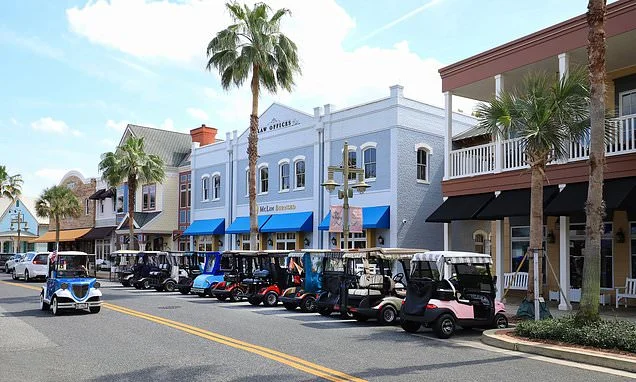
Cart life: Parked golf carts on a main street in The Villages, Florida
She begins in Glenrothes, Scotland, a purpose-built post-war new town where the art of David Harding and the architecture of community helped forge a neighbourhood for the miners employed by the Fife Coal Company.
We then discover the underground city carved out beneath Helsinki. Originally built during the Cold War, the expanse now houses shopping centres, swimming pools, go-kart tracks and almost a million beds ready to be set up within 24 hours of a Russian attack.
Much of Bennett’s findings relate to the threat of, or destruction caused by, war.
In Ukraine she not only visits the foundational ruins of residents’ houses, but also the architecture school that is training a new generation to rebuild the country.
In this section she writes vividly of the demolition of cities such as Kyiv and Lviv and the resilience Ukraine’s people are showing in the face of Russian brutality.
But there are moments of levity here, too. Bennett veers onto a tangent about The Sims – a life simulation computer game that has sold nearly 200 million copies.
An avid fan herself, Bennett understands the appeal of building a world and characters that you can control, especially when the world around you might feel uncertain.
It’s unexpected, but not entirely surprising, to learn that The Sims was created after game designer Will Wright’s home was destroyed in a Californian wildfire.
Equally, the Swedes have come up with an ingenious way of combating the effects of iron ore mining in the mountain on which a town, Kiruna, is built.
As the land breaks up and houses disintegrate, buildings such as Kiruna Kyrka, itself a 672-tonne church, are edged forward less than half a mile per hour on remote-controlled platforms welded to 228 wheels for over two days until they reach a safe enough distance.
This is not a permanent solution, but works well enough to keep the buildings safe for a few years.
Bennett also challenges herself to spend 24 hours in Tokyo without speaking to another human when a robotic or automated option is available. It’s easy as it turns out.
Where this would be impossible, however, is in The Villages, Florida. A huge retirement community, where the preferred mode of transport is the golf cart (their churches have been modified for ‘drive-by worship’ in the carts), and everyone knows everyone a little too well. Swingers abound and sexually transmitted diseases are said to be rife...
Despite the title, this insightful study is not a ‘how to’ guide for laying out streets, parks and hospitals. Instead it is a story of resilience, strength and humanity’s innate resourcefulness.