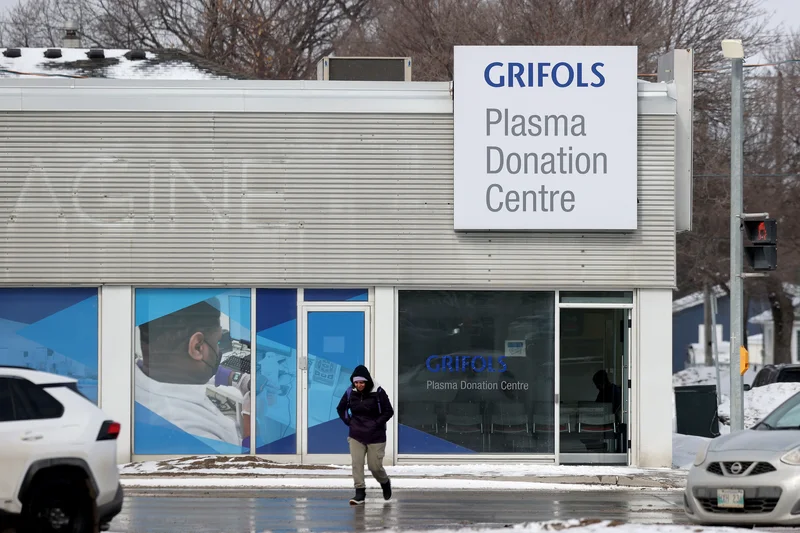

A Grifols plasma donation centre in Winnipeg.Shannon VanRaes/The Globe and Mail
Health Canada says it did not consult the work of its own inspectors when writing a medical summary that said a young woman’s death in October last year had no connection with the plasma donation she was undergoing when her heart problems started.
The agency’s internal medical summary of the young plasma donor’s death in Winnipeg was based on information provided by Grifols, the plasma collection company, and an autopsy, but did not include information about problems Health Canada inspectors found with Grifols’ operations after the donor’s death, a spokesperson for the department said.
The revelation is raising fresh concerns from the donor’s family and from a member of Parliament about how thoroughly Health Canada evaluated the death.
The donor, Rodiyat Alabede, a 22-year-old university student in Winnipeg, died as a result of a sudden cardiac issue. Her heart problems began while she was about 45 minutes into a plasma donation at a site operated by Grifols, Canada’s only major commercial collector of plasma. She was taken by ambulance to hospital, where she was pronounced dead.
Grifols lifted plasma-donation ban despite disease concerns, Health Canada report shows
Plasma is a golden-coloured fluid found in blood that is manufactured into high-demand medicines such as immunoglobulin, which can be used for patients with immune deficiencies. Grifols operates in Canada as part of a partnership signed with Canadian Blood Services. Grifols pays donors, while CBS does not.
In early April, Health Canada announced it had put terms and conditions on Grifols’ licences after inspectors found deficiencies in the company’s operations during an inspection of the company’s head office. Days later, Health Canada said it believed there was “no linkage” between Ms. Alabede’s death and the donation she was making when her health problems began.
MPs on the House of Commons health committee and Ms. Alabede’s family requested documents from Health Canada about her death. Health Canada provided those documents, the contents of which The Globe and Mail has previously reported on.
Included in the documents was a medical summary prepared by an unnamed Health Canada staff member on March 27 that said Ms. Alabede’s death was “temporarily coincident” with the plasma donation, but not caused by it. It also said staff training and emergency response at the Grifols donation centre were “all found to be compliant” with applicable standard operating procedures.
That finding was at odds with a report written by Health Canada inspectors in December, who visited the Winnipeg collection site and found deficiencies, such as staff not terminating Ms. Alabede’s donation after the machine she was hooked up to displayed an alert that the machine’s user manual says should have prompted staff to end the procedure early.
No plasma collected from donors flagged by Health Canada over disease concerns, Grifols says
The Globe first asked Health Canada questions about the discrepancies between the medical summary and the inspector’s report on May 15. The department did not begin responding to these questions until July 15.
Health Canada spokesperson Mark Johnson said the agency’s statement in April that “no linkage” had been established between the death and the donation was based on the information available to the department at that point in time.
Providing insight into how Health Canada’s medical summary was written for the first time, Mr. Johnson said the department’s report was based on documents from Grifols and Manitoba’s chief medical examiner, not information gathered by Health Canada inspectors when they visited the Winnipeg site in the weeks after Ms. Alabede’s death.
Mr. Johnson acknowledged Health Canada’s inspection of the Winnipeg donation centre “identified deficiencies, including issues with training, incomplete or illegible records, and standard operating procedures not being followed.”
But he said the agency’s medical summary written in March was “was prepared exclusively based on the Manitoba Medical Examiner’s report and Grifols’ investigation report.”
After Ms. Alabede’s death, Grifols prepared a final investigative report as required by Health Canada, which was filed March 25. The Manitoba medical examiner’s report was dated Feb. 24 and included as an appendix to Grifols’ report.
Canadians’ plasma is now a liquid asset. Is that ethical?
The medical examiner’s report and autopsy determined the cause of Ms. Alabede’s death as “sudden cardiac death” and notes she had “dilated cardiomegaly,” referring to an enlarged heart. The medical examiner said Ms. Alabede was in the middle of a plasma donation when her symptoms began, but does not say whether or not there was a causal link between the plasma donation and her death.
Grifols’ report into Ms. Alabede’s death concluded that “all procedures were followed appropriately, that equipment was functioning properly and that supplies used were suitable for use” – a sentiment that is similar to Health Canada’s medical summary, which declared that staff training and equipment function were all compliant with standard operating procedures. “Regulatory, procedural, and equipment reviews identified no contributory deficiencies,” the medical summary concluded.
Mr. Johnson did not explain why the writer of the medical summary did not reference the Health Canada inspector’s report, which found deficiencies and said not all procedures were followed.
He said Health Canada’s role as a regulator means it “does not determine the cause of death, including whether the donation process may have contributed to a death.”
He said the objective of an inspection, such as the one Health Canada carried out in Winnipeg, is to “confirm compliance with legislation and regulation, and not to determine whether any identified deficiencies contributed to a specific adverse event.”
Kat Lanteigne, a patient advocate who Ms. Alabede’s family has asked to speak on their behalf, said health officials have misled the public about the circumstances of Ms. Alabede’s death.
“We have repeatedly asked health officials to correct her record of death and the refusal to do so demonstrates a wanton disregard for the law and respect for human life,” she said.
The filing of Grifols’ final report into Ms. Alabede’s death on March 25 and the writing of Health Canada’s medical summary on March 27 coincided with a Grifols executive testifying at the House of Commons health committee on March 26.
Mary Hughes, vice-president of sales and commercial operations at Grifols Canada, testified as part of a parliamentary study on pharmaceutical sovereignty. However, most of the questions she received from MPs concerned the deaths of Ms. Alabede and another donor, who died on January 30 but about whom few details have been released.
Conservative MP Dan Mazier, who sits on the health committee and has led some of its work looking into the deaths, said it was concerning that the medical summary sent to him and other MPs appeared to be based on Grifols’ own investigation and excluded the findings of Health Canada inspectors.
“Each new revelation raises further questions about Grifols’ operations in Canada and Health Canada’s oversight, which is why Parliament should be investigating this instead of keeping Canadians in the dark,” Mr. Mazier said.
Grifols said in an unsigned statement that all assessments of the Winnipeg deaths have shown no link to the donation process. The company said it accepts these findings and respects the authorities that carried them out.