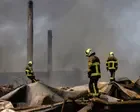
“Invincible.” That was how Vladimir Putin described Russia’s latest generation of ballistic missiles in 2018. In 2022 he would unleash this arsenal to strike across Ukraine, hitting command centres, critical infrastructure and airfields. Then, in 2023, Ukraine received Patriot air defence systems from its international partners. The US-supplied missile interceptor would prove to be an effective shield against Russian strikes.
But this year, supplies of Patriot missiles have run out and Kyiv has suffered the consequences. Intercepts have gone from more than 70% to none, so that night after night Russia strikes Ukraine’s infrastructure with impunity. This tragedy was long foretold, and there are no quick fixes.
While the military narrative of the war has largely been of cheap mass-produced Ukrainian weapons overwhelming exquisite Russian military hardware, most of the serious damage from Russia’s long-range strikes has come from cruise and ballistic missiles, and Ukraine’s campaign has suffered for want of them. Countering ballistic missiles is not a simple or cheap activity.
To intercept a tactical ballistic missile, such as Russia’s Iskander, a defensive system needs to be remarkably sophisticated. Its target will be descending from the high atmosphere at more than five times the speed of sound. The incoming missile will also be manoeuvring through the air, rather than following a predictable ballistic trajectory. The defensive system needs to be able to track the precise location of this incoming missile and communicate this to the intercepting missile, allowing the latter to adjust course while climbing against gravity. Building the radars, data links and interceptors for such a task involves a huge amount of research and development, and across Nato most states have been happy for Washington to invest over decades to make the Patriot up to the job.
The US and licensed manufacturers in Germany and Japan are able to produce about 840 Patriot interceptors a year. About 240 of these are older, larger PAC-2 interceptors, which climb until they are close to the target and then explode – meaning they must carry the weight of a warhead to the target – and 600 are PAC-3s, which are smaller and fly directly into the target. The latter approach is more effective but requires even more precise navigation. The former can be used against other target types.
Russia produces about 750 Iskander missiles a year and is looking to increase production. In addition, Russia uses air-launched Kinzhal ballistic missiles and repurposed air-defence missiles to conduct strikes, along with its arsenal of cruise missiles and drones. To have a high probability of success, it is generally recommended to fire two to three interceptors against each ballistic missile. When you also factor in that the launchers themselves can only protect a relatively small area, and Ukraine is a vast country, then it becomes clear that Kyiv would ideally have three to four times the annual global production capacity of Patriot missiles to protect itself. Countries supporting Ukraine have therefore had to give their own stockpiles to Kyiv.
Even before the US decision to attack Iran, western allies were nervous about depleting their own stocks by giving Patriot missiles to Ukraine, knowing that it would take a long time for them to be resupplied. The US attack on Iran – prompting Tehran to fire ballistic missiles across the Middle East – has created an acute global shortage. Where Russia usually fires fewer than 10 ballistic missiles in a single attack, Iran has launched upwards of 170 a day during the current and last year’s war. A portion of Iran’s missiles were also advanced. In one instance, it took 17 Patriot interceptors to defeat a missile. ** **And Iran has many more missiles in storage.
The point is that Ukraine is not going to receive enough Patriots between now and the winter to save its critical national infrastructure, irrespective of whether some countries make the political gesture of releasing a few more from their stockpiles. At this point, Kyiv must plan for a winter with severely disrupted power, and disperse and fortify life-support systems such as water, sanitation, power and heating.
Kyiv is trying to convince the US to activate Starlink satellite navigation modules over Russian territory to enable its drones to hunt for the Russian missile launchers. But, as the US recently found in Iran, pulling off this kind of mission over a large area is extremely difficult. Another line of effort in Kyiv is to attack the production of Russia’s ballistic missiles. These factories are well defended. To succeed, Ukraine’s partners will need to expand the funding and industrial capacity behind Ukraine’s nascent cruise-missile industry, or reopen questions of providing weapons systems such as Germany’s Taurus (which Berlin didn’t provide to Ukraine for fear of military escalation).
But the real lesson here is that Nato members have abjectly failed in defence planning. The numbers in this equation have been known since before 2022 and yet the investments to expand Patriot production (or mature alternative systems such as the Franco-Italian SAMP-T) have not been made. Such a level of complacency is devastating for Ukraine today, but it also risks Europe being bereft of defences in the future. It remains remarkable that Europe – watching the consequences unfold on its very borders – has remained so idle.
- Jack Watling is senior research fellow for applied military sciences at the Royal United Services Institute