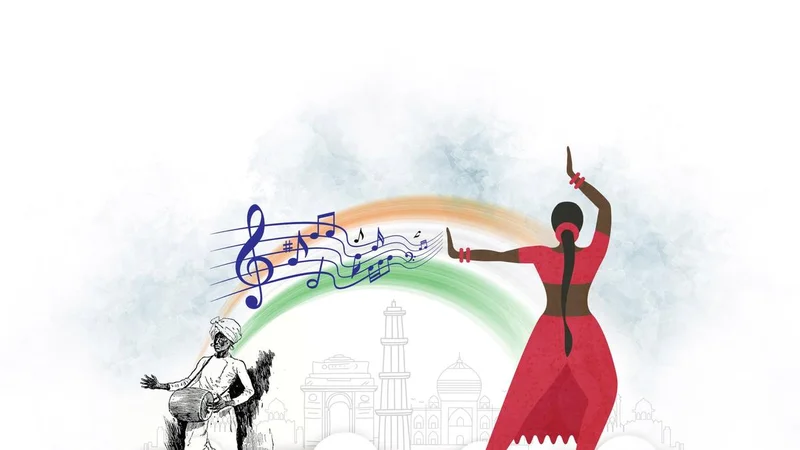
In a land as vast and diverse as pre-Independence India, and long before the telecommunication revolution, the flame of patriotism was lit by the written, spoken and sung word. Poets used their pens as weapons of resistance and inspired people to put the Nation before self. It was through these literary works that the stories of courage and sacrifice spread across the country — the songs and poems spoke about the crushing isolation of dark prison cells and the brutalities of the British.
Sometime in the 1970s and 1980s, growing up in the suburbs of a tier-two city in Tamil Nadu, about 50 km from Tirupur, where the 27-year-old Kumaran, famously revered as ‘Kodi Kaatha Kumaran’, chose death over letting the flag fall, and near Coimbatore, where freedom fighter V.O. Chidambaram Pillai was imprisoned, our connect to the freedom struggle was through stories narrated by elders and the patriotic songs aired on Akashvani and Vividh Bharati.
There would be a smattering of Tamil songs, and a few Hindi favourites — ‘Achamillai achamillai acham enbadhillaye’ (there is simply no fear), ‘Vande maataram enbom’ (let’s all chant Vande Mataram), ‘Vaazhga nee emmaan’ (may you live long, a song about how Mahatma Gandhi helped raise a country from the depths of despair), ‘Thaneer vitto valarthom sarvesa’ (did we water the plant called independence? No, we raised it with our tears), and the ubiquitous ‘Saare jahaan se accha’ and ‘Nanna munna rahee hoon’ (made popular by Doordarshan)
A love for the Tamil poet Subramania Bharathi was instilled in us from an early age. In ‘Agnikunjondru kanden’, he writes about finding a tiny spark of fire, hiding it in a hollow in the forest and watching the forest burn down. This idea of igniting a spark seemed to be a recurrent theme in the works of poets and writers in pre-Independence India, and it inspired ordinary people to join the movement.
On the other end of the spectrum was Hindi poet Makhanlal Chaturvedi’s 1921 poem ‘Pushp ki Abhilasha’. It was written from the perspective of a flower that desires to be plucked and placed on the path trodden by the brave who fought for the motherland. The verses tugged at the heartstrings.
Decades later, in 1988, the Lok Seva Sanchar Nigam created a song that reinforced the concept of unity in diversity — ‘Mile sur mera tumhara’, with lyrics in 14 languages, for the youth of the time. It was composed by Ashok Patki and arranged by Louis Banks, and featured well-known names from the field of arts such as vocalists M. Balamuralikrishna, Pt. Bhimsen Joshi, Lata Mangeshkar and Kavita Krishnamurthy, besides film stars such as Amitabh Bachchan, Sharmila Tagore and Waheeda Rehman. The very next year came a 13-minute video ‘Desh Raag’, where musicians and dancers celebrated the cultural plurality and shared national identity through an ancient Hindustani raag.
In 1997, as India rang in 50 years of Independence, composer A.R. Rahman and filmmaker Bharat Bala teamed up for a new version of ‘Vande Mataram’. ‘Maa tujhe salaam’, a track from the album, soon became the anthem of youngsters. Pakistani singer Nusrat Fateh Ali Khan’s ‘Gurus of Peace’, from the album, also became popular. Written by Mehboob, Tim Cody and Dinesh Kapoor, the lyrics went thus: “Boundaries have been drawn on land, but don’t raise a wall between hearts.”
Today, in a deeply cynical world, that age of innocence seems like a distant dream. As nostalgic as this all is, one truly wishes we went back to simpler times where we celebrated commonalities instead of highlighting differences. Bharathi would agree. After all, in his song, ‘Thaayin manikodi paareer’, he asks us to celebrate the diversity of a country that is home to people from varied cultural backgrounds and languages, linked by one common flag.
The first dawn of Independence
Padma Subrahmanyam
I was four then and too young to grasp the historical significance of the day. My father, K.G. Subramanian, a Congressman and filmmaker, had hosted a large feast. Our house in Santhome, spread over 36 acres, was teeming with people: freedom fighters, relatives, artistes and friends. We were used to having guests every day, but that gathering remains etched in my memory. Looking back now, I can imagine the emotions that swept across the nation. One memory stands out clearly: my father asking my mother to compose a special song for me. Standing before the guests, I sang, ‘Gandhi thatha solli paadu paapa…’ What remains with me is not so much the song itself as the atmosphere that surrounded it. The house was filled with people from different walks of life, all united by a sense of joy, relief and hope for the future.
T.V. Gopalakrishnan
I do not particularly like being reminded of that day, because, in many ways, I feel we have let ourselves down as a nation. I often wonder how much we have honoured the sacrifices and commitment of those who fought to secure our freedom, and where we are headed today. I say this because the dawn of Independence was ushered in a truly secular spirit. In Tirupunithura, where I lived, songs by Tagore, Bharati, Kumaran Asan and Vallathol echoed through the streets as people across social and economic divides came together, singing and rejoicing as one.
Umayalpuram Sivaraman
I was 12 years old and studying in the third form. I lived with my paternal grandmother on West Main Street in Thanjavur and attended mridangam lessons twice a day at the home of my guru, the renowned mridangam vidwan Thanjavur Vaidyanatha Iyer, on Pandamanickapa Street. That day, the lanes were so crowded that it was nearly impossible to walk through them. I am 90 and don’t think I have ever witnessed such an outpouring of joy. People dressed in white khadi were all over, singing ‘Vande Mataram’ as they marched. As a teenager, I was excited and joined them in song, sharing in the jubilation of a nation celebrating its newfound freedom.
Published - August 14, 2026 02:57 pm IST