Justin Blinder lost his job two weeks before the Covid-19 pandemic hit in 2020. To pay his rent, he turned to delivery services, riding his bicycle across New York City to deliver food. As he went, he noticed the disparities in where the food items went. Which order of Nomé sushi went where and how much people tipped.
“The city started to feel much more economically and psychologically disparate,” Blinder tells WIRED. “It really changed so much on a block-by-block level. These inequalities and demographic differences were happening in such close proximity.”
That experience has morphed into an art-project gadget called Ground Truth that Blinder hopes will raise awareness about the housing affordability crisis in New York City and beyond by making a Citi Bike—one of the ever-present ebike rental options across the city—harder to ride through places where it’s harder to live.
Blinder, a Brooklyn artist and contractor at Meta, received a $10,000 grant for the project from a Brooklyn arts organization called Idle Hands.
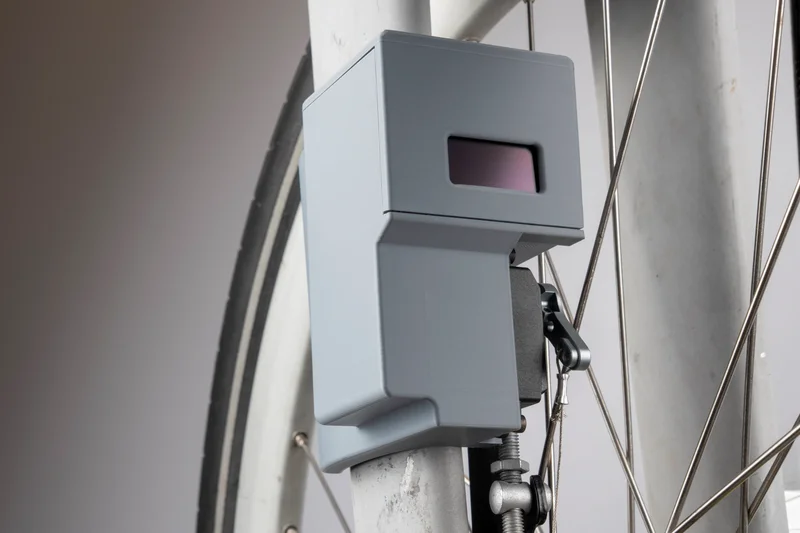
Ground Truth is a box that will trigger the brakes on the Lyft-owned bicycle, adding more resistance to the pedals when riding through rent-burdened neighborhoods, where people living in those areas spend more than 30 percent of their income on rent. Ride past an economically well-off block, and the bike is easier to pedal. Going past a block where rent takes the bulk of the households’ incomes can slow the bike down to a crawl.
There are two versions, one that can work on a regular bicycle and one built specifically for Citi Bikes.
The box mounts on the bike’s fork and is then attached to the front brake line. A battery-powered GPS component tracks the bike’s location. As it moves, the location is cross-referenced with household economic data from the US Census Bureau’s American Community Survey, stored on the device. When the bike passes a block the dataset says has a higher percentage of rent insecurity, the microcontroller triggers a small motor that applies the brake to add resistance, and the bike gets physically harder to pedal.
Blinder is also the creator of the Covid-inspired Pandemic Pulse, an app that used real time Covid statistics to change the brightness of your device’s screen. The screen would darken whenever data showed infections growing, and then black out briefly whenever a death was recorded. As with Ground Truth, Blinder says the goal of these projects is to help people understand large datasets in a more tactile way.
“It’s really trying to make the way we traditionally visualize a lot of big data more tangible and embodied,” he says. “Create something a bit more confrontational and try to force people to consider how they traditionally look at data.”
Blinder says the device is not a working product or something other people will be able to use. (Likely for legal reasons, as you can’t just change how a rideshare electric bicycle drives.) But he has ridden about 35 miles or so, filming the experience as Ground Truth changes its resistance in different communities.
He hopes the project will also call attention to the rising cost of renting a Citi Bike. The service has raised its prices for the past five years in a row.
“The price has just become so astronomical that it felt like this really nice connective tissue in the affordability crisis, connecting all of those different elements,” Blinder says. “It’s really thinking about how affordability changes throughout the city on a block-by-block basis and how this system could allow people to experience that.”