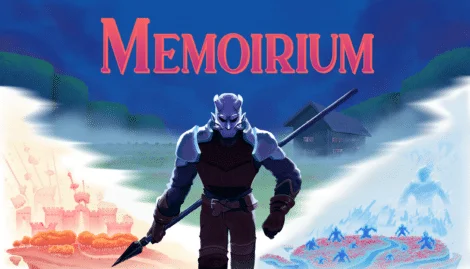
Memoirium is an indie Soulslike wonder made by a solo Filipino dev
Paolo Villanueva started learning how to code and make games in 2020, during the pandemic, while looking for a career shift from freelance writing. Five years later, his solo project under GoldenGratus has become Memoirium, a Soulslike set inside a collapsing realm of dreams.
The setting gives Villanueva room to put things together that would make little sense in a conventional fantasy world. A modern conservative school can exist beside a bright red castle made from sand and wax, while another area is an enormous version of the house where he grew up.
“All these locations are based on my real-life experiences and how I viewed them, and how they shaped me,” Villanueva said.
Article continues after this advertisement
That becomes particularly clear in the castle made from sand and wax. Its design reflects the expectations of masculinity that Villanueva grew up with.
“A few things we were told to be a man: you must swallow up your feelings, stay strong, handle things yourself, and never cry,” he said.
Memoirium treats its dream world as a reflection of the people trapped inside it. Villanueva believes that perception and understanding shape both conscious and unconscious experiences, which gives the game’s environments a role in its narrative rather than making them disconnected stages.
The dream setting also solves a practical game design problem. Dreams gave Villanueva the freedom to combine different settings and genres without needing to establish a conventional geography connecting them. It also gave him a way to explain mechanics that would otherwise require more conventional storytelling.
Article continues after this advertisement
He cites respawning as one example. In a typical game, dying and returning to a checkpoint is simply part of the rules. In Memoirium, the life-and-death cycle can exist naturally within a world built around dreams.
Villanueva wanted players familiar with action games and Soulslikes to recognize the basic rhythm. Enemies attack, players look for openings and the timing of each encounter becomes part of the challenge. The dream logic is allowed to shape the world, while combat remains something players can learn and understand.
Memoirium uses Connection as its equivalent of a mana system, but Villanueva did not want it to be limited to casting abilities. Connection also functions as the player’s status bar for conditions such as fire, cold and shock.
Article continues after this advertisement
It is one of the ideas that survived from the game’s earliest prototype. Another did not. Villanueva originally planned to have only three weapon classes, consisting of a spear, greatsword and staff. After receiving funding, he expanded the arsenal because having more weapons would make the game more enjoyable and give players more reasons to replay it.
His approach to equipment was shaped partly by frustration with traditional RPG inventories. Rather than give players hundreds of pieces of equipment to compare, Memoirium has a smaller selection where individual items are intended to have a noticeable effect on how players approach encounters.
“After playing so many RPGs over the years, I was tired of sorting through hundreds of items to decide what to put on,” Villanueva said. “As a solo developer, one of my tenets was quality over quantity.”
The same thinking led to one of Memoirium’s less conventional decisions: consumable items replenish instead of permanently disappearing.
Villanueva wanted to avoid a problem he had encountered repeatedly in RPGs, where players collect useful items and refuse to use them because they are saving them for a situation that may never come.
“I hated playing games where I hoarded items until the very end, and in many cases, I never used them at all until after beating the game,” he said.
Allowing consumables to replenish does technically weaken the risk-reward structure Villanueva values, but he was willing to make that trade.
“When something is more fun than sensible, I will always pick the fun.”
A Soulslike that gives players room to experiment
Villanueva also deliberately avoided some of the restrictions associated with the Soulslike formula.
Many FromSoftware games make changing a character’s build a deliberate commitment, requiring players to find specific resources before they can reallocate their progression. Villanueva wanted Memoirium to make experimentation easier because players should have opportunities to try different approaches rather than becoming locked into one style of play.
The game also uses its equipment and consumables to provide options for players who may struggle with the combat. Villanueva said players who pay attention to their surroundings can prepare for encounters and use the tools available to them rather than relying entirely on mechanical skill.
Early versions of Memoirium only allowed players to change equipment at checkpoints. Villanueva initially believed that the restriction would make equipment choices more meaningful. Playtesters instead ran into a simpler problem: they would pick up new equipment, be unable to try it immediately and then forget about it. He eventually changed the inventory system so equipment can be changed anywhere.
Memoirium includes a personal room where players can decorate, write and take a break from the game’s combat. Villanueva came up with the idea while trying to combine his interest in writing with his passion for games.
“I wondered how I mixed my love of writing with my passion for playing,” he said.
The room became a place where players could step away from the game’s difficulty and, he hopes, write about their own lives.
Players wanted more from the room than Villanueva originally anticipated. He was surprised by requests for more customization because he had been concentrating on its writing elements rather than the physical space. He eventually added more objects and the ability to change their colors.
There is also a cat, which Villanueva believes could be enough to convince people who normally dislike Soulslikes to give Memoirium a chance. Players can spend time with the cat in the room, gradually earning its trust which makes this game a must-buy in my opinion.
The room is also where one of Memoirium’s central ideas becomes less abstract. The game is built around difficult combat and risk-reward decisions, but it also gives players somewhere to stop and simply exist.
Dreams, lullabies and memories
Memoirium’s 67 Lullabies provide another way for Villanueva to connect the game’s mechanics to its setting.
Rather than functioning exactly like traditional spells, Lullabies can be repeatedly cast at the cost of the player’s health. They are designed to put others into a deeper sleep, but the same concept can turn against the player.
The game also contains hidden or unexplained mechanics involving Lullabies and Keepsakes, which Villanueva expects players to uncover through experimentation.
That is part of what he enjoys about making games. Players can discover interactions that the developer never intended or anticipated, and he is looking forward to seeing what people find once they begin experimenting with Memoirium’s systems.
The game’s PS1-era presentation is another decision that came from the realities of solo development. Villanueva said the retro aesthetic was primarily an artistic choice, but using simpler visuals also made sense when he was responsible for the entire project.
“Sticking to clear and simple visuals saves me a lot of time and effort,” he said.
Villanueva’s own background in games goes back to childhood, when Sonic was his favorite character. As he grew older, his tastes shifted toward more challenging action games, eventually leading him to the Soulslike genre that became the foundation for Memoirium.
The transition from freelance writing to solo game development was a significant one. Villanueva said UI and UX became his biggest weakness during development, pointing out that the work is often invisible when it is done correctly but immediately frustrating when it is not.
He also approached the development process with a deliberate scope. Before starting the project, Villanueva researched the design philosophies of studios such as Valve and Nintendo. He created a design document based on what he believed he could realistically accomplish and used playtesting to determine what needed to change.
The result is a game that uses a familiar Soulslike foundation without being entirely bound by the genre’s conventions. Combat follows recognizable rules, while the world, equipment and resource systems give players more room to experiment.
“I hope they are thinking about their lives and how to appreciate the good things while they can,” he said.
That intention explains why Memoirium’s strangest locations are also its most personal. The school, the wax-and-sand castle and the other dream spaces are built from memories and experiences rather than from a conventional fantasy setting.
Memoirium began when Villanueva decided to learn game development during the pandemic. His experience at PGDX 2024 later gave him the confidence to continue working on the project, and he credits the developers he met there for helping him keep going.
For other aspiring Filipino developers, his advice is straightforward.
“Make something you yourself would love to play,” Villanueva said. “And if at least one other person feels the same way when they try it, then you should keep working on it.”
Memoirium is built around that same idea. It is a difficult action game shaped by the things Villanueva wanted to play, but its dream world also gives him a way to examine the experiences that shaped him. The result is a Soulslike where the strange environments are not separate from the developer’s story. Memoirium is now available on Steam for PHP 485.