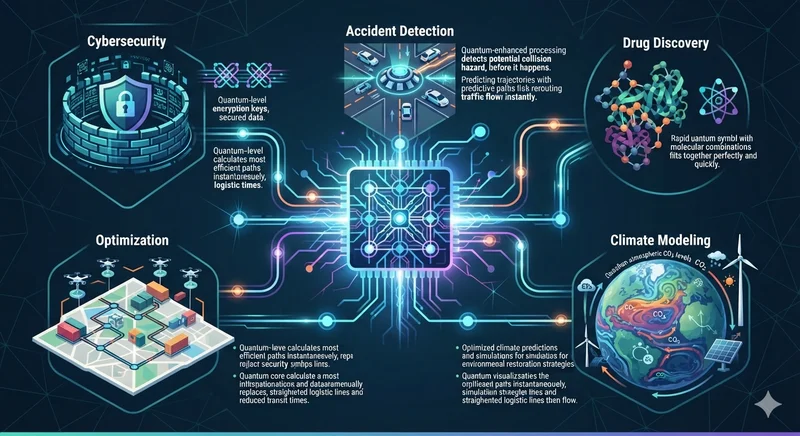
Being a researcher in the field of quantum computing and quantum cryptography, this thing always revolve in my mind that what if we apply quantum computing in everything. How things will work, what will be the merits and de-merits, and all such questions.
But First we need to understand why quantum computing at all. There can be multiple answers for this faster computation, accurate results in complex situations, higher depth of analysis, more reasoning power and much more. But the other side of the same coin is at what cost? Well, the answer is quite contained in the name itself. Quantum computers are still very less in number on this earth (around 200), they are expensive, sensitive to noise, and need special conditions to even run properly. So we cannot just put them everywhere tomorrow.
The main difference between classical computers and quantum computers is how they handle information. In classical computers, every bit is either 0 or 1, strictly one at a time. In quantum computers we can have qubits which can be in a superposition that is they can somehow represent both 0 and 1 together at the same time, and they can also get entangled with each other. Because of this property, for some special problems quantum computers can explore many possibilities much faster than normal computers. It is not magic for every problem, but for certain types of calculations the difference can be huge.
Now let us think about some real scenarios where this “quantum in everything” idea can actually matter.
Scenario 1: Accident Detection System
Imagine a smart city where cameras, sensors, radars and vehicle data are continuously flowing. In today’s classical systems, detecting an accident in real time across a whole city is still limited. The system have to process video frames, sensor readings, weather data, traffic density, driver behaviour patterns all this at the same time and then have to decide whether something is going wrong.
If we bring quantum computing into this accident detection system, the computer can look at a much larger combination of possibilities almost simultaneously. It can correlate unusual patterns from multiple cameras and sensors faster and quicker. For example, a sudden change in speed of three vehicles, a pedestrian suddenly stopping, a wet road surface, and a slight tilt in one car, all these small signals together can be analysed more deeply and quickly. The result could be early warning to nearby vehicles, automatic alert to ambulance, and even adjusting traffic lights in surrounding area before the accident fully happens. Of course the quantum part will not sit inside every traffic light; it will probably work in a powerful central system that classical computers will talk to. But the speed and depth of analysis can improve a lot.
Scenario 2: Cryptography Cracking Using Quantum Computing
This one is both exciting and scary. Most of the internet security today is based on mathematical problems that classical computers find very hard to solve like factoring very large numbers. That is why our banking, WhatsApp messages, government secrets all remain safe.
Quantum computers, especially with algorithms like Shor’s algorithm, can in theory break many of these classical encryption methods much faster once they become powerful enough and stable enough. So if quantum computers become common, a lot of current cryptography can become weak. This is the reason researchers (including people like me) are working hard on quantum cryptography and post-quantum cryptography and looking for new methods that can remain safe even against quantum attacks.
In a world where quantum computing is everywhere, the same technology that can crack old encryption can also create new, much stronger ways of secure communication using quantum properties like entanglement and no-cloning theorem. So it is a double-edged sword. On one side it can break today’s security, on the other side it can give us almost unbreakable communication if we design it properly.
Other Everyday Places Where It Can Touch
If we stretch the idea of “quantum computing in everything”, we can think of drug discovery where molecules are simulated more accurately, weather and climate models that can handle more variables, financial risk analysis that looks at many market scenarios together, logistics and supply chain optimisation for big companies, and even personalised medicine where treatment options are explored faster for each patient. In each case the quantum machine will not replace classical computers completely; it will work as a special accelerator for the hardest parts of the problem.
Merits and De-merits
Merits are clear speed for certain hard problems, ability to handle complexity that classical machines struggle with, new possibilities in security, science and optimisation.
De-merits are also real. Quantum computers are still error-prone, need extremely low temperatures, are costly, and require specialised knowledge to program. We cannot put a quantum computer inside every mobile phone or every traffic camera in the near future. There is also the risk that powerful quantum machines in wrong hands can break current security systems before the world is ready with quantum-safe alternatives. And of course, the energy and infrastructure cost is high right now.
So the dream of quantum computing in everything is powerful, but it will come slowly and only where it truly gives advantage. For many ordinary tasks, classical computers will remain better, cheaper and more practical.
In the end, as a researcher I feel this field is like standing at the edge of a new kind of thinking machine. We do not fully know how far it will go, but the questions it raises are already changing how we look at computing, security and complex decision making. The real challenge is not only to build better quantum computers, but to wisely decide where to use them and how to protect the world while we do it.