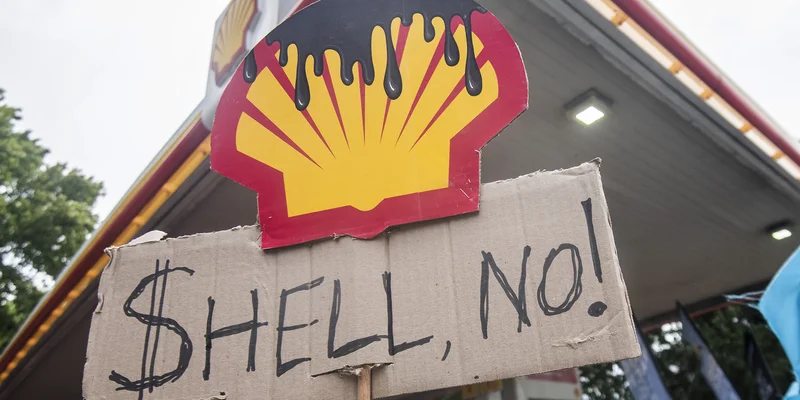
The Constitutional Court has ruled in favour of Wild Coast communities and environmental organisations, overturning an order that had allowed Shell and Impact Africa another opportunity to preserve an offshore exploration right.
The apex courtâs judgment, delivered on Friday, 14 August 2026, brings to an end the companiesâ attempt to retain the right through another renewal application and reinstates the effect of a high court order setting it aside.
The dispute concerned an exploration right granted to Impact Africa in 2014 and later held jointly with Shell interests. The right covered a large area off the Eastern Capeâs Wild Coast and would have enabled seismic surveying in the search for offshore oil and gas.
Wild Coast residents and environmental organisations challenged the right, citing inadequate consultation as well as failures to consider climate change and other environmental and cultural impacts.
How the exploration right was kept alive
In 2022, the Eastern Cape Division of the High Court found that the exploration right and its subsequent renewals had been granted âunlawfullyâ. The court held that decision-makers had failed to consider several relevant factors, including the livelihoods, customary practices and spiritual and cultural rights of coastal communities.
The high court accordingly set aside the exploration right.
The Supreme Court of Appeal (SCA) later agreed in 2024 that the right had been granted âunlawfullyâ, but suspended the setting-aside order. Its remedy allowed the exploration right to remain alive while the authorities considered another renewal application, subject to an additional public-participation process intended to correct the earlier consultation failures.
This portion of the SCAâs order became the focus of the Constitutional Court proceedings.
The communities, Sustaining the Wild Coast, Natural Justice and other environmental organisations argued that the remedy ultimately imposed by the SCA was not just and equitable.
They maintained that consultation conducted during a renewal process could not retrospectively cure the failure to consult communities before the original exploration right was awarded.
Court slams door shut on another chance
The Constitutional Court agreed that the SCAâs intervention could not stand, meaning the companies cannot rely on the renewal process to keep the âunlawfulâ exploration right alive.
It also limits the circumstances in which an appeal court may interfere with a lower courtâs exercise of its remedial discretion.
The case attracted national attention because of its implications for offshore oil and gas exploration, administrative justice and the constitutional rights of communities whose livelihoods and cultural practices are closely connected to the ocean.
Environmental organisations have described the litigation as a test of whether companies and the state may correct serious procedural failures years after an exploration right was originally granted.
Shell and Impact Africa had argued that cancelling the right entirely would cause substantial financial prejudice and that further consultation during the renewal process could provide an equitable solution.
The Constitutional Courtâs ruling shuts down that route and means the exploration right and its renewals remain cancelled.
The judgment is a significant victory for Wild Coast communities, which have opposed seismic exploration in the area since at least 2021. They have argued that decisions affecting their coastline cannot lawfully be made without their meaningful involvement.
Cormac Cullinan of Cullinan & Associates, the firm representing the NGOs Greenpeace and Natural Justice, described the litigation before the ruling as âprobably the highest profile environmental case in South African historyâ.
A prominent Cape Town lawyer also leading an international campaign to recognise the Antarctic region as a âlegal personâ, Cullinan described the Wild Coast struggle as a global symbol of communities standing against a major foreign oil company at a moment when, as he put it, âweâve already found too much oil and gas in the world to burnâ.
The Legal Resources Centre and Richard Spoor Inc Attorneys represented the Wild Coast community applicants.
âA monumental victory for the rule of lawâ
Ricky Stone, a lawyer on the legal team, told Daily Maverick: âThis judgment vindicates the Wild Coast communities whose customary and spiritual relationship with the ocean, and whose very livelihoods, were treated as an afterthought.â
The significance, he argued, âreaches every corner of our country. It fortifies the right to just administrative action; it confirms that our courts will not breathe life into decisions taken in breach of the Constitution; and it affirms that our coastline, our marine life, and our climate commitments are not casualties to be traded away for extraction.
âThis is a monumental victory for the rule of law, and indeed, for the principle that people and nature must always come before profit.â
Shell could not be reached for immediate comment. DM