When Wei Qing and his team drafted the application seeking UNESCO World Heritage status for Jingdezhen Handicraft Porcelain Industry Sites in Jingdezhen, Jiangxi province, in 2023, they soon realised that the city’s ceramic legacy could not be told through kilns and workshops in downtown Jingdezhen alone.
The story, they realised, can also be found across the surrounding hills, in the pine forests that fuelled the kilns, the kaolin (Gaoling) deposits that strengthened porcelain, and the porcelain stone quarries that provided the foundational materials. This network, now mostly hidden deep in the mountains, once formed an intricate industrial chain that supported Jingdezhen’s porcelain supremacy for centuries.
On 25 July, it became a newly minted UNESCO World Heritage site, turning the spotlight on the components that made this millennium-long achievement possible — not just the finished porcelain, but its raw materials and fuel.
“They constitute an integrated industrial production system centred on the area’s porcelain production centre and stretching far across the surrounding mountains, which is a sophisticated model of regional resource allocation,” says Wei.
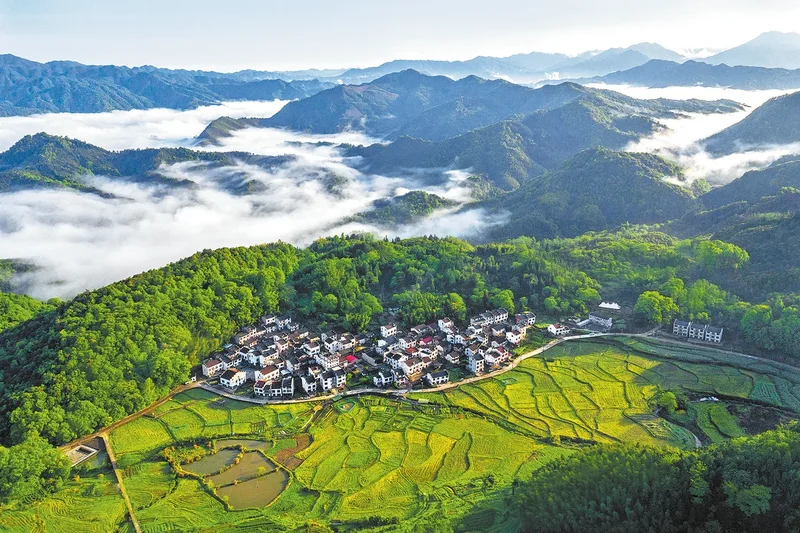
They were introduced to the Lifang village in Fuliang county, Jingdezhen, which thrived with the firewood industry in the Ming (1368-1644) and Qing (1644-1911) dynasties, but few written records existed to support that.
Villagers, however, still kept their clan genealogies. One villager provided his clan genealogy, which contains an illustrated manual that explains how the forest, which produced Masson pine for firewood, was managed by a clan-based system during the Qing Dynasty.
Each clan held designated sections of the forest and enforced strict agreements to protect the trees. Trees were distributed to clan members for caretaking, but logging was permitted only upon the clan head’s approval.
When logs were cut, they were moved to the riverside and stacked, waiting for the flood season. When the water level rose, the logs were cast into the mountain streams, drifting downstream with the current until intercepted by water barriers in the rivers. After being retrieved for further drying and stacking, they were loaded on boats and transported to downtown Jingdezhen.
“Making full use of natural streams, rivers, artificial dams, bridges, and docks, this method significantly cut transportation costs,” says Hu Qiaoheng, deputy director of the Fuliang County Cultural Heritage Protection Centre. “The firewood supply chain ensured that the materials would meet the surging demand of the Ming and Qing dynasties, when Jingdezhen’s porcelain industry flourished,” she adds.
More stories of Jingdezhen’s porcelain production are told in the Gaoling village, also in Fuliang, which provided kaolin clay, a fine, white mineral that is essential to porcelain production. Jingdezhen was one of the first places to realise its value and promote its use.
Historically, objects made exclusively of porcelain stone had a low melting point, which could easily collapse in kilns. In the Yuan (1271-1368) and Ming dynasties, artisans discovered that mixing the stone with kaolin in precise proportions — the so-called “binary formula” — greatly enhanced the body’s structural integrity and heat resistance, enabling the production of true, hard-paste porcelain.
In the 18th century, French missionary Francois Xavier d’Entrecolles introduced the clay to Europe. German geographer Ferdinand von Richthofen named it “kaolin”, which gave it its worldwide name since the 19th century.
Archaeological efforts help decode details of the mining back then. Li Zhaoyun, an archaeologist at the Jiangxi Provincial Institute of Cultural Relics and Archaeology, says kaolin mining was conducted on a large scale during the Ming and Qing periods.
He says the whole Gaoling site covers 3.86 square miles, with about 90 suspected mining caves and over 60 washing pond complexes identified in initial surveys. Many more have likely collapsed over time.
Microelement analysis supports the use of kaolin in porcelain making: earlier Jingdezhen porcelain shows high potassium and sodium with little aluminium, but later samples show a significant rise in aluminium, clear evidence of kaolin being added, says Li.
“All porcelain produced worldwide today is hard-paste, which relies on kaolin. Therefore, the discovery of kaolin not only ushered in Jingdezhen porcelain’s golden age, but also revolutionised ceramic techniques worldwide,” says Li.
Beyond kaolin, porcelain stone, the other half of the binary formula, was processed along mountain streams, where water-powered mills crushed the rock into fine powder. The Xiaowuli and Dawukeng sites in Fuliang, opened last year to reserved groups of visitors as part of the hiking routes, allowing them to trace these ancient mining and processing operations.