On a recent Sunday, I visited the Museum of Goa, a private museum founded by the Goan artist Subodh Kerkar. The event I was there for focused on ‘Wilderness Within’, the second chapter of the book Fish, Curry and Rice (edited by environmentalist Claude Alvares), a beautiful non-fiction source on Goa’s local ecology and lifestyle.
Past the 30-foot-tall statue of demon king Narkasur and through the excellent in-house cafe, Alvares was addressing the guests, reminding everyone that all of Goa is a wildlife sanctuary — not only the tigers and elephants, but also the plant life, birds, insects, micro-organisms, wetlands, estuaries, lateritic plateaus, marine ecosystems, and agro-ecosystems.
The State’s extraordinary biodiversity is reflected even in our backyards. Like the mango and kokum that overfed me during the summer, or how my garden becomes a constant supplier of herbs, greens and roots during the rains. My garden in Goa is an experiment of sorts: everything is grown from cuttings I picked up on walks or from my friends’ gardens. It was a dusty brown patch when I moved in a year ago, but a couple of swales (a channel for water) and lots of mulch and homemade compost mean that I now regularly eat from it.
I don’t grow any vegetables, only plants that grow wild in the region, and yet there is always something there for the kitchen: pandan for rice, borage (ajwain) for tea, colocassia (arbi) leaves for steaming, ginger flowers for cocktails, turmeric leaves for fish… and I keep discovering new plants to use. Plants I’m not sure I planted!
Stir-fried ferns, anyone?
I was at MOG that sunny, humid afternoon for the tasting table that came after Alvares’ talk. Chef Sai Sabnis, founder of Posa, a food lab that supplies ‘supersalads’ via a subscription model, had created tapas from wild and organic Goan foods, reimagined in a modern way. Whatever hadn’t come from her backyard or Edricia, an organic farm in Siolim, was bought at Mapusa market — that holy grail of Goan markets.
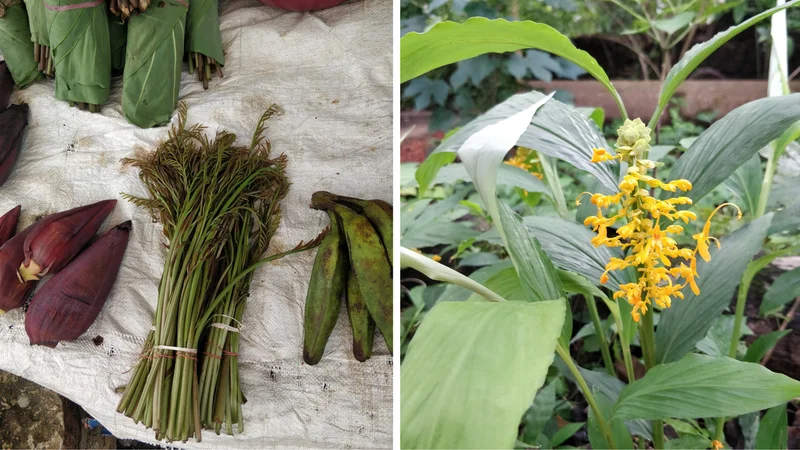
On the table was akur or Golden Leather Fern, a large species that grows in the mangroves. Only edible in the monsoon when the baby fronds sprout, Mapusa market is full of them at this time of year. Mostly drowned in masala when eaten locally, Sabnis showcased its texture and asparagus-esque subtlety by serving it stir-fried with a cheese-like faote (white lablab bean) cream.
Another favourite was the taikile (Cassia tora) pesto served on a slice of beetroot with a mayonnaise that featured the ground dry fish Goans rely on during the monsoon when the fishing boats can’t go out. Sprouting wherever there is space, taikile is a monsoon staple in Goan homes and is considered medicinal by Ayurveda, being high in protein, carbohydrates, fibre and anti-oxidants.
Weeds for the dining table
But the real discovery for me was the Pepper Elder. Goans don’t use it, and it is not available in the market, but it sprouts in gardens and parks everywhere. A ‘weed’ at Edricia Farm, according to Tanya Fernandes. But the lovely farmer-owner did some research after noticing how prolific it was and found it was edible. Sour, with a mustard-like odour, Sabnis cleverly let it speak for itself, leaving it raw and freshly plucked to be had on its own.
I came back home and plucked as many greens from my garden as I could for dinner that night. While eating, I marvelled at how cheap (free!) my highly nutritious meal was. But it is always important to do research before digging in — even if it means asking the lady who sells the greens how she cooks and eats them. (The first rule of wild foods is to know how to process them, to remove any toxic compounds that may be present.)
The wilderness is all around us, not just in a reserve forest somewhere else for us to visit or save. So, the next time you’re in a park or out for a walk, have a look at the humble weeds growing below your feet and you just might find it.
A series written through the lens of someone who works the land. Let’s make thinking about the ecology feel like Second Nature.
Published - August 14, 2026 04:31 pm IST