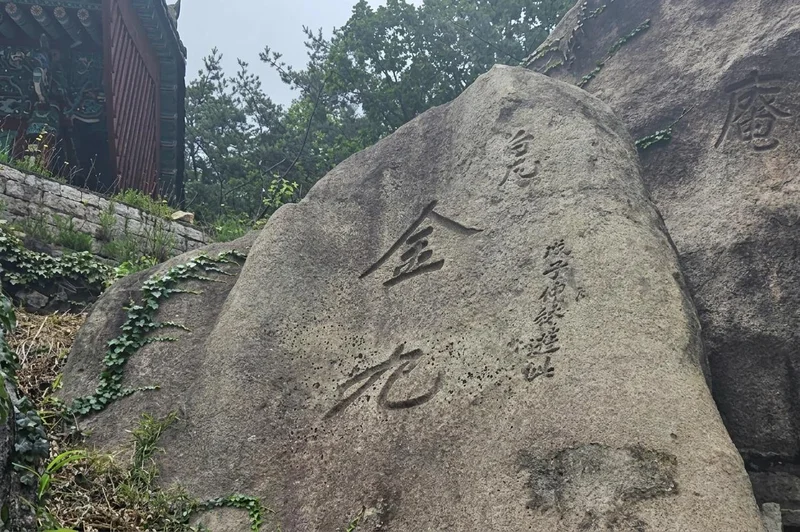
After Korea's liberation from Japanese colonial rule, independence leader Kim Koo visited Seokguram Hermitage in Bukhansan National Park. At this location, where he took refuge before going into exile in Shanghai, he reflected on the past and left a carved inscription reading, "At Seokguram, Kim Koo, who visited this place in the autumn of 1948." His calligraphy, reflecting his longing for Korean independence, remains vivid on the giant rock.
On the eve of the 81st National Liberation Day, the Korea National Park Service on Friday highlighted the historical legacy left by those who fought to restore Korea's sovereignty and achieve independence. A natural boulder below Cheonwangbong Peak in Jirisan National Park, measuring 4.2 meters wide and 1.9 meters high, holds a 392-character rock inscription.
Composed by late Joseon-era scholar Muk Hui and written in calligraphy by Kwon Ryun, the inscription was carved into the rock on July 1, 1924. The text invokes the power of Mount Jiri and the majesty of Cheonwangbong Peak to repel foreign invaders in hopes of a brighter era.
A rock at Baegundae, the main peak of Bukhansan National Park, bears an inscription hand-carved by independence activist Jeong Jae-yong.
The carving notes that Choe Nam-son, born in 1890, drafted the Korean Declaration of Independence on Feb. 10, 1919, in Seoul's Cheongjin district. It also documents that Jeong, born in 1886, led chants of "Long live Korean independence" at Tapgol Park on March 1, 1919. The agency believes the text was engraved after the March 1 Independence Movement as a factual record to prevent historical revisionism.
As these outdoor records face the threat of weathering and erosion, the park service is working to preserve the inscriptions. The agency created a 3D digital archive of the Jirisan Cheonwangbong inscription in 2024 and digitally documented the Mount Bukhan carving in 2026.
"The historical and cultural resources in the national parks are invaluable heritage assets embodying the spirit of the nation's forebears and the collective memory of the people," Korea National Park Service Chairman Joo Dae-yeong said. "I hope citizens will visit the parks for Liberation Day to reflect on the struggle for independence and the meaning of liberation in nature."
This article from the Hankook Ilbo, the sister publication of The Korea Times, is translated by a generative AI system and edited by The Korea Times.