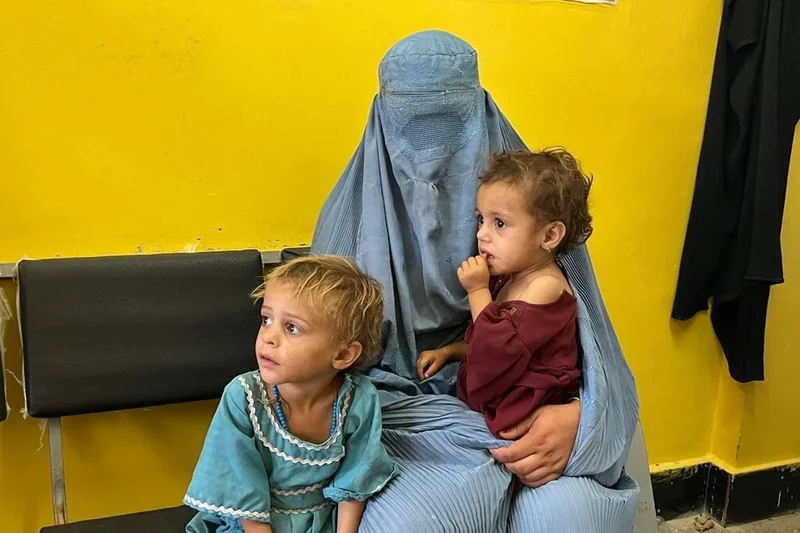
The hunger crisis in Afghanistan has grown so severe after five years of the Taliban’s rule that the UN is training its food aid workers to handle distress calls from starving people who say they are considering suicide.
The UN’s World Food Programme says about a million more Afghan women and children are acutely malnourished now than when Kabul fell to the Taliban on 15 August five years ago.
The agency has reported a surge in distress calls, from women in particular, saying they are considering take their lives because they are unable to feed their families.
“We have a WFP hotline. It's a telephone number people call. We've seen in the last few months a 60 per cent increase in distress calls from Afghan women, with too many of them threatening to commit suicide,” John Aylieff, country director for the WFP, tells The Independent.
Aylieff says his organisation, which has been forced to scale back its food aid programme because of funding cuts by Western governments, is now forced to spend scarce resources on retraining staff to deal with such calls.
“We have retrained our call operators to deal with suicide calls because we were seeing such a high surge in them, people so desperate they just do not know where to turn because they have been cut from WFP programmes, which are now defunded,” Aylieff, who is stationed in Kabul, says.
Aid workers say that entire families are surviving on potato peel as millions of Afghans suffer from hunger and starvation five years after the Taliban took control of the war-ravaged country. Efforts to turn around the country’s collapsed economy have only been harmed by the Taliban’s archaic restrictions on women’s rights to education and work.
The UN warned in August that child malnutrition had reached critical levels in a third of Afghanistan’s 34 provinces, and would likely worsen as the wars in the Middle East and Ukraine divided the world’s resources.
“Some of the family homes I visited were living in such desperate conditions that they showed me what they were having for lunch and it was basically a bowl of potato peels that had been rotting for I don't know how long,” Olga Cherevko, a spokesperson for the UN humanitarian office in Afghanistan, tells The Independent.
Aylieff recalls doctors and nurses at a WFP clinic in Herat telling how depressing the situation is now.
“One of the nurses, with almost tears in her eyes but with such determination and defiance, told me that she had never seen this level of malnutrition,” he says.
“She is handling three times more cases of severe malnutrition, which is the worst type.”
The WFP is one of the last remaining international agencies in Afghanistan with access to aid and permission from the Taliban to continue operations. The agency distributes food packages of fortified biscuits, as well as essential commodities like wheat, flour, rice and oil.
Foreign aid cuts have forced it to shut 142 health centres, leaving almost 13,000 children without access to nutritional treatment.
“We met Sadiqa, a mother of seven, and she was so desperate for any relief that she told us, ‘I wish God had given me and my children death because then we would have been saved from the suffering of our hunger,” Aylieff says.
Sediqa, like thousands of Afghan mothers, is unable to breastfeed her infant because she goes without food for days and is too malnourished to produce milk.
Her three-year-old daughter is at risk of severe acute malnutrition and faces a high risk of medical complications.
“The malnutrition crisis certainly is worse than it was five years ago. In fact, today, a million more women and children in Afghanistan are acutely malnourished,” the WFP official says.
“We are turning away six out of seven acutely malnourished women and children coming to us for relief. This is dramatic because once you’re acutely malnourished, you’re in a life-threatening situation and the heartbreak of turning away six out of seven acutely malnourished women and children is painful.”
He says the risk of people starving to death is at its highest since the withdrawal of Nato forces in 2021. “We have seen famine once or twice in this country in the last few years. It’s rare but it can happen and there is a risk of it happening now,” he says.
“In 2022, we fed half the population. The economy had collapsed after the takeover of the country. Needs were high. Now, we are down to 10 per cent, or less. From August on, we are likely feeding nobody.”
The UN has warned that the US-Israeli war against Iran and Afghanistan’s conflict with Pakistan have disrupted the supply chains which allowed deliveries of aid into the country, impacting about a million malnourished women and children.
The war in the Middle East has reduced Afghanistan’s trade with or through Iran by about 60 per cent.
“The prices of staples when the Iran war broke out shot up by 20-30 per cent. So, wheat, rice and other staples that keep the poorest families alive become expensive overnight and out of reach of millions of Afghan families,” Aylieff says.
The Taliban’s restrictions on women have deepened the crisis as they have taken out a vast chunk of the workforce, damaging the economy.
Cherevko recently visited the remote district of Ashtarlay in Daikundi province to assess the livelihood and health situation and met a woman who reportedly told her the Taliban’s ban on women’s education was “the worst thing” they were facing right now.
“That is telling,” she says, “for people in remote areas to say that unprompted.”
Aylieff is concerned about what the future may bring if the Taliban government persists with its ban on women working outside their homes.
“Studies and estimations show that it will be so much harder by 2030 to find a female doctor,” he says, “and in the absence of female doctors, women will simply not come and get medical care at all in some places. “
“Banning 50 per cent of your workforce from working, because it is illegal for women to work, is having a dramatic dampening effect on the economy, no doubt about it.”