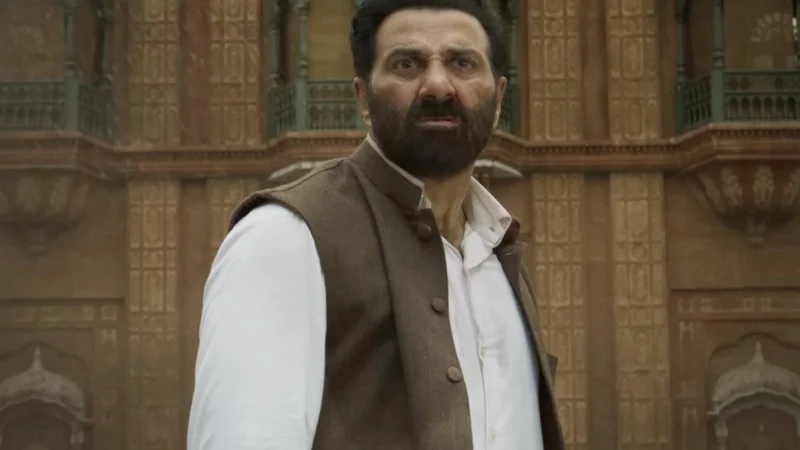
In a cinematic landscape dominated by polarised, ‘us versus them’ period pieces, Rajkumar Santoshi serves a humanistic counter-narrative this partition day. Based on Asghar Wajahat’s seminal play Jis Lahore Nai Vekhya O Janmeya Nai, the film poignantly handles the play’s core ideological conflict and subverts Sunny Deol’s popular persona to underline that human empathy and shared grief can outlast any artificial border.
A Muslim refugee family from Meerut is allocated a Lahore haveli vacated during Partition, only to discover an elderly Hindu woman, Durga Devi or simply Mai, refusing to leave. Having just survived the horrific communal violence, Sikandar Mirza and Hamida (Preity Zinta) arrive in Lahore carrying immense psychological trauma. To them, the allocated haveli is a hard-earned refuge and a rightful compensation for everything they lost in India.
When they discover Mai (Shabana Azmi) hiding in the house, they don’t see a helpless old woman who lost her everything to communal mayhem. To them, she represents the ‘other’, the very people who slaughtered their neighbours and relatives and forced them to flee. However, as time passes, it is hard to maintain burning communal hatred when the enemy is a fragile grandmother making tea and offering home remedies. Despite opportunistic neighbours, a radicalised son (Karan Deol), and communal rhetoric, Sikandar gradually discovers that trauma has no religion and sees the image of his own mother in Mai.
Batwara 1947 (Hindi)
Director: Rajkumar Santoshi
Duration: 143 minutes
Cast: Sunny Deol, Shabana Azmi, Preity Zinta, Abhimanyu Singh, Karan Deol
Synopsis: A Muslim refugee family moves into a Lahore haveli and discovers an elderly Hindu widow residing inside. When the family takes a moral stand to protect her, defying local extremists, all hell breaks loose.
Wajahat’s mother is not an abstract figure or a political prop that certain ideologues and demagogues champion. Santoshi ensures Mai functions as a tangible human presence that challenges sectarian division without making a show of it. When Sikandar shouts in agitation, “A mother is a religion in herself; every person’s first religion is their mother,” the film shifts the definition of patriotism away from national borders or religious rituals to internal morality.
On Deepawali, when Mai sings a moving Ram bhajan, written by Javed Akhtar and composed by A.R. Rahman, the lines of religion and blood get blurred in her mind, and the protective warmth of Sikandar begins to mirror the memory of her own son lost to the same barbarity that Sikandar is struggling to forgive and forget. When lines like mann ki aankhon se jo dekhoge usko, toh paaoge Ram ko har kahin (If you see with the eyes of your heart, you will find Ram everywhere) strike the conscience, one fails to see justification for CBFC’s adult rating for a film that promotes a timely thought.
Audiences have developed a form of screen desensitisation to Partition-era brutality. However, Batwara 1947 uses this lack of censorship not for shock value, but to establish psychological terror and then turn to Sunny-style larger-than-life punches. It is a structural paradox, and ace cinematographer Santosh Sivan navigates the two atmospheric zones satisfactorily. Stage plays rely on clear archetypes to quickly establish a moral universe. Santoshi keeps these archetypes but tweaks them to suit his star power. By preserving the play’s theatrical, slightly stylized nature, he makes it feel like a timeless moral fable.
When the message is on the surface, it is Sunny’s space. In this long-awaited reunion of Santoshi and Sunny, who previously defined 90s gritty cinema with Ghayal, Ghatak and Damini, one finds their magic hasn’t lost its vibe. Santoshi tunes his typical high-pitched directorial style to slow-burning, emotionally driven storytelling and, along the way, strips away Sunny’s post-Gadar screaming archetype to mould him as a vulnerable Muslim migrant, who not only uses his physical might to protect an elderly Hindu woman but, much like Ghatak and Damini, questions the silence of the virtuous civil society. Sunny is most potent when he channels his explosive vocal delivery into a desperate, morally righteous interrogation of the system. The message hits like a sledgehammer. The target audience that usually cheers for his jingoistic violence is asked to clap for his roar for empathy and coexistence.
Shabana’s grace and poise prove a perfect aesthetic foil. Much like her contemporary Naseeruddin Shah in Main Vaapas Aaunga, Shabana, with that gentle Punjabi on quivering lips, lends emotional gravity to Batwara 1947. She frames Mai’s stubborn refusal to leave Durga Niwas not as a political defiance but a quiet declaration that a cartographer’s line cannot partition a person’s soul.
While the film beautifully highlights the bond between Mai and Sikandar, it does so at the cost of the play’s rich ensemble of supporting characters who represent the city’s broader socio-political fabric.
With limited screen time and the elbow room Sunny demands, the philosophical poet (Ali Fazal) and the progressive priest are reduced to functional plot devices. In Wajahat’s text, the gutsy maulvi represents the internal theological battle, fighting against local thugs who use religion to justify greed and violence. Santoshi shifts the burden of confronting the main antagonist, Yakub Pahalwan (Abhimanyu Singh crosses the line from genuine threat to a loud, predictable caricature), from the priest’s ideological conviction to Sunny’s physical resilience. The father-son jugalbandi doesn’t have much impact, as Karan remains a work in progress. Be it the deep anguish or the linguistic rhythm, Karan’s physical and emotional reflexes don’t reflect the upbringing of a Muslim household.
While Santoshi occasionally compromises the narrative with a cartoonish villain and larger-than-life action blocks, the Sunny-Shabana symphony and the film’s core message remain deeply impactful. As for the bigger message, in 2001, Gadar changed the way popular Indian cinema approached the Partition; with Batwara 1947, Sunny flips that 25-year-old legacy on its head. Will the tide turn?
Batwara 1947 is currently running in theatres
Published - August 14, 2026 06:01 pm IST