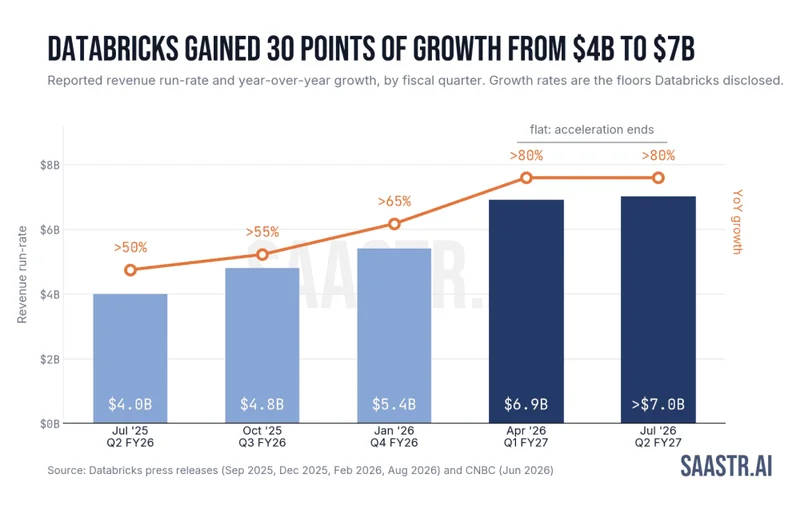
This is almost unprecedented in B2B software
Databricks just announced it crossed a $7 billion revenue run-rate in Q2, growing more than 80% year over year, and closed a $5 billion strategic round at a $190 billion valuation led by Coatue.
Most of the coverage will lead with the valuation. But it’s the epic growth curve that is working doing a deep dive on. Databricks is reaccelerating at $7B ARR. To a stunning 80%+ growth.
#1. Growth went from 50% to 80% in four quarters
That’s thirty points of acceleration between $4 billion and $7 billion of run-rate. Companies at this scale are supposed to decelerate, and almost all of them do. Databricks went the other way for four straight quarters.
Worth being precise about the last data point. This quarter held at 80% rather than climbing again, so the acceleration is a completed arc as of today, not something still in motion. Growing 80% at $7 billion is still better than anything else in enterprise software. It’s just flat now instead of improving.
The other thing to check next quarter is the sequential add. Databricks put on roughly $1.5 billion of run-rate between the January and April quarters. April’s $6.9 billion to July’s “>$7 billion” reads like a fraction of that. “>$7 billion” is a threshold rather than a real figure, and 80% growth on last year’s $4.0 billion implies at least $7.2 billion, so the gap is probably rounding. But it’s the line I’d watch.
#2. Databricks passed Snowflake three quarters ago
Both companies close their fiscal year on January 31, so the quarters line up. Annualizing Snowflake’s product revenue against Databricks’ reported run-rate:
Databricks went past Snowflake in the October 2025 quarter and has widened the gap every quarter since. Snowflake’s Q2 hasn’t reported yet, so that last figure is their own guidance of $1,415M to $1,420M in product revenue.
The comparison isn’t perfectly clean. Snowflake’s number is audited GAAP revenue. Databricks’ is a self-reported run-rate from a private company with no obligation to define it consistently, and no auditor checking. Directionally sound, not precise.
Snowflake is also not in trouble. Product revenue grew 34% last quarter, up from 30%, with 126% net revenue retention and a raised full-year guide of $5.84 billion. On the bigger base they add roughly $1.8 billion of net new product revenue a year. Databricks’ data warehousing product, Lakehouse, passed $1.5 billion growing over 100%, which adds roughly $1.5 billion. Snowflake is still putting on more absolute dollars in the category Databricks built Lakehouse to attack.
What changed is the company-level race, and Databricks won it by expanding into AI infrastructure Snowflake doesn’t sell: Lakebase, Genie, Agent Bricks, Unity AI Gateway. Lakebase alone passed a $100 million run-rate this quarter from a standing star
#3. Agents drive the revenue and eat the margin
At the Data + AI Summit in June, Ali Ghodsi told CNBC margins are shrinking because agents generate far more queries than humans do.
“It’s the consumption-based business model, agentic AI coming. The agents are generating way more queries.”
We’ve written a version of this three times in the last two weeks:
- Figmagave up five points of gross margin year over year to AI credits, with beta products burning inference against no revenue.
- Atlassianbundled AI free into paid Jira Cloud and guided non-GAAP operating margin from 36% in Q4 down to 25% for FY27.
- Canvacut its growth forecast by a third and started metering Pro features, because the free tier stopped costing close to nothing.
Databricks is the one in that group whose pricing captures agent traffic directly, and it’s still taking a margin hit. A consumption-priced infrastructure vendor growing 80% is absorbing gross margin compression from agent query volume. Per-seat vendors bundling AI into a flat price are absorbing something worse.
If you’re pricing an AI product right now, the useful frame is load pattern. Agents query the same account an order of magnitude more often than the humans inside it did. Your pricing has to survive a customer whose agents hit you 50 times for every one time a person used to.
#4. Almost all of it is expansion inside existing accounts
The customer numbers in today’s release:
- More than 1,000 customers now consume at over $1 million run-rate, up from 650+ in September 2025. Roughly 54% growth in that cohort in eleven months.
- More than 100 customers consume at over $10 million run-rate, a tier Databricks hadn’t disclosed before.
- Net retention was last disclosed above 140%.
- 20,000+ organizations total, including 70% of the Fortune 500.
The $10 million tier is the one that explains the valuation. A hundred-plus logos each generating eight figures, still expanding. With 70% of the Fortune 500 already in the door, Databricks isn’t growing 80% by adding logos. The growth is coming from getting much larger inside accounts it already had.
#5. The multiple, while impressive, has barely moved across three rounds
September 2025: above $100 billion on $4 billion, about 25x.
February 2026: $134 billion on $5.4 billion, about 25x.
Today: $190 billion on $7 billion-plus, about 27x, or closer to 26x if the real figure is $7.2 billion.
The valuation went up 90% in eleven months and the multiple moved maybe two turns. Nearly all of the increase is revenue that actually showed up. Across three rounds and very different macro conditions, the market has kept paying 25 to 27 times run-rate for this business, which reads more like a clearing price than a mark.
#6. No IPO anytime soon
Ghodsi told CNBC the company intends to go public eventually but not now. “We’re not just a company that wants to stay in the private, but right now I just think there would be too much distraction in the public market.”
He’s raising $5 billion privately, running positive adjusted free cash flow over the last twelve months, and carrying a valuation that would put Databricks in the top tier of public software companies on day one. Nothing about the financing requires filing. On the same day, Databricks bought ElectricSQL, the team behind PGlite, which went from 1 million to 13 million weekly downloads over the last twelve months, to speed up Lakebase reads and writes for agents.
Companies with this profile used to go public because they needed the capital and the acquisition currency. Databricks has both without filing, and gets to absorb the cost of agentic consumption without explaining a margin line every ninety days.
What to take from this if you’re not Databricks
- Growth doesn’t automatically decay with scale anymore.Figma, Atlassian at $6.6 billion, Snowflake at $5.3 billion, and now Databricks from $4 billion to $7 billion have all accelerated in the last year. The old rule came out of seat-based expansion in a market with fixed headcount. Consumption pricing against agent workloads doesn’t behave that way.
- Consumption pricing is the advantage in this cycle, and it comes with a bill.Everyone capturing AI-driven volume growth is also absorbing AI-driven cost growth. Consumption-priced vendors at least get paid for the volume they’re absorbing. Per-seat vendors are eating it inside a flat price.
- Model your largest accounts in an agent world.If agents rather than people start querying your product, your biggest customers get much bigger and your gross margin gets tested in exactly those accounts.