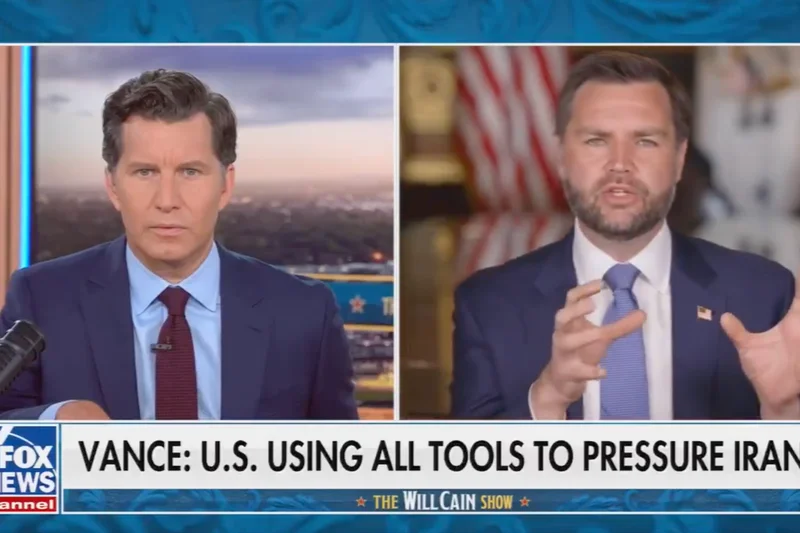
Vice President JD Vance has said that keeping gas prices low is the Trump administration’s “goal number one” in the Iran war as frustration with the conflict threatens to see Republican candidates hard hit at November’s midterms.
Interviewed on Fox News’s The Will Cain Show Thursday, Vance again attempted to clarify the purpose of the war amid criticism over the administration’s mixed messaging, saying its aim was “twofold.”
“It’s ensuring that the Gulf countries continue to send oil and gas to the world economy so that we have energy price stability, that’s obviously important for the American people,” he told Cain.
“I know that oil is down today and it’s way down from the highs in the early days of the conflict. That’s goal number one – keep oil and gas cheap for Americans all over our country and then obviously goal number two is ensure that Iran never gets a nuclear weapon.”
He continued: “I feel confident we’re accomplishing both of those goals but it’s inherently an unpredictable thing because the Iranians themselves are unpredictable and they sometimes don’t honor the commitments they’ve made to us.”
Domestic gas prices were steady prior to the launch of the U.S. and Israel’s Operation Epic Fury strikes on Iran on February 28, to which Tehran responded by retaliating against those countries’ allies in the region and by shutting off the Strait of Hormuz, through which around 20 percent of global oil is shipped.
With the U.S. Navy currently blockading the waterway but Iran still seemingly in control, the passage of tankers has slowed to a trickle, limiting the supply of oil and driving up prices at the pump – despite Vance’s attempted reassurances.
As of Friday morning, the U.S. national average gas price stood at $4.07 a gallon, according to the AAA’s index, a further increase coming two days after it hit an all-time high for mid-August. The latest figure also represents an increase from $3.86 a month ago and $3.16 a year ago.
The hike could come back to bite the GOP in November, given that voters have consistently told pollsters that affordability and inflation are their top priorities and that they do not believe President Donald Trump has done enough to address them.
Vance is known to have opposed the Iran war before it began but assured Trump he would support him if he decided to go ahead, subsequently leading the peace talks that resulted in the signing of a short-lived memorandum of understanding between the two sides.
Since the resumption of hostilities, the VP has continued to make his fears known, saying on a recent appearance on Joe Rogan’s podcast that he does not back U.S. boots on the ground in the Middle East, warning of further bloodshed and a likely humanitarian crisis.
For his part, Trump’s rhetoric has see-sawed between making violent existential threats against the Iranian regime and insisting its leaders are “desperate” to make a deal with him, neither of which has resolved the stalemate.
The president has recently talked about “low keying it,” stepping back and allowing the economic pressure applied by sanctions on the country to take its toll, rather than engaging in further strikes to try to pummel it into submission.
“We are only semi-negotiating with them,” he told Axios. “We are just watching Iran with its huge inflation and the fact they have no money.”
He has also bragged about the success of his blockade, writing on Truth Social: “Our Naval Blockade is being called, by everyone, ‘A WALL OF STEEL,’ and there is nothing Iran can do about it.”
Defense Secretary Pete Hegseth has meanwhile claimed the U.S. could keep it up “indefinitely” and told reporters: “We’ll rotate ships in and out, as we have, and we’ll continue to.”
An indefinite blockade would not help to lower oil and gas prices, however, meaning there is little prospect of Vance realizing his stated aim so long as that strategy remains in play.
His claim that stopping Iran from building a nuclear weapon remains “goal number two” is also noteworthy because it comes despite Trump and Hegseth claiming that last summer’s Operation Midnight Hammer strikes had “obliterated” the country’s uranium enrichment program.
Tehran has repeatedly insisted it has no ambitions towards developing such a weapon and is only interested in pursuing nuclear power as a source of energy.