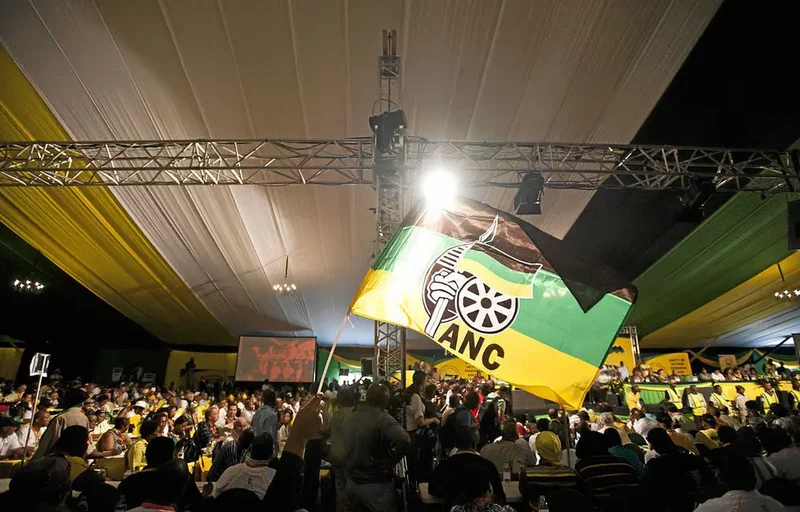
Senior ANC leaders fear that the litigation that has disrupted the party’s Eastern Cape provincial conference could open the way for further legal challenges over provincial conferences and ultimately threaten preparations for the ANC’s national conference in 2027.
The concern follows the ruling of the Eastern Cape Division of the High Court in Makhanda that the appointment of the ANC’s Provincial Task Team (PTT) was unconstitutional and unlawful and should be set aside. The ruling also barred members of the 44-member task team from representing the province in ANC structures and activities.
"What they are doing now clearly shows that there will never be a national conference of the ANC next year because all provincial conferences of the ANC will be litigated,” a senior party insider told the Mail & Guardian.
“That will be Gauteng, North West and even the national conference will be litigated because all these conferences must still sit. Even in the Eastern Cape, it must still sit before the national conference.”
The dispute dates from March 2026, when ANC members Lwazi Rotya, Sinethemba Mpande and Nompumelelo Mzotywa successfully approached the high court to stop the Eastern Cape’s 10th provincial elective conference from going ahead.
The applicants raised concerns about branch processes, delegate verification and the accreditation of delegates.
The conference, which was due to take place at the end of March, was halted by an interim interdict and has since been postponed indefinitely.
With the conference unable to proceed and the term of the provincial executive committee (PEC) having expired, the ANC’s national executive committee (NEC) appointed a PTT in May to oversee the province.
The decision was subsequently challenged by Rotya, Mpande and Mzotywa, who argued that the appointment of the PTT was unconstitutional, unlawful and in breach of the ANC’s rules.
In June, the Makhanda High Court agreed with them, declaring the PTT’s appointment unlawful and setting it aside. The court also declared decisions taken by the task team invalid.
The ANC has challenged the judgment, arguing that the NEC had acted within its constitutional powers after the PEC’s term expired. The party maintains that its decision to appoint the PTT was properly taken at an NEC meeting.
The legal dispute has left the Eastern Cape ANC without a recognised provincial leadership structure while the party prepares for the local government elections and its next national leadership contest.
A senior ANC source in the province described the litigation as an attempt to weaken the party in one of its strongest provinces.
“Here, it is just about liquidating the ANC, reducing the ANC’s strength on the 4th of November,” the source said.
“They want to create a vacuum where there is no PTT and so that it can’t play its role in terms of both candidate and mayoral selections and the finalisation of lists.”
The source said the legal disputes could eventually be used to challenge the ANC’s main candidate lists.
“They are preparing serious litigation so that the ANC must not submit its lists and we won’t be shocked if the ANC’s list is challenged in court.”
The source described the broader dispute as “serious infiltration” and a “counter-revolution” aimed at weakening the ANC. “They have been trying to destroy the ANC in the Eastern Cape for years and years but the party has been resilient.”
At the centre of the political battle is the breakdown in the relationship between provincial chairperson Oscar Mabuyane and former provincial secretary Lulama Ngcukayitobi.
Mabuyane is seeking a third term as provincial chairperson, while Ngcukayitobi has been positioned as his challenger before the provincial conference.
The Eastern Cape is an important ANC stronghold and is expected to play a significant role in the party’s 2027 national leadership contest.
Mabuyane is understood to be interested in a senior position in the national leadership, with ANC secretary-general Fikile Mbalula also expected to contest the presidency at the next national conference.
A second senior source alleged that some PTT members were aligned to Ngcukayitobi and supporting those who had taken the ANC to court because they did not want the provincial conference to proceed.
The source alleged that the group was seeking to pressure the NEC into appointing a 50-50 PTT representing different factions.
“There is a PTT in KZN, there is a PTT in Gauteng and the NEC converted the previous [Eastern Cape] PEC to a PTT because almost all members who were in the previous PEC are in the PTT and only one, two or three comrades were added to the PTT,” the source said.
"The PEC ended, the term ended; it was not that it was dissolved. They were supposed to go to the conference in April but the conference was litigated.”
The source rejected suggestions that Ngcukayitobi had been on course to win the provincial conference.
“When they talk, some people create the impression that the provincial secretary was a contender. He was not nominated by more than 20 branches out of over 600 branches that were ready for conference.
"There was no contest and the only way to save them was this court issue, which came against the backdrop of the letter he wrote to the officials.”
The source said the ANC’s national conference could proceed even if some provincial structures were not in place, because most of the delegates were elected from branches.
“It is ideal that, in a normal, healthy organisation, the provincial structure, as allowed by the constitution, must be there so that they can guide the conference and provide direction. But it doesn’t mean that if they are non-existent, the conference cannot sit because 90% of delegates must be from branches.”
After the Makhanda judgment, the ANC said it had noted the court’s decision and would pursue further legal recourse, including a petition to the Supreme Court of Appeal.
The party said it respected the judiciary and the constitutional processes through which disputes were resolved.
Acting ANC national spokesperson Nonceba Mhlauli told the Mail & Guardian that the party remained committed to establishing stable provincial leadership.
"If it was up to us, the provincial conference would have already sat and we would already have a new leadership,” she said.
Mhlauli said the court judgment did not reflect the ANC’s version of what had happened.
“We did have an NEC meeting and in that NEC meeting we did officially dissolve the PEC and appointed the PTT as per the constitution of the ANC. We believe those factors were not taken into consideration, hence the decision to appeal the particular judgment.
"As far as we are concerned, the court judgment says what we say happened didn’t happen. We have minutes to say that we did dissolve the PEC as per the constitution. That meeting sat in Cape Town and it was a physical in-person one.”
She said there was evidence that the meeting had taken place, including media coverage, photographs and minutes. The judgment had not properly considered the outcome of what the ANC believed was a constitutionally convened NEC meeting.
Mhlauli said the ANC was challenging the judgment partly because of the potential implications for other provinces whose PEC terms were approaching their expiry.
“In the North West, the term of office is coming to an end in a week or two. We have to dissolve the PEC officially and appoint a structure there, which is within the normal function of the organisation.”
She said the ANC wanted to ensure there was no legal ambiguity around the process to be followed when a provincial structure’s term of office expired.
Responding to allegations that those who had taken the ANC to court were seeking to destabilise the party in the Eastern Cape, Mhlauli said she did not want to speculate on the motives of those involved in the litigation.
She said the ANC’s officials had been engaged in political discussions to try to bring the different sides towards a common understanding.
“This is a process that is obviously handled at the level of the officials insofar as the official position of the ANC is concerned."
Mhlauli said the ANC’s eight regions in the province were in good standing and that most of the problems were concentrated at the provincial level.
She added that the party’s election preparations were continuing, with the provincial elections task team reporting to Luthuli House weekly.
“At the NEC meeting last weekend, we actually invited the chair and secretary of each of the eight regions. They were all in our meeting of the NEC, where we were reviewing our draft manifesto that we will launch next week.”