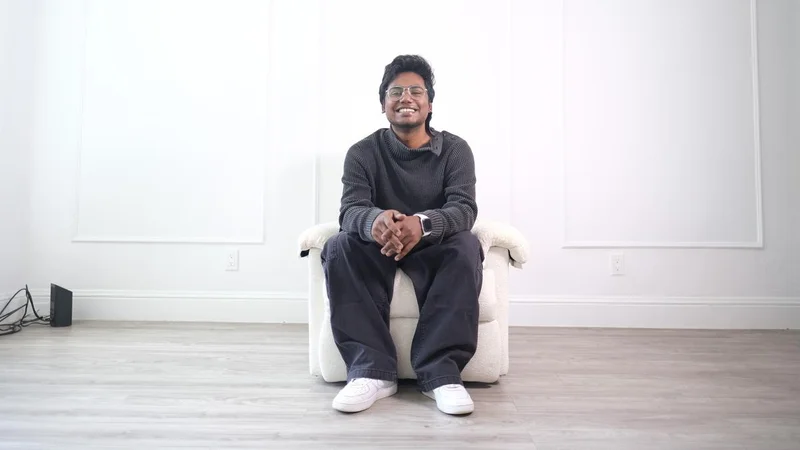
“With this special, I tell 15-year-old Manjeet, who was a child labourer, that he has everything he ever wanted,” says Bengaluru-based stand-up comedian Manjeet Sarkar, who is currently touring with his third one-hour show, Meanwhile.
Hailing from Bastar, Chhattisgarh, Manjeet’s comedic voice has evolved over the past decade. His debut special, Let’s Talk About It, released in 2024, explores the artiste’s origins, which “ended up being interpreted as Manjeet talking about caste”. During the international tour of this show, he also created an award-winning documentary, Untouchable: Laughing Out Caste.
His second special, however, was about what bothered the artiste and the consequences of the first one, which resulted in him receiving death threats. Titled Democrazy, the special is addressed to the government.
“Meanwhile is about how crazily my life has changed, and the mental health struggles that came with it. I believe the young me would judge me for that. It tracks my progress from being someone with a difficult childhood to an artiste who gets to travel in business class,” says Manjeet, over a call from Bastar.
“My comedy reflects who I am as a person,” says Manjeet, explaining how his comedy is rooted in discomfort. “I am inspired by stand-up comedians from the US, and the idea is that you must be yourself on stage. If you have to fake it, then you might as well do some other job.”
“I am not an entertainer. I share my discomforts and opinions with the audience, so if they are paying to listen to me, it goes beyond entertainment,” says Manjeet, who considers American comedians Dave Chappele and the late Patrice O’Neal to be his idols. “For me, comedy is about originality. Some people make jokes like yeh aurat aisi hai (women are like this) or homophobic jokes. I can walk into a conservative household in Bastar, where someone would make such comments. You don’t need a mic to say such things.”
However, it wasn’t always this way for Manjeet. “I was someone who used to fake my likability. Initially, I used to tell engineering jokes and cab driver jokes on stage because I did not have a reference to see what I was supposed to do. I was doing what I have seen others do. Until one day, I went on stage and opened up, ‘I am a Dalit, and I come from a village’.”
He adds, “This identity was something I was the most insecure about. I felt like I had to keep it hidden for a long time, and that people were already judging me for not speaking ‘good’ English. But once I spoke about this, I felt free, and this made the audience enjoy themselves better. Now, I keep writing jokes centred around my persona.”
When asked about being labelled a Dalit comedian, Manjeet says, “It’s the worst thing you can do. I recently spoke to a journalist and didn’t talk about caste during the entire interview. However, when the article was published, while other comedians did not have a prefix with their names, I was labelled Dalit comedian Manjeet Sarkar. In this country, if you want to be just a comedian, you must be an upper-caste male.”
“I am not an entertainer. I share my discomforts and opinions with the audience, so if they are paying to listen to me, it goes beyond entertainment.”Manjeet SarkarComedian
“It bothers me that my caste is used as a description,” he says. “Initially, my audience was academics and liberals. I wanted to leave that space and become mainstream, which is why I did my second special, which discussed politics. I used to have 20,000 followers after the first special; now I have 200,000 followers. Half of the audience didn’t know I was Dalit, and my first special was irrelevant to them.”
In his first two specials, Manjeet also calls out Savarna guilt. “I call such people out in both of my specials, and if those people come to my shows, they are the ones who look like idiots. They are not in on my jokes.”
While talking about receiving death threats for his material, the artiste says that the backlash for stand-up comedy only fuels the art form. “My father didn’t know about Samay Raina before. However, due to the backlash from conservatives who cancelled him, my father is aware of Samay. He also knows about Kunal Kamra. At its core, this is a validation-seeking art form , so any attention you give to it, you are making us win.”
He adds, “For a country where the art form is at such an early stage, comedy is doing better than any craft. It is a household name in India. However, it is not a very comedy-oriented audience, but a comedian-oriented audience. Even though in cities like Bengaluru, Mumbai and Delhi, people are selling out shows without any famous faces on the poster, we still have a long way to go.”
Tickets to Meanwhile are available on bookmyshow.com
Published - August 14, 2026 05:00 pm IST