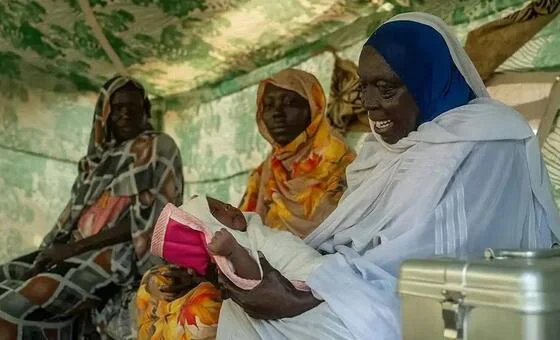
Sudan: The harrowing reality of giving birth in a war zone
By
Daniel Johnson in Geneva
Sudanese women about to give birth are losing their babies and sometimes their own lives because of a lack of specialist healthcare support, amid the ongoing war, UN humanitarians said on Friday.
Key points
- Pregnant women travel for hours to reach emergency maternity care
- Golo town hospital is only one able to perform C-sections for miles around
- Essential medical supplies running out, including oxytocin to prevent fatal bleeding
- War is ongoing and humanitarian needs are massive
In an alert, the UN sexual and reproductive health agency, UNFPA, highlighted urgent needs among expectant mothers in Golo, in western Sudan’s Central Darfur region. The mountain town has only one hospital capable of performing a C-section and it is the only one for many miles around.
“Most women reach it from mountain villages on foot, often walking for hours or being transported on crude wooden stretchers through the mountains, when they're already in labour or bleeding,” said Fabrizia Falcione, UNFPA Sudan Country Representative.
“Those who can afford it hire a donkey, but many women cannot. Many arrive when it is already too late for them and also for their babies.”
The UNFPA official noted that Golo hospital’s dedicated doctors, midwives and other staff often run short of supplies, including anaesthetic. “A few days after a C-section, women return to their villages on the mountain, again on foot,” Ms. Falcione noted, in a call to support mobile clinics closer to vulnerable communities.
Tawila: Unimaginable needs
Needs are also massive in sprawling Tawila displacement camp, which is several hours’ drive by all-terrain vehicle from Golo across mountainous terrain, some 60 miles (around 100 kilometres) away.
The residents are hundreds of thousands of people displaced by Sudan’s ongoing war between the paramilitary Rapid Support Forces (RSF) and Sudanese Armed Forces (SAF), which first clashed following a break-down in transition to civilian rule in April 2023.
“Women come even from Golo [to Tawila] to get a C-section when they know that their situation is desperate. Now, if it took us by four by four, nine hours [by car], you can imagine how long it will take a woman on a donkey...And that is exactly why the medical health providers told us when the women reach here, it's often too late and they cannot do anything and they lose their lives and those of their babies.”
As in Golo, health facilities in Tawila and across central and northern Darfur are running out of oxytocin, which is used to stop fatal bleeding during childbirth.
“Arriving in Tawila displacement camp puts you in front of an unimaginable picture,” Ms. Falcione explained.
“The camp stretches across the desert in all directions; you can't see the beginning or the end of it. With more than 700,000 people displaced, who are now sheltering there and the new families who are arriving daily and are erecting their makeshift tents.”
Too late to help
Health workers in Tawila who include UN agencies and NGO partners report that expectant mothers come “even from Golo to get a C-section when they know that their situation is desperate”, the UNFPA official said.
The veteran humanitarian insisted on the need to bring reproductive healthcare closer to the most vulnerable women. "We can’t give pregnant women no other option than going across this vast and difficult terrain to reach a hospital to give birth safely.
"We need to decentralize healthcare, expand mobile services to reach those most difficult to reach."
Community midwives who are "everywhere" need much more support too, Ms. Falcione said, noting how many are paid in bars of soap or sugar along "A well-trained and properly equipped midwife can meet 90 per cent of medical needs before, during and after delivery," she stressed.
Elsewhere in Sudan, reports on Friday indicated that RSF fighters have continued to use attack drones and siege tactics to target the strategic city of El Obeid in North Kordofan state, which is still controlled by the SAF. In October 2025, the paramilitary RSF overran El Fasher city, unleashing “a wave of intense violence” that amounted to war crimes and possible crimes against humanity, the UN human rights office, OHCHR, said earlier this year. More than 6,000 people were killed in the episode, OHCHR noted.
Refugees in crisis
In related news, UN aid teams warned that more than 650,000 refugees and asylum seekers in neighbouring South Sudan risk losing further access to lifesaving food, nutrition and other assistance amid critical funding shortfalls.
Up to 3,000 refugees and returnees continue to arrive from Sudan each week, placing further pressure on already overstretched humanitarian resources.
"For refugees and host communities, food assistance is often the difference between coping and crisis," said Adham Effendi, Deputy Country Director for the UN World Food Programme (WFP) in South Sudan. "Urgent support to save lives and livelihoods is vital – to meet essential needs and reduce long-term dependence on humanitarian assistance.”
WFP has an immediate $37 million funding gap for its refugee response. Meanwhile, the UN refugee agency, UNHCR, has secured only 28 per cent of the $286 million it needs this year to sustain core protection and assistance for nearly four million refugees, internally displaced persons, returnees, and vulnerable host communities.