Topline
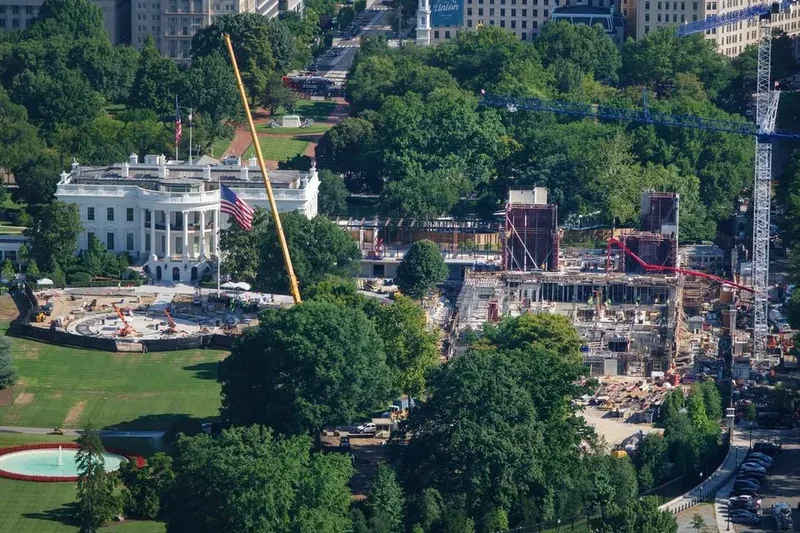
The Trump administration asked the Supreme Court on Friday to allow it to finish constructing President Donald Trump’s planned $600 million White House ballroom, after multiple lower courts ruled against it, leaving it up to the 6-3 conservative court to determine the fate of one of the president’s signature projects.
Key Facts
The government filed an emergency request asking the Supreme Court to allow construction on the White House ballroom to continue, after a federal appeals court ruled it should be blocked.
The Trump administration tore down the White House’s former East Wing and started building a ballroom with additional high-security areas in it last year, which Trump has held up as one of his biggest projects as president and alleged is necessary for national security.
Lower courts have ruled the president didn’t have the authority to build the new ballroom and it has to be authorized by Congress, but construction has still so far continued as the case has moved forward in court—until a federal appeals court ruled last week for it to be halted.
The Trump administration argued to the Supreme Court the court order blocking the construction is a “blatant abuse of discretion” and the new ballroom complex is “required” to protect Trump’s safety, also claiming it would be a “disaster” to stop construction when the project is already 65% complete.
The government asked the Supreme Court to immediately allow construction to continue while it considers the case, and then issue a more lasting ruling that pauses the lower court’s order against the ballroom while the case is litigated—allowing construction to continue for the foreseeable future.
The filing also suggests the Trump administration will file another request that asks the court to take up the question of whether the White House ballroom construction is legal for oral arguments and issue a final ruling on the matter.
Crucial Quote
“No bystander could plausibly prefer to view an unfinished 70-foot-tall superstructure to the finished Project,” the Justice Department argued Friday in favor of allowing construction to continue, also arguing Trump is “the sole, elected head of the Executive Branch, and Congress has authorized him to renovate, secure, and protect the White House and its grounds, as other Presidents have been allowed to do, without exception.”
What to Watch for
The Supreme Court will likely rule on Trump’s request within the next week, as the federal appeals court gave the government two weeks to appeal its ruling before its order halting construction takes effect. It’s unclear how long the litigation could take to play out, and whether the Supreme Court will allow the construction to continue. If it does, it’s possible the ballroom could be completed by the time any final court decision comes out on its legality, as the Trump administration noted Friday that the construction is “moving quickly towards completion.”
Big Number
At least $600 million. That’s how much the White House ballroom is expected to cost, according to estimates reported by The Washington Post in June. Costs for the ballroom have ballooned since construction began, with the project initially estimated to cost $200 million, and then being raised to $400 million. Trump has claimed the project will be funded entirely by private donors—an allegation repeated in its Supreme Court petition Friday, which argues, “Zero taxpayer dollars are needed or required.” The Post found taxpayers will actually be on the hook for approximately half the costs of the ballroom construction, however. The White House ballroom is one part of a broader planned overhaul of the White House grounds by the Trump administration, which also includes a new helipad, updates to nearby Lafayette Square and a new visitor screening center. Those projects altogether will cost at least $927 million, the Post reported Tuesday.