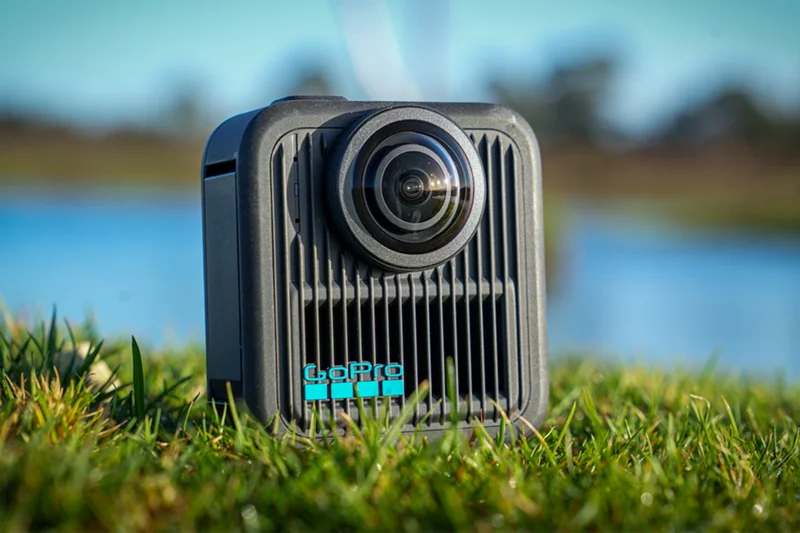
I’ve spent more than 10 years testing the best action cameras, and through that time, GoPro has remained one of the biggest names in the category. Its compact, rugged cameras are built for capturing everything from HD and 4K footage to 8K video, with some models offering frame rates as high as 240fps. Their tiny size also makes them easy to mount to helmets, bikes, vehicles and other equipment, which is why they became so closely associated with extreme sports. But action cameras have come a long way since then, and today they’re just as useful for vlogging, photography and even professional broadcast work.
One of the biggest reasons to purchase an action camera is that they’re easy to mount or hold, waterproof and easy to use. There has also been something of an evolution of design in the past year, with 360 action cameras finally breaking through to the mainstream and offering a little more than a standard fixed-ratio camera. A 360-degree action camera enables you to shoot 360 footages so you can play the video back through one of the best VR headsets, or (if you have the time) you can edit the footage to recompose, ensuring the composition is always spot on.
The action camera market has become more concentrated, with four manufacturers now dominating the category. GoPro remains a major name, but each brand has its own strengths and is better suited to different types of users. Brand loyalty will always play a part, but this guide focuses on what each camera offers, helping you find the best fit for your needs and budget.
Read more: Best smartphone cameras, tested
The best action cameras for 2026 are:
- Best overall– GoPro hero13 black: £329.99, Currys.co.uk
- Best budget 360-degree model– Akaso 360: £199.99, Amazon.co.uk
- Best for low-light performance– DJI osmo 360: £279, Amazon.co.uk
- Best for social creators– Insta360 X4 air: £359.99, Argos.co.uk
- Best ultra-compact design– DJI osmo nano: £279, Currys.co.uk
Read more: Best personalised photo books, tested
- Bestaction camera overall
- Why we love it- Class-leading stabilisation
- Outstanding image quality
- Rugged dependable build
-
Versatile creative modes
-
Take note- Higher upfront cost
- Reduced battery longevity
- Slightly heavier body, compared with some other options
- Accessories add expense
The GoPro hero13 draws direct lineage from the original action cameras that were popularised by extreme sports enthusiasts. While initially the updated feature set from the hero12 might not seem that major, as most of the specifications have remained the same, it was the internal workings that received a boost across the board. The latest model is a refinement an upgraded GP2 processor and enhanced video stabilisation.
The GoPro setup process is extremely straightforward. After the battery and MicroSD card are installed, you just need to click through a few screens to complete setup. Like most of the latest cameras, this one utilises wifi 6 connections to pair to the mobile app, enabling you to operate the camera remotely, as well as download, edit and share footage.
One of the reasons GoPro became the leading action camera was due to the mounting options, and here the two prongs fold down so you can mount the camera directly to almost anything. Alongside the GoPro mount, there’s also a quarter-inch thread, enabling the camera to be mounted to a standard camera tripod, as well as multiple other supports.
GoPro’s design is robust, and the 10m waterproofing meant it survived submersion in water, getting caught in rain and splashed with mud without issue during my tests. Importantly, the lens glass is ultra tough and scratch-resistant, with a hydrophobic coating that ensured most rain simply rolled off the lens, without obstructing the view.
Video quality is exceptional and with plenty of resolution and framerate options, the GoPro will appeal to all levels of user, including professionals looking to use the camera in log video workflows that can be blended in with footage from other cameras.
During testing, I also found that the low-light performance saw the video quality still retain a good amount of detail and colour, although you can see a drop in the video quality compared with footage shot in bright daylight conditions.
A few of the features that boosted the use and performance of the GoPro hero13 black above the competition included easy connectivity to Bluetooth mics. What’s more, the optional lens kits give you even greater scope, making this a great all-round camera.
Key specifications
- Type:Fixed
- Dimensions:71.8mm x 50.8mm x 33.6mm
- Weight:154g
- Max resolution:5.3k
- Max framerate:240fps (1080p)
- EIS: HyperSmooth 6.0
-
Waterproof:Up to 10m
-
Bestbudget 360-degree action camera
- Why we love it- Relatively affordable entry-level option
- Easy 360-degree experience
-
Lightweight mounting system
-
Take note- Lower frame rates compared with some rivals
- Basic stitching results
- Limited low-light ability
- Shorter battery duration compared with some other models
Over the past couple of years, the market has been flooded with 360-degree-capable action cameras of varying quality – especially at the entry-level end of the price scale. The Akaso 360 is the one camera that has stood out in my tests, striking a perfect balance when it comes to affordability, video quality and software.
The Akaso camera is considerably cheaper than the other 360 action cameras I tested – it’s also smaller and lighter. The setup was straightforward, linking into the companion app with no issues. I was able to control, download, edit and share footage with relative ease.
Mounting options are a little more limited than some rivals, but the quarter-inch thread on the base enables easy pole attachment. There are also options to add a GoPro-style mount onto the base, enabling you to attach the camera to almost anything.
What really struck me about this camera was that, despite its cheaper price point, the build quality was exceptionally good, and the simple design offers a sleek aesthetic. Akaso has, perhaps, taken the sleekness of the design one step too far by seamlessly integrating the start/stop record button into the panel below the screen. Once you know it’s there, it’s fine, but on first use, I did need to delve into the instructions to find its location.
After puzzling over that for a while, the use of the camera is extremely straightforward, made easier by the one-touch operation and simplistic app that enables you to get on with having fun, undistracted.
The video quality in bright, sunlit conditions is excellent, but you can see the limitation compared with premium models. Using this model in isolation, I was more than happy with the results, but you can see the image doesn’t quite command the level of detail and quality compared with its pricier counterparts. The one more serious point to note is that low-light performance is an issue, as colour de-saturates and detail becomes lost.
If you’re looking for a decent entry-level model, there are few (if any) budget 360-degree action cameras that can get close to the Akaso 360. Combined with the companion app and desktop software, it offers a complete beginner-friendly solution to capturing impressive 360-degree footage.
Key specifications
- Type:360-degree
- Dimensions:109.8mm x 46.9mm x 30.8mm
- Weight:180g
- Max resolution:5.7K 360-degree
- Max framerate:30fps
- EIS: Electronic stabilisation
-
Waterproof:Yes
-
Bestaction camera for 360-degree creativity
- Why we love it- Captures everything
- Superb 360 stabilisation
-
Creative reframing freedom
-
Take note- Heavier than some other models
- More expensive workflow
- Shorter battery life
- Editing takes some practice
This is the second 360-degree action camera GoPro’s made. While the design has evolved from the original, anyone used to the earlier version will be pleased to see much of the original form factor has been retained, only refined. Much of the setup process mimics that of the GoPro hero13 black and utilises the same app and software, which further adds to the ease of setup and use.
Once again, the camera features the two small fold-down mounting prongs that are universal among almost all action cameras, and that give you a huge amount of mounting options. Most importantly for these 360-degree cameras, there’s a good long pole that enables you to get some of the more striking video effects, such as ‘little planet’, a spherical perspective where the horizon wraps around into a circle, making it look like, well, a planet.
The build quality of the Max 2 is equal to that of the hero13 black, and the colourway, look and feel are all very similar. The one difference, aside from the size and shape, is that there are two lenses – one on the front and the other on the back. These are a little more exposed than those of the hero13 and feature simple push fit lens caps to keep them protected.
One thing to note is that the gill design across the front, which acts as a heat sync for the inner workings, does tend to capture mud, but a wash under a tap cleans any muck with relative ease.
Video quality is exceptionally good, with the 8K 360-degrees capture enabling plenty of scope when it comes to editing and output in both 360 or flat 16:9 when re-croped. Colour, sharpness and detail all looks good in bright daylight conditions.
Drop to lower light conditions, however, and the camera really starts to suffer with colour saturation, detail reducing and plenty of noise.
Over the original max model, however, this is still a major update, and the video quality and stitch between the two lenses is definitely far better. The other major point for content creators is that the camera supports connection to wireless mics, so if you are using the camera for 360-degree vlogging or just fun with the family, then you can connect a set of Rode wireless micro mics to boost the overall audio quality.
Key specifications
- Type:360-degree
- Dimensions:64mm x 69.7mm x 48.7mm
- Weight:195g
- Max resolution:8K (360-degree)
- Max framerate:4K 60fps (single lens)
- EIS: Max HyperSmooth
-
Waterproof:Up to 5m
-
Bestaction camera for low-light performance
- Why we love it- Relatively affordable 360-degree model
- Crisp immersive footage
- Easy mobile workflow
-
Compact and travel-friendly
-
Take note- Limited pro controls
- Battery drains faster compared with some other models
- Fewer accessories available
Better known for its popular range of drones, DJI has become a major player in the imaging industry, with a close partnership with premium camera manufacturer Hasselblad. While the brand’s cameras featured in this review are straight DJI, they are no less impressive.
This model is DJI’s first 360-degree camera and as you’d expect from a company that has led innovation in several sectors, this camera follows the same sleek design principles and design quality. The camera is also part of the larger DJI ecosystem, so can be used directly with the superb DJI mic 3 wireless microphone kit (£169, Dji-retail.co.uk), making it a great solution for creators and businesses looking for an easy way to capture footage.
The initial setup is easy enough, although DJI does rope you into its sign-up account from the outset, which is no bad thing, as it ensures you stay up to date with the latest firmware updates. In the same way as the GoPro models have features in common, the osmo 360 and action 6 (also included in this roundup) share a magnetic clamping system, with the default mount offering a GoPro standard, enabling you to utilise a huge range of existing mounts.
The build quality and design are decidedly premium. As with all other 360-degree cameras, the lenses positioned on either side of the body are protected by a cover that’s of a simple push fit design. The form factor is slightly taller than the GoPro max 2 but equally easy to mount or attach to a pole, and the design ensures that you can use it for day to day as well as off-road use.
The DJI Mimo app is available for both iOS and Android devices and connection is made through wifi (for robustness). The apps proves to be solid, enabling complete control over the camera as well as the ability to download, edit and share footage.
Video quality is again superb and inline with both the GoPro max 2 and X4 air – in normal daylight conditions, there’s very little to separate the three. However, as I headed into more overcast and dull conditions throughout the testing period, it was obvious when reviewing the footage that the osmo 360 just had the edge when it came to low-light performance.
As a straightforward high-performance 360-degree camera, there’s little to fault with the osmo 360, but it especially stands out for its low-light abilities, which are a level up from the competition.
Key specifications
- Type:360-degree
- Dimensions:61mm x 36.3mm x 81mm
- Weight:183g
- Max resolution:8K 360-degree
- Max framerate:4K 100fps
- EIS: RockSteady 360
-
Waterproof:Up to 10m
-
Bestaction camera for vlogging
- Why we love it- Dual-screen convenience
- Excellent onboard audio
- Strong low-light handling
-
Lightweight vlog setup
-
Take note- No 8K option
- Voice control quirks
- Stabilisation softens edges
- Accessories raise cost
This camera is a direct competitor to the GoPro hero13 black (which took the top spot in this review). The first point I noted when testing the DJI action 6, aside from the huge volume of accessories, was the addition of the lens sets that, like the GoPro, can be added quickly to the front of the camera in place of the existing lens. These give far more scope for creativity.
The camera also offers wireless mic pairing and is fully compatible with the DJI Mic 3 wireless mics (£145, Dji-retail.co.uk). This pairing makes a phenomenal combo for vloggers or anyone needing a small video kit at the ready.
Another major point here is that this is the first camera with a variable aperture, this means that I was able to get a little creative with the depth of field. The result was OK – not quite the defocus of the background that I had hoped, but definitely a step in the right direction. However, when you pop on one of the lenses, the effects are boosted further, and this offers some exciting potential.
Once again, the Mimo app is well laid out. For ease of use, it isn’t quite up to the simplicity of the Akaso or GoPro options, but there’s nothing here that should over complicate its use.
When it comes to the video quality, this is the feature that has drawn many professionals to the system, thanks to the camera’s ability to capture 10-bit 4K footage and the option to utilise log format filming.
Like all the main contenders on test, the DJI osmo action 6 offers plenty of accessories, including a grip with controls that, along with the good low-light performance and mic pairing, make this a great vlogging and content creation option.
Key specifications
- Type:Fixed
- Dimensions:72.8mm x 47.2mm x 33.1mm
- Weight:149g
- Max resolution:4K
- Max framerate:120fps
- EIS: RockSteady/HorizonSteady
-
Waterproof:Up to 20m
-
Bestultra-compact action camera
- Why we love it- Truly pocket sized
- Ideal selfie framing
- Great travel companion
-
Simple creator workflow
-
Take note- Not entirely waterproof
- Average low-light results
- Small sensor limitations
- Limited manual control
Offering huge potential for mounting and use, this is the smallest of the action cameras I tested. It’s also the one that I would use to film with Pip, my labrador, as the nano adds little bulk or weight.
There are a few key features of this small camera that I really liked from the outset. The first is the modular design – this isn’t the first time DJI has gone down this route, and while the older DJI action 2 was innovative, it didn’t really capture the imagination of users at the time, so DJI reverted to the more tried-and-tested box-like design. The osmo nano is more user-friendly in both approach and aesthetic design, with a focus on those who just entering the action camera market.
Setup is incredibly simple and with the internal 128GB of memory, you can essentially very quickly charge, step outside and get going. The modular design means that the main camera module features built-in battery and memory, which will provide around 60-90 minutes, depending on the settings and outdoor temperature.
Again, the same mounting system is used as seen on the DJI osmo action 6 and DJI osmo 360 (both included in this roundup), so if you do delve into the ecosystem then all accessories are cross-compatible. The camera module on its own will connect into the familiar Mimo app, where you can adjust settings, download, edit and share footage.
If you want more control, this is when the larger screen module can be attached. This uses the magnetic clamp system to securely attach to the base of the camera and the contacts on top ensure a decent data connection between the two. A great feature here is that the screen can be attached either way, so it can be seen from in front of or behind the camera. In use, it all felt solid enough, and while not to the level of robustness of the more traditional action camera designs, it still felt like the modules would stand up to more than a knock or two.
Thanks to its small size and light weight, the nano will also likely go unnoticed by your pet, so if you do want to catch a pet's eye view of the world, this is a fun option (with the right mounts, of course). It's also extremely easy to use and can connect wirelessly to the DJI Mic 3.
Key specifications
- Type:Fixed
- Dimensions:28mm x 29.5mm x 57.3mm (camera); 22.3mm x 42.2mm x 59.1mm (vision dock)
- Weight:52g (camera); 72g (vision dock)
- Max resolution:4K
- Max framerate:60fps
- EIS: Electronic stabilisation
-
Waterproof:Camera up to 10m; camera and vision dock IPX4 water resistance
-
Bestaction camera for social creators
- Why we love it- Brilliant social reframing
- Smooth stable footage
- Strong creator tools
-
Rapid mobile editing
-
Take note- Large file sizes
- Battery drains fast
- Requires stitching time
- Bulkier than others
What Insta360 is superb at doing is creating compact action cameras that look stylish, utilise premium build quality and design that appeals to many enthusiasts and professional users. Here, the user interface is fast and responsive and offers absolute ease of use.
As with the majority of cameras tested for this roundup, there is an activation process that’s required, with the app for iOS or Android needing to be downloaded and paired with the camera. The entire process is straightforward and should only take a couple of minutes.
Once activated, the camera can be used in isolation and I liked the large screen and formfactor, which made it far easier to handle without accessories, compared with some other cameras tested. The knurled side textures also give it a good tactile feel, and it seems robust.
While I found the Insta360 app easy enough to use, the volume of pop-ups and animations quickly became a distraction. It was the only app that I, at times, found frustrating.
Checking out the video quality, the 8K capture results in clear, crisp and well-saturated visuals. There’s also the ability to pair with a wireless mic. In daylight, the visuals are on a par with the GoPro max 2 and DJI osmo 360, while in low-light conditions it sits between those two models, with a touch of noise and reduction in the overall clarity.
The physical design and wireless mic connectivity makes this an ideal option for content creators, and while the app isn’t always as smooth to use as some rivals’, when it comes to functions, it’s actually finely tuned. The 360-degree video recomposition works incredibly well, as do the general editing tools, again reinforcing this camera as a tool for creators or anyone looking to edit and share on the move.
Key specifications
- Type:360-degree
- Dimensions:46mm x 113.8mm x 37mm
- Weight:165g
- Max resolution:8K 360-degree
- Max framerate:120fps (1080p)
- EIS: FlowState 360
-
Waterproof:Up to 15m
-
Bestaction camera for hybrid creators
- Why we love it- Outstanding hybrid versatility
- Bright responsive sensor
- Excellent colour science
-
Strong AI editing tools
-
Take note- Gets warm while recording
- Heavier than some rivals
- Accessories bundles increase the cost
Having dominated the 360-degree action camera market, Insta360 moved into the more traditional action camera arena in 2020 with the One R. This camera instantly created a huge amount of buzz, boasting a modular design that enables you to swap between lenses.
The design of the camera evolved over time, and the past two iterations – the ace pro and this, the ace pro 2 – are in many ways more-traditional action cameras. However, the theme of modularity continues, and while the lenses may no longer swap out, the amount of accessories that are available takes a slightly different direction to the brand’s competitors.
Setup is easy and the camera-to-app connection is almost instant. However, the initial impression of the Insta360 app is a little overcrowded with inspiration and examples, but once you orient yourself to options, it’s all straightforward (as long as you don’t get distracted by other users' videos).
Mounting the camera is also straightforward, with the usual set of magnetic clip mounts, and with the GoPro prong option enabling you to attach the camera to almost anything. The big point here is that with accessories such as the Xplorer bundle, you can convert the camera into a fully fledged compact camera.
What’s more, as a solution for hybrid creators as well as families, the accessories build into a very powerful all-in-one solution. Alongside the Xplorer cage is a set of ND filters and lenses further enhancing the look and style of the footage that you can capture – I would highly recommend the cinematic option. Then there's the mic kit – this enables you to record high-quality audio through a wireless mic, which is easy enough to pair through Bluetooth with the camera, and you can also use it with your mobile phone.
Finishing off the accessories of note is the small printer, giving you onsite pictures that you can physically take with you or give to friends and family.
Reverting it back to a small action camera seems a bit of a shame, but bike mounted, the ace pro 2 looks the part, with a solid build. My only reservation is the complexity of the front design and the large grate mic section that could be prone to capturing mud (especially during winter in the UK).
The video quality is superb and the 8K is excellent in bright sunlit condition. However, as with the majority of other small action cameras, the low-light performance could be better.
For me, this is the most complete action camera on the market at the moment, and while the off-road design leaves something to be desired when it comes to cleaning off the mud, as a camera with plenty of flexibility – especially for vloggers and anyone travelling – it’s a solid choice. Just note that the price can increase considerably, depending on which of the accessories bundles you opt for.
Key specifications
- Type:Fixed
- Dimensions:71.9mm x 52.2mm x 38mm
- Weight:177.2g
- Max resolution:8K
- Max framerate:120fps
- EIS: FlowState
-
Waterproof:Up to 12m (up to 60m with dive case)
-
Bestbest action camera for stabilisation
- Why we love it- Impressive stabilisation & autofocus
- Generous 107GB built-in storage
- Beginner-friendly controls
-
Can use hand gestures to control camera when solo filming
-
Take note- Best experienced as a bundle
- Not a rugged action camera
The osmo pocket 4 is an emerging content creator’s dream, and after hearing everyone from full-time social media influencers to seasoned videographers singing the brand’s praises, I knew I had to give it a try.
The first thing I noticed when unboxing the camera was its impressively compact size. Unlike traditional action cameras that rely on digital cropping to smooth out footage, the osmo pocket 4 uses its physical 3-axis mechanical gimbal to steady footage from the moment it’s filmed.
This model builds on the brand’s best-known features, keeping the easy to navigate auto-tracking while offering the versatility to snap sharp photos alongside video. In testing, I found the ability to operate the camera using simple hand gestures to be a complete game-changer for solo filming, as I was able to trigger recording and keep framing accurate without needing a second person behind the lens. The wireless mic pairing was another feature one might easily take for granted – it worked seamlessly and automatically connected to the camera in seconds.
Usability is where the osmo pocket 4 really shines. The rotatable touchscreen makes toggling between portrait and landscape framing effortless. Another standout during testing was the generous 107GB of built-in internal storage, which was a lifesaver when I had forgotten to pack an SD card along for a shoot.
When it comes to image quality, the 1in CMOS sensor delivers professional-level results, which explains why long-time videographers are gravitating toward this device. The camera also gives plenty of playing room for editors, with the inclusion of D-Log filming for more flexibility when colour grading, along with 4K/240fps slow motion.
While you can purchase the camera on its own, it’s well worth opting for the creator combo bundle to ensure you’re getting the most out of your user experience. Bundle attachments include a mini tripod, fill light, wide-angle lens and the full set-up for the DJI mic 3 transmitter, along with an additional portable carrying pouch.
Reviewed by Niki Cottrell
Key specifications
- Type:Handheld gimbal camera
- Dimensions:144.2mm × 44.4mm × 33.5mm
- Weight:190.5g
- Max resolution:4K
- Max framerate:4K 240fps (slow motion)
- EIS: N/A (3-axis mechanical gimbal stabilisation)
- Waterproof:No