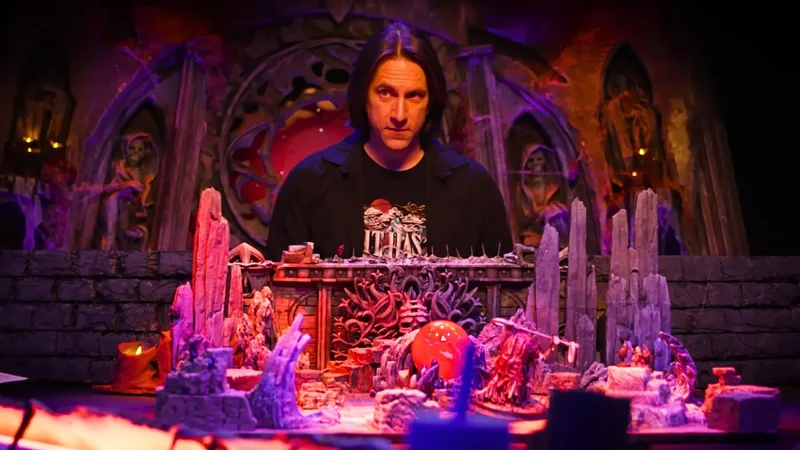
Critical Role is no stranger to exploring misfortune, but in the godforsaken, hopeless setting of the Halcyon Domain, disaster seems to creep around every corner. That's never been more obvious than in the final episode of Critical Role's latest Daggerheart campaign, Age of Umbra: Sallowlands. The result is a bittersweet tragedy of Shakespearean proportions.
The six-part miniseries debuted on July 9 and followed Sister (Laura Bailey), Dillwyn and her companion, Badger (Jennifer English), Mercy (Abubakar Salim), Caguama (Vico Ortiz), and Alphonse (Zachery Renauldo). Matthew Mercer resumed his classic role as the Game Master for Sallowlands.
This article contains spoilers for the finale of Age of Umbra: Sallowlands.
The five players first joined together at the beginning of the series to make their way towards a gargantuan metropolis that, like a flower reaching towards the sun, had suddenly sprouted from the ground. Wary of the cursed land and the shambling dead, but ultimately hopeful that this emerging city could teem with new life and magic, the party set out together.
From the very beginning, Sallowlands has been about hope in terrible times. A quick glance at the characters on this journey shows they've all been shaped by what they've loved and lost. Some, like Sister and Caguama, were around when the Halcyon Domain was a celestial place ruled by the God-King Oethedias. Their weary desperation for salvation in this new city is not just for themselves but for the generations to come. Others, such as Dillwyn and Mercy, are hated everywhere and driven to the city in hopes of acceptance. Even Alphonse, a surly elven blood hunter, has a twisted sense of faith — not in the world, but in the people he wants to protect. All of them have lost something — whether family, lovers, or memories — but if they reach the city, they hope to find meaning in what they’ve lost.
The themes of hope and fear are so prominent in the series’ narrative, so it makes sense that Critical Role continues to choose Daggerheart as its game system whenever it returns to the Halcyon Domain. While Dungeons & Dragons is much more strategic and combat-focused, Daggerheart wears its love of narrative on its sleeve. However, that doesn’t mean Daggerheart’s systems — combat or otherwise — are sloppy or undercooked. For example, stress in the game represents the mental and physical strain placed on a character. It can be used to activate abilities or, if you’re all out of stress points, stress moves on to reducing HP. It’s the toll of being an adventurer — especially one in a dead world like this setting — that can make something like an ability roll prove fatal down the line.
The cast of Sallowlands has moved at a punishing pace from the very beginning, driven by urgency to reach the new city. It hasn’t helped that, when they've had a chance to rest, they have often been besieged by enemies they once thought were allies, such as the Templars they encounter in the Tower of Oxodus, leaving them little time to recover. This pressure snowballs into catastrophe, with characters like Dillwyn coming face-to-face with old friends in a new zealous group called the Dova.
Like the Templars they had met before, the Dova is also fighting for meaning, acceptance, and a new world beyond the despair of the Halcyon Domain. Their methods are extreme and often come at a great cost—for example, the Dova branding and forcibly transforming others to fit into their ‘ideal’ community—but, like the party, they commit these terrible acts to shape a new world from the one they’re living in. There are no heroes or villains in Sallowlands, just people damned to carve a bloody path to their goals.
What keeps the party going each time they are driven from safety is the sweet idea that each obscenity and atrocity will be worth it for the deliverance and redemption to be found within the city. Yet by the time GM Mercer leads the players to what they were seeking, the truth of what they find — a city of demons and destruction, and a prison for a usurper of the gods who wants nothing but to annihilate the world and start over — brings everything crashing down.
Worse, death, which has been so achingly close in each episode of Sallowlands, finally arrives. It first takes the giant undead, fungal brawler Mercy, who sacrifices himself to save his friends from demons. Salim uses one of Daggerheart’s handful of death mechanics, Blaze of Glory, a welcome addition that Critical Role has even brought to Campaign 4, making death and dying far more interesting and dynamic than it ever was in Dungeons & Dragons. Mercy’s death is a harrowing one, and it leaves the party’s faith in their goal shaken but with the final battle so close, there is only one thing to do: move forward.
To escape every trap the GM threw at them, the players, like animals caught in a trap, had to gnaw off their own legs, leaving them damaged and bruised. The result is as bloody as it is bleak, with a fight against the usurper of the gods that feels equal to Jack fighting the Giant. The usurper doesn’t just hit hard but also hits wide, with several attacks that make death not just seem likely but inevitable.
That is until Sister, in typical Laura Bailey fashion, also goes out in a blaze of glory, ripping the usurper apart with a spell that saves not only the party but the world from a great evil that would have erased communities across the Halcyon Domain.
We knew going into this miniseries not to expect the same sunshine and rainbows that Critical Role’s main campaigns usually end with, where we often see players pair off, get married, and sometimes travel the world in search of new adventures with a skip in their step. Even so, the Sallowlands party’s loss of Mercy and Sister is especially heartbreaking, because these two characters were ultimately the heart of the party and encouraged the others to keep going even when despair seemed close to swallowing them whole.
And yet, Mercy and Sister’s sacrifice ultimately changed those who survived them for good—they made Alphonse believe in the world again, helped Dillwyn find a new home and family, and made Caguama brave enough to return home to those whom he had left behind. These changes were costly and brought tears, but they also planted hope in those remaining, and isn’t hope in dark times what the Age of Umbra is all about? While the number crunching of D&D can often add extra flavor to a story, we can't imagine a tale as poignant as this one working for any other system as it did for Daggerheart.